
Fly Screens
Fitted in Rainham
Home Decisions supplies and installs made-to-measure fly screens across Rainham, Barking, Dagenham, Romford, Hornchurch, Upminster, Ilford, Stratford, and East Ham — professional fitting, no DIY kits, no loose frames, no callbacks.
Made-to-Measure Insect Screens in London
Fly Screens Made to Fit Every Window and Door in Rainham and East London .
Got flies, mosquitoes, or wasps coming through the window the moment you open it?
It is a problem every household in East London and Essex faces from late spring through September. Opening a window for ventilation should not mean sharing the room with insects. A properly fitted fly screen — measured to your exact window or door, installed so nothing can squeeze past the edges — solves the problem permanently without blocking airflow or natural light.
Home Decisions installs made-to-measure fly screens across Rainham (RM13), Romford (RM1–7), Hornchurch (RM11–12), Dagenham (RM8–10), Barking (IG11), Upminster (RM14), Ilford (IG1–3), and throughout East London. Every screen is measured by our team at your property, manufactured to those exact dimensions, and fitted by the same people who took the measurements. There are no contractors, no handoffs, and no guesswork with frame sizes.
Every job starts with a free home visit. We measure every window or door you want screened, advise on the right screen type for each opening, bring physical samples of our mesh grades so you can compare them in your own light, and leave you with a written price — no obligation to proceed until you decide.
What Are Fly Screens ?
A fly screen is a mesh panel fitted over a window or door opening. When the window or door is open, air passes freely through the mesh while insects cannot. The mesh is bonded into or clipped into a rigid frame, tensioned into side channels, or mounted on a roller cassette — depending on the screen type and the window it covers.
The UK is not tropical, but East London and Essex are not insect-free either. Common house flies, bluebottles, wasps, and occasional mosquitoes are present through the warmer months. Homes near Rainham Marshes, the Beam River corridor, Barking Creek, and green spaces around Upminster see higher insect pressure in summer, particularly in ground-floor rooms and rooms facing gardens or allotments. Kitchens and bedrooms are where the problem is felt most sharply: flies around food preparation surfaces and insects disrupting sleep.
The honest answer to “do I need fly screens in the UK?” is: not year-round, but certainly from May to September, and especially if you keep windows or doors open overnight or run a food business where insect exclusion is a hygiene requirement.
Fly Screen Types We Fit
Every window and door has a different opening mechanism and a different frame. The right screen type depends on both. Home Decisions fits three distinct screen systems, each suited to particular applications. These are not interchangeable products — fitting the wrong type to a window causes gaps, difficult operation, or damage to the frame.
Magnetic Fly Screens
No screws, no drilling, no tools. A magnetic fly screen uses a magnetic strip bonded around the window or door reveal — the frame pulls firmly shut and holds in place against the strip. To open the window, the frame lifts off cleanly. To refit it, align and press. It seats itself.
Best for: sash windows, rental properties, and any opening where a no-fixings solution is required. The magnetic closure holds reliably against light wind and keeps insects out without permanent attachment to the frame.
Magnetic screens are also a practical choice for households with children or elderly residents who need to open and close the screen frequently — there is no mechanism to operate, just lift and replace.
Frame colours: white, anthracite grey, brown. Mesh options: standard fibreglass, fine midge mesh, pollen mesh.
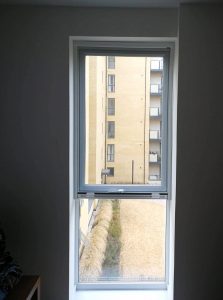
A retractable fly screen, also called a roller fly screen houses the mesh inside an aluminium cassette fixed to one side of the window or door reveal. Pull the mesh across when the window is open; it rolls back into the cassette and disappears when not needed.
Best for: casement windows, tilt-and-turn windows, Velux and roof windows, bi-fold doors, and French doors where you want the screen to vanish entirely when not in use.
Suits the large casement windows common in 1930s and 1960s housing across Dagenham, Hornchurch, and Rainham. Also works on tilt-and-turn windows in newer builds at Barking Riverside and Rainham Riverside. The screen stays installed year-round deploy when open, retract when closed. Nothing to store in winter.
Frame colours: white, anthracite grey, brown. Mesh options: standard fibreglass, fine midge
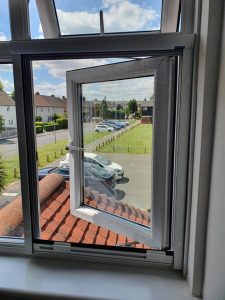
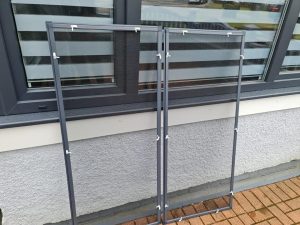
A rigid aluminium frame with mesh bonded into it. Not retractable — it sits over the opening in one of three configurations:
Lift-off: Spring-loaded pins hold the frame in the reveal. Remove it in ten seconds by compressing the pins and pulling the frame out. Simplest and most affordable option.
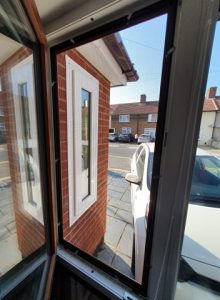
Hinged: The frame is hinged on one side and latches on the other. Open it like a door to access the window handle. Best for windows adjusted frequently for ventilation.
Magnetic: The frame closes against a magnetic strip around the reveal. Holds firmly against light wind, easy to open and refit. Good where children or pets push against the screen.
Best for: casement windows, sash windows, stable-style back doors, kitchen windows.
The standard choice for kitchen windows in East London terraced and semi-detached homes. Also the commercial kitchen standard where EHO insect exclusion compliance is required.
Frame colours: white, anthracite grey, brown. Mesh options: standard fibreglass, fine midge mesh, pet-resistant mesh, pollen mesh.
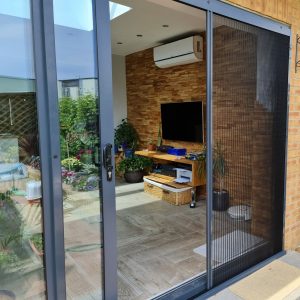
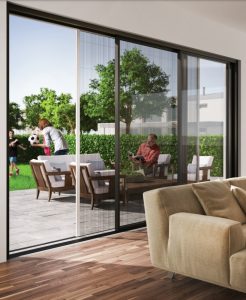
Mesh concertinaed into a plisse fold that compresses and expands horizontally along a track. Push or pull the handle and it stacks neatly to one or both sides when not in use.
Best for: bi-fold doors, patio and sliding doors, French doors, wide openings.
The most requested product for garden-facing bi-fold and patio doors across East London. A fully opened bi-fold door leaves a wide, completely unscreened gap — a pleated screen spans the entire opening, operates independently of the door, and stacks compactly when full width is needed. Single-panel and twin-panel configurations available.
Frame colours: white, anthracite grey, brown. Mesh options: standard fibreglass, fine midge mesh.
Door Fly Screens
A door fly screen is a framed mesh screen fitted over a doorway — a back door, kitchen door, stable door, or utility entrance. It allows the door to stay open for airflow and ventilation while keeping flies, wasps, and insects out of the room.
Best for: sliding patio doors, kitchen back doors, side entrances, and any doorway kept open during the day.
Framed door screens are hinged on one side and latch on the other — they open and close like a conventional door behind the main door. For high-traffic doorways such as commercial kitchen back doors where staff pass in and out frequently, chain fly screens (strip curtain screens) are available as an alternative that requires no opening and closing at all.
Frame colours: white, anthracite grey, brown. Mesh options: standard fibreglass, fine midge mesh, aluminium (commercial).
Made-to-Measure Window Screens
Standard-size fly screens sold in DIY retailers are cut down to approximate a window they never fit exactly, leaving gaps at the edges where insects still enter. A made-to-measure window screen is manufactured to the millimetre dimensions of your specific window reveal, so it seats cleanly with no gaps.
Best for: tilt-and-turn windows, top-hung windows, pivot windows, and any window with an irregular size, a non-standard reveal depth, or an awkward angle that a kit screen cannot address.
Every fly screen Home Decisions makes is made-to-measure by this definition whether it is a simple lift-off framed screen for a kitchen casement or a full pleated system for a bi-fold door. The point is worth stating clearly: we do not stock standard sizes and trim them down. Every screen is cut and built to your window.
Frame colours: white, anthracite grey, brown. Mesh options: all grades available.
Fly Screen by Window and Door Type
Knowing your screen type is the first step. The second is matching it to your specific window or door. The opening mechanism, frame depth, and threshold clearance all affect which mounting approach works and these vary considerably across the housing types found in East London and Essex.
Bi-Fold Doors
A pleated screen spans the full opening on its own track. It does not interfere with the bi-fold door’s running gear and stacks cleanly to one side when the full doorway width is needed. Track fixes to the floor threshold and the top lintel — no structural work required on existing doors.
French Doors
A pleated screen sits in front on its own track and pushes to one side as you pass through. Alternatively, two hinged framed screens (one per leaf) suit doors left open for long periods without needing a separate screen track.
Patio and Sliding Doors
Sliding patio doors already operate on a track. A single or twin-panel pleated screen occupies a parallel track position in front of the sliding door. The screen is independently operated the glass patio door opens behind it. For doors with a deep enough threshold reveal, a roller screen mounted horizontally can also work, though the pleated system is more reliable at wide spans.
Sash Windows
Sash windows are common across Victorian and Edwardian terraces in Ilford, Barking, and East Ham. The lower sash slides up and the upper sash slides down. A framed lift-off screen fits into the reveal of the lower sash opening, covering the gap when the sash is raised for ventilation. The screen is sized to the lower sash reveal specifically, not the full window frame. It lifts out when the window is closed.
Velux and Roof Windows
Roof windows open inward or pivot and are typically out of direct reach when open. A roller fly screen for a Velux sits in its own channel guides on the inner face of the roof window. When the Velux is opened, the roller screen is pulled down to cover the opening — it sits flat in the reveal rather than protruding into the room. Pleated options are also available for wider roof windows and conservation-specification frames.
Casement and Tilt-and-Turn Windows
The most common window type in post-1960s East London housing. A roller screen cassette mounts to one side of the reveal and extends across when the window is in the open or tilt position. Cassette position is adjusted on site where the window handle protrudes into the reveal.
Conservatories
We assess each conservatory in person frame profiles and depths vary too much across manufacturers for a generic configuration. A combination of framed screens on fixed panes and pleated screens on bi-fold or French doors is typical.
Mesh Grades
The frame keeps the screen in position. The mesh is what actually excludes insects. Mesh grade is chosen during the free home visit — we bring samples of each type.
Standard fibreglass (18×16) — blocks house flies, bluebottles, wasps, and flying beetles. Good airflow and a clear view. Correct for most domestic windows in Rainham, Hornchurch, Romford, and Dagenham.
Fine mesh (20×20) — excludes gnats, midges, and mosquitoes. Tighter weave, marginally reduced airflow. Recommended near Rainham Marshes, the Thames foreshore, and the Beam River corridor.
Pet-resistant mesh — heavier-gauge fibreglass or aluminium-reinforced. Resists cats scratching or dogs pressing into the screen. Standard mesh deforms quickly under regular pet contact.
Pollen mesh — dense-weave fabric. Reduces airborne pollen ingress. Relevant for hay fever sufferers. Reduces airflow more than other grades — worth knowing for a room with a single ventilation window.
Aluminium mesh — standard for commercial food-premises screens. Harder, more rigid, and easier to sanitise.
Commercial and Food-Premises Screens
Insect exclusion in food preparation and storage areas is an EHO requirement, not a preference. An unscreened kitchen window or back door is a compliance failure.
Home Decisions fits commercial fly screens across cafés, takeaways, restaurants, bakeries, butchers, and school kitchens in the RM and IG postcode areas. Aluminium-frame framed screens with aluminium mesh are standard — specified for robustness and cleanability. Chain fly screens are available for back doors where staff movement is too frequent for a hinged screen to be practical.
If you need screens in place before an EHO inspection, contact us directly. We can usually arrange a site visit within the week.
Fly Screen Repair and Re-Meshing
Fibreglass mesh splits at corners under repeated tension, pets push through it, or it is punctured by items moved near the window. The frame itself is often structurally sound.
Re-meshing replaces the damaged mesh while retaining the original frame. The spline is removed, old mesh stripped, new mesh stretched over the frame, and the spline re-pressed into the channel. Result: a screen that functions as if new at a fraction of replacement cost.
Home Decisions carries out repair and re-meshing across East London and Rainham. Bring an intact frame to our Rainham workshop or request a home visit for an assessment.
How We Fit Your Screens
Free home visit — we measure every opening, assess frame depth and window mechanism, check door threshold clearance, and confirm which screen type is correct. Mesh samples and frame colours come with us. Takes 20–60 minutes.
Written quotation — fixed price for every item discussed. No deposit until you confirm. No changes on fitting day.
Manufacture — screens are made to your exact measurements at our Rainham workshop. Demand peaks April–May; earlier booking means faster turnaround.
Installation — the same team that measured fits the screens. Framed screens take one visit. Pleated screens across a wide bi-fold take around half a day. We walk you through operation before leaving.
Aftercare — if anything needs adjusting in the first year, we return at no charge.
Measuring for Fly Screens
Framed lift-off and hinged: Measure the reveal opening — the clear space inside the frame, not the outer frame. Take width at top, middle, and bottom; use the smallest. Take height on both sides; use the smallest. Screens are made 2–3mm undersize to let the spring pins engage without forcing.
Roller screens: Measure reveal width and height from the top of the reveal to the sill. Reveal depth (front to back) must be at least 16mm to seat the cassette.
Pleated screens for doors: Width is the full doorway between the inner faces of the door frame. Height runs from the top channel to the finished floor at the threshold.
If your window has an irregular shape, a damaged reveal, or a deep threshold overhang, the free home visit is the only reliable approach.
Fly Screen Costs
Pricing depends on screen type, size, mesh grade, and quantity.
Framed lift-off screens — the most affordable option. Correct for most domestic kitchen and bedroom windows.
Roller screens — higher cost due to the cassette and guide channel system. Justified on windows where retractability matters.
Pleated screens — the most complex to manufacture and install. Priced accordingly for wide bi-fold and patio door openings.
Re-meshing — substantially less than a full replacement. If the frame is intact, re-meshing is almost always the better financial decision.
We do not publish a price list because dimensions vary too much across window types. A written quote from the free home visit gives you an accurate fixed price.
Roller, Framed or Pleated — Quick Comparison
Every home and opening type has different requirements, which is why roller, framed, and pleated fly screens are designed for different situations. Some prioritise a discreet appearance, others focus on durability or covering large openings. The table below provides a quick overview of the main differences, making it easier to identify the most suitable option for your windows and doors.
| Feature | Roller | Framed | Pleated |
|---|---|---|---|
| Best opening | Casement, tilt-and-turn, Velux | Casement, sash, stable door | Bi-fold, patio, French door |
| Retracts? | Yes — rolls into cassette | No — lift-off or swing open | Yes — stacks to the side |
| Max width | ~1200mm single panel | ~1500mm | 6000mm+ multi-panel |
| Mesh grades | Standard, fine, pet | Standard, fine, pet, pollen, aluminium | Standard, fine |
| Commercial use | Limited | Yes | Limited |
| Re-meshable? | No | Yes | Partial |
Storing Screens in Winter
From October through April, most East London households remove framed screens and store them until spring.
Framed lift-off — spring pins compress, frame slides out, stores flat. Mark each screen with the window it belongs to — screens for different windows look identical but are not interchangeable.
Roller screens — leave in place year-round. They retract into the cassette and do not affect window operation.
Pleated screens — can stay on the track year-round. If removed, panels slide off the track; the track stays fixed.
Never fold or crease mesh when storing. Stack flat or stand upright — creases in fibreglass do not recover.
Fly Screens With Existing Blinds
Many homeowners assume they must choose between fly screens and blinds, but in most cases both can be installed on the same window. With the correct measurements and positioning, fly screens can work alongside existing blinds without affecting their operation.
A framed screen can sit within the reveal in front of a blind fitted inside the recess, allowing the blind to operate normally behind it. Roller fly screen cassettes are typically mounted to the outer reveal, providing sufficient clearance for Perfect Fit blinds clipped directly to uPVC window frames.
We regularly install fly screens alongside roller blinds and other window coverings, checking all clearances during the survey stage to ensure a smooth fit and trouble-free operation.
Book Your Free Fly Screen Survey
See the different fly screen options in person and receive a no-obligation quote. We’ll assess your windows and doors, take precise measurements, explain the available screen types, mesh options, and colours, and recommend the most practical solution for your home.
📍 Based in Rainham — supplying and installing fly screens across East London, Essex, and surrounding areas.
Roller Fly Screens
Our Italian designed premium grade retractable roller fly screens are the most unobtrusive and appealing fly screens available.
Pleated Fly Screens
The latest release from Home Decisions for regular and extra-large doors pleated fly screens, made to meet the evolution in the building industry: very wide openings with minimal profiles sections. 4,5 meters wide openings can be protected from insects without any profile or mullion in the middle. The Home Decisions Center Pack can be operated from both sides independently. Performing and versatile, it can be installed inset and face mount without additional frames.


Fly screens
Fly screens
Fly screens
How Can We Help You?
We are ready to help you .
Our friendly customer service team are always happy to help. Whatever you may need, feel free to get in touch.