
Perfect Fit Pleated Blinds
Clip-in pleated blinds measured to your glass, fitted without a drill, and checked against your window handles before anything is ordered.
No-Drill Pleated Blinds Measured and Fitted by Rainham Team
A Blind That Tilts, Turns and Opens With the Window .
Not sure a pleated blind will sit properly in your uPVC frame?
A perfect fit pleated blind is a fabric blind built into its own slim frame. The frame clips in behind the rubber gasket around your glass, so there are no screws, no brackets in the reveal and no holes in a frame you may have paid a lot for. The blind travels with the sash. Tilt the window and the blind tilts with it. Swing a French door open and the blind swings too.
It is not the right blind for every window. It needs a rubber gasket, enough depth behind it and clear space around the handle. It will also not give you total blackout. We say this up front because you should hear it before you order, not on the first bright morning afterwards.
Home Decisions fits perfect fit pleated blinds across Rainham (RM13), Romford, Hornchurch, Elm Park, Harold Hill, Dagenham, Barking and Ilford, and further east towards Aveley, Purfleet and Grays. The person who measures your windows is on the team that fits them. There are no subcontractors and no handovers between visits.
Every job starts with a free home visit. We bring fabric and frame samples, check the gasket, depth and handle clearance on each window, and give you a written price before we leave. Nothing is ordered until you say yes.
What Are Perfect Fit Pleated Blinds?
Perfect Fit pleated blinds are made-to-measure pleated blinds that fit directly into a dedicated frame attached to the window or door frame. Instead of using traditional brackets or drilling into the wall, the blind sits neatly within the existing glazing area.
The pleated fabric folds into a compact stack when opened and can be adjusted to control sunlight, glare and privacy. Because the blind and frame are measured to fit each individual window, it provides a clean, close-fitting finish with minimal space around the glass.
Perfect Fit pleated blinds are commonly used on uPVC windows, French doors and glazed doors where a neat, low-profile blind is preferred.
What Makes a Perfect Fit Pleated Blind Different?
The main difference is how the blind is installed and operates with the window. A Perfect Fit pleated blind is held within its own frame, allowing it to move with the window or door rather than staying fixed around the opening.
This makes it particularly useful for windows and glazed doors that are frequently opened. The blind remains close to the glass, with no loose fabric hanging away from the window and no conventional brackets projecting from the frame.
Compared with a standard pleated blind, the Perfect Fit system also provides a more integrated finish. The frame is measured for the individual window, while the pleated fabric can be moved to position the shade where you need it. This can be useful for controlling light and privacy without adding bulky fittings around the glazing.
How the Frame, Fabric and Handle Work Together
Three parts do the work. The frame is a slim aluminium surround with side rails. It clips behind the gasket using small brackets chosen to match how deep your window bead is. The fabric is the pleated sheet, held between a top rail and a bottom rail. The handle is a small grip on the bottom bar.
Inside the side rails, tension cords keep the fabric lined up and let it stay wherever you leave it. There are no loose cords or chains hanging into the room. You lift or lower the blind by hand.
Two things are worth knowing before you choose.
The stack never fully disappears. Raised, the blind still covers a strip of glass at the top or bottom. Single pleated fabric stacks slim. Honeycomb stacks a little deeper.
The frame adds depth. On most casements you will not notice. On a shallow frame it can sit close to the handle, which is why we check clearance on every window rather than assume.
Three operating options are available:
Bottom-up is the standard. Lift the bottom bar and the blind stacks at the top of the glass.
Top-down bottom-up lets you lower the top of the blind as well as raise the bottom. You can open the top for daylight and keep the lower half closed for privacy.
Motorised hides a battery in the frame and is controlled by remote. See our electric pleated blinds page for details.
Pleated Perfect Fit Options We Fit Across East London
Every option below sits in the same clip-in frame. What changes is the way the blind is operated and the fabric inside it.
Standard Tensioned Pleated Blinds With a Bottom Handle
The simplest version and the one most homes end up with. One handle, one movement, and the blind holds its position without a cleat or a chain.
It suits bedrooms, back rooms and any window where you open and close the blind a couple of times a day. It is also the easiest to live with if the window is opened often, since there is nothing to snag.
Top-Down Bottom-Up Blinds for Street-Facing Rooms
Front rooms that look straight onto a pavement or estate road are where this option earns its place. Lower the top section and the room stays bright. Keep the bottom section up and passers-by cannot see in.
It works well on ground-floor windows in Dagenham, Romford and Hornchurch where privacy matters from about waist height down and the light matters from the top.
Honeycomb Blinds in a Perfect Fit Frame
Honeycomb fabric has two layers with a pocket of air between them. Set into a perfect fit frame, that pocket sits close to the glass.
The gain is modest but real on a cold evening or in a room that overheats in summer. It will not cure a draughty frame. Think of it as a useful bonus for north-facing bedrooms and rear extensions, not the sole reason to buy.
Motorised Perfect Fit Pleated Blinds
Motorised versions carry the battery inside the frame, so nothing is visible. They suit tall windows, high windows and anyone who would rather use a remote than reach.
The motorised version is generally limited to white and anthracite frames, so check your window colour before choosing it. We confirm this at the visit. Our electric pleated blinds page covers control options and smart home set-up.
Which Pleated Blind Fabric Works Best for Each Room?
The right pleated blind fabric depends on more than colour. Think about how much light the room gets, whether you need daytime privacy, and how the blind will cope with heat or moisture. Here is what we recommend for different rooms.
Bedrooms: Dark, but Not Pitch Black
Blackout fabric stops light passing through the material. What it cannot stop is the fine band of light that usually shows where the frame meets the glass. On a window with three panes, there are three frames and therefore more edges.
For most sleepers this is a big improvement and perfectly comfortable. For night-shift households who sleep through daylight, we suggest a second layer, such as a curtain over the blind. Both together get much closer to dark.
We would rather explain this at your kitchen table than have you find out at 9am after a night shift.
Front Rooms Facing the Street
Light-filtering fabric keeps a front room bright and gives daytime privacy. After dark with the lights on, any light-filtering fabric shows shapes from outside, so pair it with a top-down bottom-up operation or a lined fabric if the window faces a pavement.
South-Facing Rear Rooms and Conservatory Side Panes
Rooms that get strong afternoon sun do better with a heat-reflective fabric than with a standard light-filtering one. The side glazing of a conservatory is a good fit for perfect fit blinds because each pane takes its own frame. Conservatory roofs are a different job, and our guide to perfect fit conservatory blinds explains why.
Kitchens and Bathrooms
Steam gets trapped between pleated folds and takes longer to dry than a flat surface. Moisture-resistant fabric with a tighter weave dries faster and resists mould. We specify it for any window near a sink, hob or shower without you having to ask.
Frame Finishes and Fabric Colours
The frame is the part you see, so it has to suit your window. Frames come in a limited set of finishes. If your window’s inner colour is not one of them, we tell you at the visit rather than fit something that looks wrong.
| Colour | Where it works best |
|---|---|
| White | Modern white uPVC in bedrooms and kitchens. The safest match and the one that reflects the most light. |
| Cream and ivory | Older cream or woodgrain-effect frames in period-style houses, and rooms with warm walls. |
| Silver grey | Contemporary living rooms and kitchen extensions, especially against grey walls. |
| Stone and natural | Rooms with brick, lime render or wooden floors where white feels too stark. |
| Charcoal and anthracite | Dark uPVC or aluminium frames, home offices and bedrooms where a calmer, darker room is the aim. |
| Soft pink and blush | Nurseries and children's bedrooms, where a gentler colour works against pastel walls. |
Which Windows Suit Perfect Fit Pleated Blinds?
Perfect Fit pleated blinds are particularly useful on windows and doors where a blind needs to sit neatly within the glazing and move with the opening. But the system is not suitable for every frame or opening style. Here is where we normally recommend it, and where another blind may be more practical.
Tilt-and-Turn and Casement Windows in Post-War Homes
These are among the most common applications. Many semis and terraces around Rainham, South Hornchurch, Elm Park and Harold Hill have uPVC windows fitted during later replacements, and the frame dimensions can vary between properties or even between windows in the same home.
We measure each window individually rather than working from a standard size, so the Perfect Fit frame is matched to the actual glazing and window profile.
French and Hinged Patio Doors
Hinged uPVC doors are well suited to Perfect Fit because the blind moves with the door. It stays close to the glass rather than hanging into the room or creating an obstruction when the door is opened.
Sliding patio doors are different. The additional frame can interfere with the sliding movement, so we do not normally fit Perfect Fit blinds to them. A vertical blind is often a more practical option.
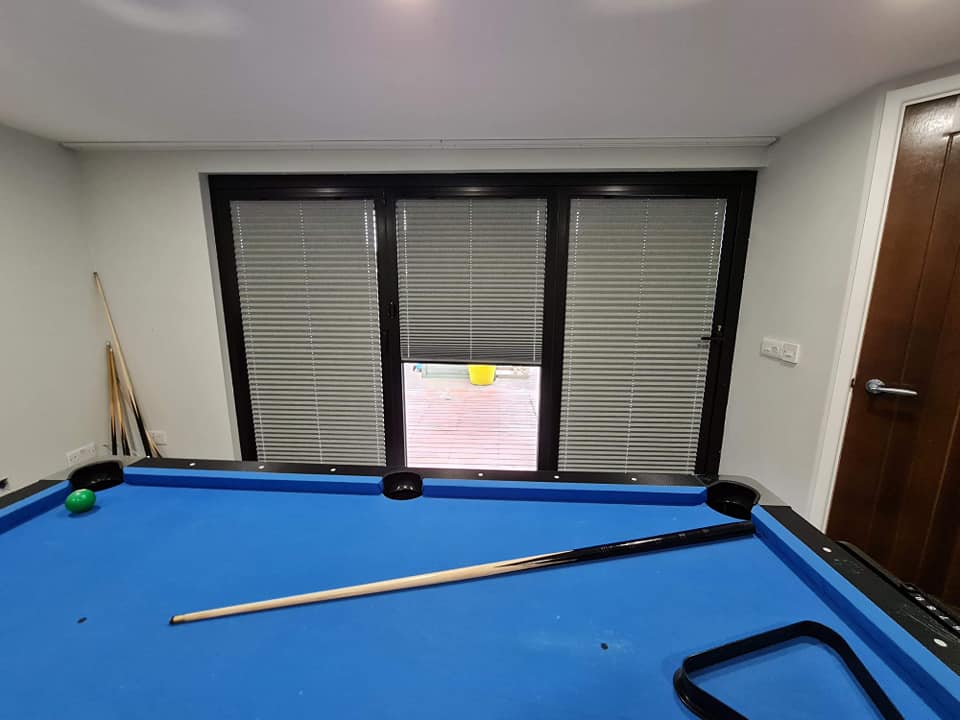
Aluminium Bifold Doors
Perfect Fit can work on some aluminium bifold systems, but the available clearance is important. Adding a frame can prevent the panels from folding back fully or sitting flush when the doors are opened.
We check the actual door configuration and fold-back clearance before recommending the system. If it compromises how the doors operate, we will tell you rather than fitting a blind that restricts them.
Bay and Multi-Pane Windows
A bay window is treated as several individual glazing sections rather than one large opening. Each pane receives its own Perfect Fit frame and blind, which is why we measure every section separately, even when the panes appear identical.
The frames sit alongside one another, so small joins between blinds are visible. There can also be slightly more light around these edges than with a single blind.
Timber and Sash Windows in Older Homes
Perfect Fit frames clip behind a suitable rubber gasket, which is commonly found on modern uPVC and some compatible window systems. Traditional timber windows often do not have the required gasket or profile.
Sash windows also operate differently, sliding vertically rather than opening on hinges. For original timber and sash windows, particularly in older properties around Barking, Ilford and East Ham, an inside-recess roller blind or Roman blind may be more suitable.
Roof Windows and Rooflights
Perfect Fit is designed primarily for vertical windows and doors. Roof glazing has different requirements because of its angle, access and method of operation.
For these installations, see our guides to skylight pleated blinds and Velux pleated blinds for options designed specifically for roof windows.
Renting, or Just Had New Windows Fitted?
Two groups ask us about no-drill blinds more than any other. Tenants in flats and rented houses across Barking, Dagenham and Beam Park, where the landlord or management company will not allow holes in frames. And owners with newer windows who would rather not put a hole in them.
The frame clips in and unclips again. Nothing is drilled or glued, and the window looks exactly as it did when it was installed. If you rent, ask your landlord if you are unsure about anything at all fixed to the window. Our guide to blinds for rental properties in East London goes through what tenants can usually do.
Beam Park is a good example of why we measure rather than guess. It mixes owner-occupied, shared ownership and rented homes across many new-build blocks, each with their own frame specification. See our page for Beam Park for more on how we work there.
Why Every Blind Is Measured to the Glass
A Perfect Fit pleated blind is not measured like a conventional blind. The dimensions are taken from the visible glass and the surrounding window details, because the finished frame needs to sit accurately against the glazing without interfering with the window or handle.
We take the width at three points and use the smallest measurement, then repeat the process for the drop. We also check the glazing bead depth, frame profile and handle position to determine the correct frame configuration.
The handle is particularly important. Its position affects how the Perfect Fit frame sits around the window, so it needs to be accounted for before the blind is manufactured. This is one reason we measure the windows ourselves rather than asking you to provide measurements.
A difference of only a few millimetres can leave an unwanted gap, create movement or affect how the blind operates. Each Perfect Fit pleated blind is therefore made for the individual window it is going into, rather than being cut down from a standard-size blind.
What We Check Before Ordering a Perfect Fit Blind
Before ordering a Perfect Fit pleated blind, we check the window itself rather than assuming the system will fit. Small differences in the gasket, frame depth, handle position or opening movement can determine whether Perfect Fit is suitable.
| Check | What we look for |
|---|---|
| Rubber gasket | A suitable rubber gasket must be present and wide enough for the Perfect Fit frame to clip into. Without one, the system is not suitable. |
| Depth behind the gasket | We normally look for around 18mm to 30mm of usable depth. The bracket size is selected according to the actual profile. |
| Handle and hinge clearance | We check for roughly 25mm of clear space around handles and moving parts so the frame does not interfere when the window opens. |
| Glass size | Width and drop are measured at three points. We use the smallest measurement to ensure the finished blind fits correctly. |
| Opening direction | We check what surrounds the window, including radiators, deep sills, curtains and other items that could interfere with the blind or frame. |
| Bifold fold-back | On bifold doors, we check whether the additional frame will allow the panels to fold and stack as intended. |
Other Blinds and Curtains We Fit
Not every window in a home needs the same type of blind. A property may have uPVC casement windows that suit Perfect Fit pleated blinds, alongside sliding doors, timber frames or roof windows that need a different solution. We can assess the windows together and recommend coverings that work across the whole property.
Perfect Fit Roller Blinds use the same clip-in frame but with smooth roller fabric rather than pleated material. They provide a cleaner, flatter appearance when lowered, although they do not offer the same top-down operation as pleated blinds.
Perfect Fit Blinds also include Venetian options, which can be practical in kitchens and other rooms where the blind may need regular wiping and cleaning.
Vertical Blinds are a practical alternative for sliding patio doors and wide openings where a Perfect Fit frame could interfere with the sliding movement.
Curtains can be fitted alongside a pleated blind when you need additional darkness, particularly in bedrooms, or when you want a softer layered look in a living room.
Roller Blinds and Roman Blinds can work well on traditional timber windows and deeper recesses where a clip-in Perfect Fit frame is not suitable.
For roof windows and loft conversions, skylight pleated blinds and Velux pleated blinds are designed for angled glazing rather than standard vertical windows.
For tall or difficult-to-reach windows, Electric Pleated Blinds provide motorised operation, making everyday adjustment easier without needing to reach the blind manually.
Where We Fit Perfect Fit Pleated Blinds
Our workshop is on Marsh Way, Rainham. There is no call-out charge on your quote, and being close usually means we can offer a home visit within a few days.
We cover Rainham, South Hornchurch and the Beam Park area, along with Aveley, Purfleet, South Ockendon and Grays to the east. Rainham is where we are based, so a repeat visit is never far away.
In Romford (RM1 to RM7), Gidea Park, Harold Hill, Hornchurch (RM11), Elm Park (RM12) and Upminster (RM14), we see a lot of mid-century homes with replacement uPVC. That is where perfect fit pleated blinds are most often the right answer.
In Dagenham (RM8 to RM10), Barking (IG11) and Ilford (IG1 to IG3), housing is more mixed. Some homes suit perfect fit well, others still have original timber windows where it will not work. We say which is which at the visit.
What Rainham Customers Get With Us
Based on Marsh Way, RM13. A local team means faster bookings and someone nearby if a blind ever needs attention.
A straight yes or no. If perfect fit will not work on a window, we say so and suggest something that will, even if that is a different product.
Free home visit with real samples. Fabrics and frame finishes held against your own window, in your own light.
Same team throughout. The person who measures your windows fits your blinds.
No cords in the room. Perfect fit pleated blinds have no operating cords or chains. You lift or lower them by hand.
A guarantee on every fitting. If anything is wrong after we fit your blinds, we come back and put it right at no charge.
Book a Free Measure for Perfect Fit Pleated Blinds
If your windows are uPVC, you want no drilling and you would like a fabric blind that moves with the window, this is worth a look. If they are not suitable, we will tell you that too.
Based in Rainham, serving Romford, Dagenham, Hornchurch, Barking, Ilford, Beam Park and East London.
Call us on +44 1708 505379 or book a free home visit.
Pleated Blinds for Windows
You’ll find a Pleated blind for every area of your home with our practical and stylish offering. Including innovative ThermaShade and blackout solutions, Pleated blinds have delicate, concertina-like folds for a soft and streamlined look at the window.
Pleated Blinds for Bifold Doors
We love the contemporary styling of glass extensions. However, the British weather can often come between us and our visions of the perfect summer’s day, flinging open our doors and enjoying the summer sun. And that’s why we offer a range of gorgeous pleated blinds to tackle those temperamental UK temperatures.
Pleated Blinds for Patio Doors
If your patio doors provide regular access to and from your house, then you need blinds that work seamlessly with your doors. Pleated blinds are a clever, no-drill solution for uPVC patio doors. There are no operating cords or chains, so Pleated Blinds are inherently child safe and great for creating a really sleek look.
Energy Saving Solutions
Are your windows energy efficient? If you are looking for ways to become more energy-efficient and save on heating bills, then our range of pleated blinds have got it covered.
Did you know that as much as 20% of the total heat loss from your home is through your windows? Yet most householders never take steps to provide effective insulation for these important features.



Pleated blinds
Pleated blinds
Pleated blinds
How Can We Help You?
We are ready to help you .
Our friendly customer service team are always happy to help. Whatever you may need, feel free to get in touch.