
Framed Fly Screens
Home Decisions builds and fits framed fly screens to the exact millimetre of your window, so a warm evening means fresh air indoors, not a kitchen full of bluebottles.
Made to Measure Framed Fly Screens Fitted Across Rainham & East London
Custom Insect Screens for Windows in East London – Perfect Fit Every Time .
Fed up with propping the window open six inches and hoping nothing flies in?
A framed fly screen is the oldest and simplest form of insect screening there is, a rigid frame with mesh pulled drum tight across it, sat directly over your window opening. It sounds basic because it is basic. What separates a screen that works for ten years from one that lets flies through the top corner within a month is not the design, it is the fit. A frame built to your exact reveal sits flush on all four sides. A frame built to a rough guess leaves a gap somewhere, and a gap is all a fly needs.
Home Decisions measures, builds and fits framed fly screens across Rainham (RM13), Romford (RM1 to RM7), Hornchurch (RM11 to RM12), Dagenham (RM8 to RM10), Barking (IG11), Upminster (RM14), Ilford (IG1 to IG3) and the wider East London and Essex area. Every frame is cut and meshed at our workshop on Marsh Way in Rainham, and the person who measures your window is the same person who comes back to fit it. There is no separate fitting crew, no handoff, no second visit to fix a measurement someone else got wrong.
A free home visit comes first. Our team checks the reveal depth, the direction the window opens, where the handle sits, and whether the frame is square, because plenty of older East London windows are not quite square anymore. You get a mesh sample to look at, a fixing method that suits how often you actually open that window, and a written price before we leave. Nothing is ordered until you say go.
What Is a Framed Fly Screen?
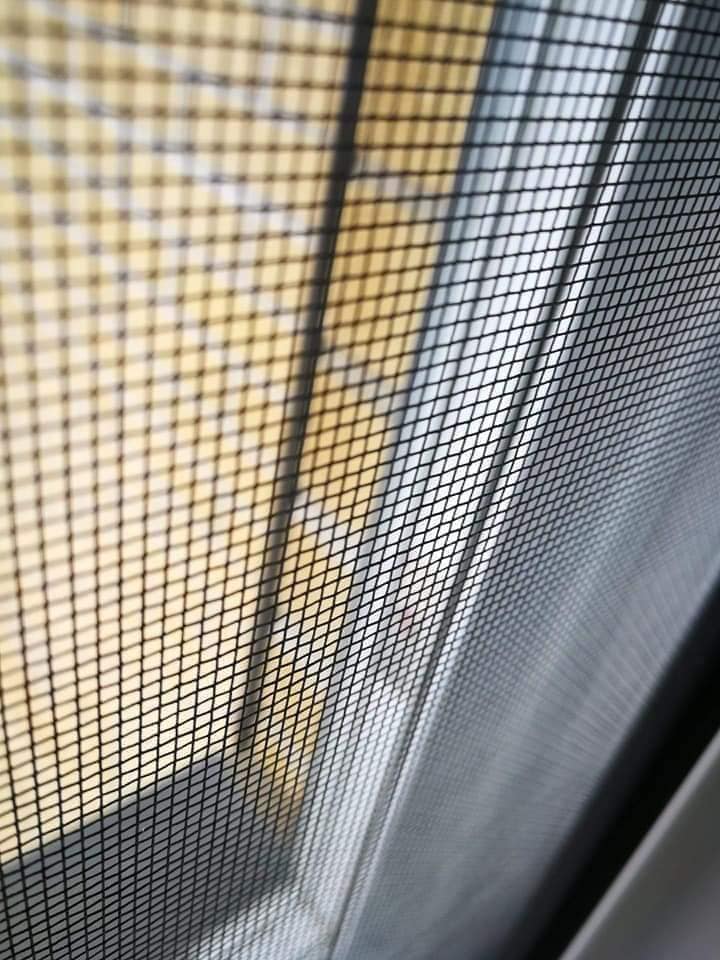
A framed fly screen is a rigid panel, usually powder coated aluminium, with insect mesh stretched across the opening and held under tension by a rubber cord pressed into a channel running around the inside edge of the frame. The corners are crimped together for strength. Once built, the whole thing is one solid piece, not a curtain, not something that rolls, just a frame you fit over the window opening and take off again when you want the window fully clear.
That single-piece design is what makes it different from a roller or pleated screen, which retract into a housing so the window stays usable without removing anything. A framed screen trades that convenience for strength and shape flexibility. Because the frame is built to the actual opening rather than needing a straight channel to run in, it copes with window shapes a retracting system simply cannot, an out-of-square Victorian casement, a small top light, an angled pane in a bay.
How a Framed Fly Screen Works
The frame arrives, or is built on site, as four lengths of aluminium extrusion cut to size and joined at the corners. The mesh is laid over the frame and a spline cord is pushed into a groove that runs around the perimeter, trapping the mesh edge and pulling it taut as it goes in. Done properly, the mesh should have almost no give when you press a finger into the middle of it. Any looseness at this stage means the mesh will sag, flutter in wind, and eventually work its way out of the spline channel.
The finished panel then sits either inside the window reveal or over the outer frame, depending on which gives the flattest, most complete seal for that particular window. Your fixing (hinges, magnets, or turn buttons) holds it in that position. The seal between the back of the frame and the window is what actually stops insects, the mesh just fills the space in the middle.
Framed Fly Screen Fixings in East London
The fixing method matters as much as the frame itself, because it decides how easily you can get the window fully open when you need to. We fit four main types, and which one suits you usually comes down to how often that particular window gets opened and closed.
Hinged Frames for Windows You Open Every Day
A hinged screen swings open like a small door and stays attached to the frame rather than being lifted off completely. Good for a kitchen casement you’re in and out of all day while cooking, since there’s nothing to find a home for on the worktop.
Magnetic Press-Fit Frames for Renters and Households with Kids
A magnetic strip runs around the screen edge and a corresponding strip sits on the window frame, held with adhesive rather than screws. The screen lifts off with one hand and presses back into place without a tool. Popular with tenants across Barking and Dagenham who need a solution their landlord can’t object to, since nothing is drilled and the strip peels off cleanly when you move out.
Turn-Button Frames for a Semi-Permanent Season-Long Fit
Small metal turn clips are fixed into the reveal, and the screen presses in and locks with a quarter turn of each clip. This is the sturdiest of the removable options and holds up better than magnets in an exposed or windy position, first floor windows facing open ground being the obvious example.
Pop-Out Frames for Awkward Handles and Easy Cleaning
Built with a slight bow or spring in the frame so it pops into the recess and pops back out for cleaning the glass behind it, without needing hinges or clips at all. Useful where a handle or stay arm would otherwise get in the way of a hinged screen swinging open.
For a full side by side comparison of these fixings, including which copes best in a strong crosswind, our framed fly screens guide goes through it in more detail.
Framed Fly Screen Mesh by Need
Mesh choice is the second decision, and it changes what the screen actually stops, not just how it looks. The right answer depends less on personal taste and more on where your window is and what you’re trying to keep out of it.
Standard Mesh for Most East London Homes
An 18×16 fibreglass weave is the default for good reason. It stops flies, wasps, bees, moths and mosquitoes while staying close to invisible from a normal viewing distance, and it’s the mesh most East London households need without ever thinking about it again.
Midge Mesh Near Rainham Marshes and the Ingrebourne
Rainham backs directly onto the Thames Estuary grazing marsh, one of the largest wetland areas on the upper Thames and a documented habitat for wetland insects and mosquitoes. Homes closest to the marshes, the Ingrebourne valley, or any stretch of standing water tend to notice smaller biting insects getting through standard mesh on still summer evenings. A tighter 20×20 weave closes that gap, at the cost of a small, genuinely small, reduction in airflow.
Pet-Resistant Mesh for Homes With Cats and Dogs
A heavier vinyl-coated weave that shrugs off a cat’s claw or a dog leaning against the screen to look outside. It looks marginally coarser close up, though from anywhere else in the room you’d struggle to tell it apart from standard mesh.
Fine Weave Mesh for Hay Fever and Pollen Sensitivity
A tighter weave again, this time aimed at airborne pollen rather than insects. Worth the airflow trade-off on a ground floor bedroom window if hay fever is a genuine issue in the household, less worth it everywhere else in the house.
Food-Safe Mesh for Kitchens, Cafés and Takeaways
Domestic kitchens benefit from a fly screen the same way any kitchen does, fewer insects near food and bins. For commercial kitchens it goes further than preference. UK food hygiene law (Regulation (EC) No 852/2004 and the Food Safety and Hygiene Regulations) expects any window that opens to the outside in a food preparation area to carry an insect-proof screen that can be removed easily for cleaning, and environmental health officers check for exactly this during inspection. A framed screen with a food-grade mesh, built to pop out for wipe-downs, satisfies that requirement rather than just improving on it.
Framed Fly Screens by Window and Property Type
East London packs an unusual mix of window stock into a fairly small radius, Victorian bay windows a few streets from 1930s semis a few streets from riverside apartments built in the last five years. A screen that suits one rarely suits all three, which is why we treat this as a measuring job every time rather than a catalogue lookup.
Casement and Sash Windows in Dagenham, Barking and Ilford Terraces
The older housing stock across these boroughs has had eighty to a hundred years to settle, which means the “square” window on the plans is rarely square in practice today. A framed screen handles that because the frame is cut to the actual shape of the opening, sagging corners and all, rather than needing a perfectly true opening to seal against. Sash windows in particular suit a framed screen fitted over the lower sash and held with turn buttons on the outer frame, since a roller system has no clean top rail to mount a cassette on.
Tilt and Turn Windows for Riverside Apartments
New-build riverside flats overwhelmingly use tilt and turn uPVC units, which open two different ways from the same handle. A framed screen fitted with magnets or turn buttons stays clear of the tilt mechanism, so the window still tilts for background ventilation with the screen in place, and turns fully open with the screen lifted off in seconds.
French Doors and Patio Doors on Rear Extensions
The rear extension boom across Romford, Hornchurch and Dagenham has put a lot of glass, and a lot of open doorway, onto the back of otherwise ordinary semis. A single hinged framed screen over one leaf of a French door, or a screen on each leaf for a wider opening, keeps the doorway usable without leaving it wide open to whatever’s in the garden that evening.
Conservatories and Garden Rooms
Conservatory glazing rarely follows standard window dimensions, and opening roof vents in particular are an odd shape for most screening systems. A framed panel built to that specific opening handles it in a way a track-based system generally can’t, and it’s one of the more common calls we get once the weather turns and the conservatory becomes unusable with the doors shut.
Cafés, Restaurants and Takeaways on Local High Streets
A serving hatch, a kitchen window propped for ventilation, a back door left open between deliveries, all of these are the entry points environmental health officers look at during a food hygiene inspection. A framed screen with a food-safe mesh and a fixing that lifts out cleanly for a proper wipe-down covers the requirement without slowing down a busy kitchen, and we quote for these the same way we quote for a domestic job, one free visit, one written price.
Flats, HMOs and Rented Homes Across Barking and Dagenham
Landlords managing HMOs and buy-to-let flats across these boroughs deal with a specific version of this problem, tenants who want the window open in summer and a fixture that won’t need explaining at the next changeover. A magnetic or turn-button framed screen answers both, it leaves the frame undamaged for the next tenancy and it’s simple enough that nobody needs a manual to use it correctly.
Why Exact Measurement Matters on Older East London Windows
A fly screen has one job, and a gap of even a few millimetres undoes it completely. Insects don’t need an open door, a fly will find its way through a corner where the frame sits a centimetre proud of the reveal, and once it’s found that gap, so will the next dozen. This is a more unforgiving product than a blind in that sense, a slightly loose roller blind still functions as a roller blind, a slightly loose fly screen simply doesn’t screen anything.
The other failure point is tension. Mesh held under insufficient tension during fitting will sag over the following weeks as the spline settles, and a sagging screen flutters in any breeze, which loosens the spline further. We build every frame to the measurement taken on the day, checked at more than one point across the opening, specifically because a frame that’s a fraction too small never regains that tension no matter how carefully it’s fitted.
How to Measure for a Framed Fly Screen
| Measurement | What to Do |
|---|---|
| Width | Measure the opening at the top, middle and bottom. Use the narrowest figure so the frame clears every point without forcing. |
| Drop | Measure from the top of the opening to the sill or base of the frame, at both the left and right edges in case the opening has dropped unevenly with age. |
| Recess depth | Check there's enough depth for the frame plus your chosen fixing, roughly 20 to 25mm is typical, more if a hinge or turn clip needs clearance. |
| Handle and stay position | Note where the handle sits and which way the window swings, since this decides whether a hinged, magnetic or pop-out fixing will clear it cleanly. |
Other Fly Screens and Blinds We Fit
Most jobs we quote involve more than one product, since different openings in the same house often need different solutions.
Roller Fly Screens retract into a slim cassette, better suited to a window you open and close several times a day and don’t want to be removing a frame from each time.
Pleated Fly Screens fold like a concertina across wide openings, the usual choice for bifold and patio doors where a framed panel would be too large to lift comfortably.
Zip Screens cover balconies and larger outdoor openings, often specified alongside framed window screens on Rainham Riverside and Barking Riverside apartments.
Perfect Fit Blinds clip into the window frame without drilling, frequently fitted on the same visit as a magnetic fly screen for rented properties across Barking and Dagenham.
Roller Blinds are the product most East London homes already have, and a fly screen sits behind the blind on the same window without interfering with it, our slimmer frames are built specifically to sit flush enough to allow this.
Areas We Cover for Framed Fly Screen Fitting
We fit framed fly screens across Rainham and East London from our workshop on Marsh Way, RM13. There’s no call-out fee anywhere in our standard service zone.
Framed Fly Screens in Rainham and South Hornchurch RM13
Rainham is home ground. We cover every street in RM13, including the newer Rainham Riverside developments and the older housing around South Hornchurch, and being based locally usually means a home visit within two to three days.
Framed Fly Screens in Romford, Hornchurch and Upminster RM1 to RM14
This covers Romford RM1, Gidea Park RM2, Harold Wood RM3, Collier Row RM5, Chadwell Heath RM6, Hornchurch RM11, Elm Park RM12 and Upminster RM14. Wherever you are across these postcodes, we bring mesh samples and measure every window at no cost.
Framed Fly Screens in Dagenham, Barking and Ilford RM8 to IG3
We fit across Dagenham RM8, RM9 and RM10, Barking IG11, Ilford IG1, Gants Hill IG2 and Seven Kings IG3, all within our standard zone with no travel charge added to the quote.
Why Rainham Homes and Businesses Choose Us for Framed Fly Screens
Based in Rainham, not dispatched from somewhere else. Our workshop is on Marsh Way. That’s why a home visit gets booked quickly and a fix, if one’s ever needed, doesn’t mean a week’s wait.
Every window measured on site, not estimated from a floor plan. Older frames in Barking, Ilford and Dagenham are rarely square, and we measure at more than one point to catch that before it becomes a gap.
One team from measure to fit. The person checking your handle position and reveal depth is the person building and fitting the screen, so nothing gets lost in translation between visits.
Mesh and fixing matched to how you actually live. A magnetic screen for a tenant, a hinged screen for a kitchen window you’re in and out of all day, midge mesh if you’re near the marshes, we ask before we quote rather than defaulting to one option for everyone.
Commercial kitchens covered properly. Food-safe mesh, removable fixings, and an understanding of what an environmental health inspection actually looks for, not just a domestic product sold into a business.
A guarantee that means something. If a screen doesn’t seal properly after fitting, we come back and correct it. No charge, no argument.
Book Your Framed Fly Screens Fitting
A fly screen should be simple to live with and easy to forget about, right up until the moment you notice you haven’t swatted a single fly all summer.
📍 Serving London, Rainham and surrounding areas
📞 Call us at +44 1708 505379
How Does This Screen Work?
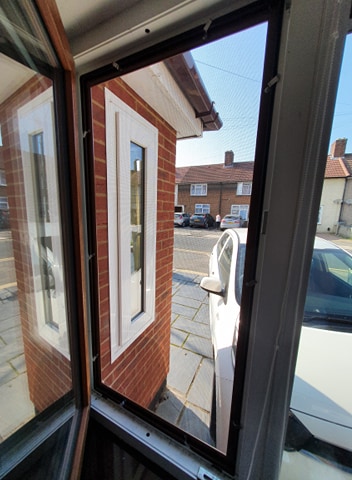
It’s a bit like a picture frame but with mesh instead of a picture. The frame lengths are cut to size and fitted together with crimped metal corners to make the screen frame and mesh is then fitted using a spline tool.
The frame is placed directly onto the window frame, surrounding your window opening, to create a seal between the back of the screen and the window frame and the mesh does the rest. Your chosen fixing holds the screen in place.
Key Features
– Framed Fly Screen – market leading high visibility insect mesh is highly effective at keeping flies, wasps, bees, mosquitoes, spiders & other insects out whilst maintaining excellent airflow and minimal reduction in daylight
– Light-weight but strong powder coated aluminium frame – available in White, Brown or Anthracite Grey.
– Neat, slim-line frame size: just 18.6mm wide x 12.4mm deep – small enough to fit behind blinds
– Crimped metal corners for long lasting strength and a professional finish
– Universal fitting – the screen can be hung from the top or sides (hinged fixing options)
– Self-adhesive fixing option means screens can be fixed without drilling into the window frames
– Lift off hinge and turn button fixing options are weather proof, making the screen suitable for outside use
– Made to your dimensions and shipped ready to fit
Scope of Delivery
- 1 fly screen for frame
- mounting materials
- illustrated mounting manual
Frequently Asked Questions About Framed Fly Screens
Yes. Standard 18×16 insect mesh blocks wasps, bees, hornets, houseflies, bluebottles and moths while still allowing normal airflow through the window. It won’t remove something already inside the room, so it works best fitted before wasp season starts in late spring, giving it the whole summer to do its job.
Yes, framed screens are one of the few options that suit tilt and turn windows properly, common across new-build flats in Rainham Riverside and Barking Riverside. The screen is measured to the reveal and fitted with turn buttons or a magnetic strip, so the window still tilts for ventilation without the screen needing to come off.
UK food hygiene law, including Regulation (EC) No 852/2004, requires windows and openings that lead outside in food premises to carry insect-proof screens where necessary, and that those screens can be removed easily for cleaning. Environmental health officers check for this at inspection, and a missing or damaged screen can affect a food hygiene rating.
Pricing depends on the window size, mesh type and fixing method. A single framed window screen typically costs less than a roller or pleated system for the same opening, since there’s no retracting mechanism involved. Wider door panels and midge or pet-resistant mesh cost more. A free home visit gives an exact, itemised price before anything’s ordered.
Not on their own. Cluster flies hibernate inside wall cavities, roof spaces and old sash boxes, then emerge through gaps in the woodwork rather than through an open window. A fly screen stops flying insects entering through the window opening in summer, but an autumn cluster fly problem usually needs the entry points in the frame or roof sealed, not a screen fitted.
Yes. Each pane of a bay window is measured and screened separately, since the angled side panes are rarely the same width as the central pane. This is common in Victorian and Edwardian terraces across Barking, Ilford and Dagenham, where the bay is often the window left open longest through summer.
No, provided the screen is measured properly. Handle position and the direction the window opens are checked during the home visit, and the frame is built around them. A screen fitted from measurements taken without checking the handle is the most common cause of a screen that catches or won’t sit flush.
Most homeowners leave hinged or turn-button screens in place all year, since the aluminium frame doesn’t corrode or degrade in cold weather. Magnetic screens are easy to lift off and store flat over winter if you’d rather. Either way, there’s nothing to do to the screen itself between seasons beyond an occasional wipe down.
Framed Fly Screens
Framed Fly Screens
Framed Fly Screens
How Can We Help You?
We are ready to help you .
Our friendly customer service team are always happy to help. Whatever you may need, feel free to get in touch.