
Pleated Blinds
in Rainham and East London
Available in modern neutral tones, each blind glides smoothly, stays fully child-safe, and keeps a clean, sophisticated look at all times.
Made to Measure Pleated Blinds for Rainham and East London Homes
Smart, Stylish Blinds Keeping Rainham And East London Homes Comfortable Year-Round .
Searching for pleated blinds in Rainham or East London that fit properly and last?
Pleated blinds are the most practical choice for windows that a standard roller blind cannot cover well. Skylights, roof windows, Velux units, conservatory panes, angled loft windows, and uPVC frames with tilt-and-turn mechanisms all need a blind that sits closer to the glass, stacks compactly when raised, and holds position without a rolling tube or heavy mechanism getting in the way. Pleated blinds do exactly that.
Home Decisions supplies and fits made-to-measure pleated blinds across Rainham (RM13), Romford (RM1 to RM7), Hornchurch (RM11 to RM12), Dagenham (RM8 to RM10), Barking (IG11), Upminster (RM14), Ilford (IG1 to IG3), and throughout East London and Greater London. We manufacture every blind at our Rainham workshop and our own team installs it. The same people who measure your windows carry out the fitting. No contractors, no third-party fitters, no measurement handoffs.
Every job starts with a free home visit. We bring fabric samples to your property, measure every window accurately, and give you a written price before we leave. Nothing is ordered or paid until you confirm.
What Are Pleated Blinds?
Pleated blinds are window coverings made from a single sheet of fabric that folds into neat concertina pleats. When you raise the blind, the folds stack together in a compact bundle at the top or bottom of the window. When you lower it, the pleats open out to cover the glass evenly.
Unlike a roller blind, which winds around a tube, a pleated blind has no tube at all. The fabric is controlled by cords running through small eyelets stitched along each fold. This gives the blind a very slim profile when raised, which is why pleated blinds are the standard solution for skylights and roof windows where space above the glass is limited and a roller mechanism would not fit.
The pleated fabric also sits closer to the glass than most other blind types. This matters for insulation. The small pockets of air trapped between each fold and the glass surface act as a thermal buffer, reducing heat loss through the window in winter and slowing heat gain in summer. Standard pleated fabrics do this to a degree. Honeycomb fabrics, which use a cellular double-layer structure, do it much more effectively and are the right choice for conservatories and rooms where heat control is a real problem.
How Pleated Blinds Work
A pleated blind has four main parts: a fabric panel folded into even pleats, a headrail at the top, a bottom rail, and two cords threaded through the fabric from rail to rail.
Pulling the bottom rail upward causes the fabric to gather into its compressed pleat stack at the top. Releasing it allows the fabric to extend back down the window. The cords hold the blind at any position between fully raised and fully lowered without it sliding or dropping on its own. This is the tension cord system, and it is what makes pleated blinds suitable for angled windows and roof glazing where gravity would cause a chain-operated blind to behave unpredictably.
Three operating options are available:
Standard cord is the most common. Two cords at the sides of the bottom rail raise and lower the blind. Cord cleats are fitted to keep cords secure and out of reach of children.
Top-down bottom-up allows the blind to be opened from the top as well as the bottom. You can lower the top section for light while keeping the lower half closed for privacy. This is the most popular operating option for ground floor rooms in Dagenham and Rainham where the lower part of the window faces a pavement or road.
Motorised replaces all cords with a battery or mains motor. Best for roof skylights and overhead glazing where reaching a cord every day is not practical. See our electric pleated blinds page for full details.
Pleated Blind Types We Fit Across East London
Pleated blinds come in four versions at Home Decisions, each suited to a different window type or fitting situation. All four are available as made to measure options fitted by our own team.
Perfect fit pleated blinds clip directly into the rubber bead around a uPVC or aluminium window frame. There is no drilling, no screws, and no damage to the frame. The blind sits inside the frame and moves with the window when it opens, so tilt-and-turn windows can still be operated fully without removing or adjusting the blind.
This is the most popular pleated blind type for buy-to-let landlords in Ilford, Barking, and Dagenham who cannot drill into window frames, and for tenants in any East London rental property where the landlord does not allow permanent fixings. Available in blackout, light-filtering, and honeycomb cellular fabrics. Requires a uPVC or aluminium frame with a rubber bead seal of at least 18mm wide.
Skylight pleated blinds are designed for flat and sloped roof windows where a standard blind cannot be mounted. The fabric is tensioned by cords running in side channels, which hold the blind in position against the slope of the glass without it sliding down under its own weight.
This is the right blind for kitchen extension skylights in Rainham and Hornchurch, loft room skylights in Dagenham and Romford terrace conversions, and flat roof glazing above open-plan living spaces. Heat and glare control fabrics are the most requested option because south-facing skylights track the sun across a longer part of the day than a vertical window facing the same direction.
Velux pleated blinds are made specifically for branded Velux roof window units. The mounting system clips into the guide rails built into the Velux frame, which gives a precise fit and a clean finish without visible brackets or gaps at the sides.
These are different from a general skylight pleated blind, which is fitted to a custom-built roof window rather than a Velux unit. If your roof window has a Velux label, a Velux-specific blind is the right option. Available in translucent, privacy, and blackout fabrics to suit bedroom, bathroom, and loft office applications across RM postcodes.
Electric pleated blinds replace the cord system with a built-in motor controlled by remote, wall switch, or smart home app. They are almost always the right choice for overhead skylights and roof lanterns where pulling a cord above your head is not practical on a daily basis.
Battery motors are the most common option for retrofit situations. Hardwired motors suit new-build extensions where a mains cable can be routed to the window head during the build. Both options include remote control as standard, with smart home integration available through a compatible hub. For full details on motor options, costs, and smart home setup, see our electric blinds page.
Pleated Blind Fabric by Room Type
The fabric you choose for a pleated blind determines how much light comes through, how much privacy the blind provides, and how well it performs in different conditions. At Home Decisions, fabric samples are brought to your property during the free home visit so you can see each option in your own light before you decide.
Blackout Pleated Blinds for Loft Bedrooms
Blackout pleated fabric blocks all light through the fabric surface. It is the most common choice for loft conversion bedrooms across East London where a skylight or dormer window lets in early morning light directly above the sleeping area.
Roof windows face the sky at a direct angle, which means they receive more intense light than a vertical bedroom window in the same direction. A blackout pleated blind in a loft bedroom keeps the room properly dark in summer when sunrise can begin before 5am across Rainham and Romford. Available in both cord and electric operated versions. Note that even blackout fabric will allow some light at the edges of the blind where the fabric meets the frame, which is why side channels are used on skylight pleated blinds to press the fabric as close to the glass edge as possible.
Light-Filtering Pleated Blinds for Conservatories and Extensions
Light-filtering pleated fabrics soften daylight rather than blocking it. They reduce glare and UV without making the room feel dim, which suits conservatories, kitchen extensions, and south-facing rear rooms in East London homes that get strong afternoon sun.
The pleated fabric structure diffuses light evenly across the surface of the blind rather than reflecting it in a single direction. This gives a softer, more even quality of light in the room compared to a roller blind in the same fabric. For conservatories in Hornchurch and Upminster that overheat in summer, a light-filtering pleated blind on the roof sections and a solar or blackout fabric on the side glazing gives full control over temperature and brightness at different times of day.
Honeycomb Cellular Pleated Blinds for Heat and Cold Control
Honeycomb pleated blinds use a double-layer fabric structure where the pleat folds trap a sealed pocket of air against the glass. This air pocket reduces the rate at which heat passes through the window, working in both directions: slowing heat loss in winter and slowing heat gain in summer.
These are the most effective pleated blind for thermal performance. They suit conservatories that are cold in winter, loft rooms with poor insulation, and older RM postcode properties with single or early double glazing where window heat loss is a real issue. Available in single-cell and double-cell construction. Double-cell offers better insulation but a slightly thicker profile when stacked.
Moisture-Resistant Pleated Fabric for Bathrooms
Pleated blinds in bathrooms need a fabric that tolerates steam and condensation without absorbing moisture, warping, or developing mould. Polyester fabrics with a moisture-resistant coating are the right choice for loft conversion bathrooms with skylight windows, ground floor bathroom windows in older Rainham and Dagenham housing, and any window in a wet room or en-suite.
Standard pleated fabric is not recommended for bathrooms. The accordion folds trap moisture between the layers and take longer to dry than a flat blind surface. Moisture-resistant fabrics with a tighter weave dry faster and resist mould growth. We specify moisture-resistant options automatically for any window in a bathroom or wet area.
Pleated Blind Colours for London Homes
| Colour | Room and context where it works best |
|---|---|
| White | Maximises light in darker loft rooms and north-facing conservatories. The most popular choice for Velux and skylight blinds. |
| Silver grey | Clean, neutral finish for kitchen extensions and modern rear additions. Works well against aluminium window frames common in newer builds. |
| Cream | Warm neutral that suits period properties and traditional interiors. Popular for Hornchurch and Romford semis with wooden internal window boards. |
| Stone and natural | Earth tone that reads well in rooms with exposed brick or lime-rendered walls. Common in rear extensions and garden room glazing. |
| Charcoal | Used in loft offices and home cinema loft rooms where a darker, calmer environment is the goal. Also used for maximum blackout effectiveness. |
| Dusky pink and blush | Popular for loft conversion children's bedrooms and nurseries with skylight windows. Soft enough to work against both white and pastel wall colours. |
Fabric and colour samples are brought to your home during the free visit. Colours read differently under artificial light in a showroom compared to the natural light in your actual room, which is why we always show samples on site before anything is ordered.
Pleated Blinds by Window Type
Pleated blinds can be tailored to suit far more than standard windows. From skylights and conservatories to sloping and uPVC windows, the right style and fitting can provide practical light control while complementing your space.
Skylights & Roof Windows
Pleated blinds are particularly well suited to skylights and roof windows, where traditional window blinds can be difficult to install. Their slim, compact design sits neatly against the glass, while the pleated fabric can be positioned at different points to control sunlight without taking up much space.
For homes across East London and the RM and IG areas, we supply pleated blinds for rooflights, loft windows, kitchen extensions and dormers. Blackout fabrics are popular for bedrooms, while light-filtering and solar fabrics work well in kitchens and living spaces where you want to reduce glare without making the room too dark.
Pleated Blinds for Conservatory Windows
Large areas of glazing can make conservatories uncomfortable during bright or sunny periods. Pleated blinds provide a practical way to soften sunlight, reduce glare and add privacy while keeping the space looking light and uncluttered.
Every conservatory panel is measured individually before manufacturing. This ensures the blinds follow the exact shape and dimensions of each section, particularly where roof panels or frames vary in size. The result is a neater fit and smoother operation across the whole conservatory.
Pleated Blinds for Sloping & Angled Windows
Sloping windows require a blind that stays securely in position rather than sliding down the glass. Pleated blinds use a tensioned cord system that keeps the fabric stable, making them a versatile choice for angled glazing, loft conversions and unusual window shapes.
Depending on the angle and design of the window, we may recommend side channels to minimise light gaps and keep the fabric neatly aligned with the frame. For less steep angles, a standard tensioned system may provide everything needed.
If you’re covering a larger angled opening, our sloping vertical blinds can be a better alternative where the size and layout of the window suit a vertical blind system.
No-Drill Pleated Blinds for uPVC Windows
If you don’t want to drill into your window frames, Perfect Fit pleated blinds offer a convenient alternative. They clip directly into the existing window frame, making them especially useful for uPVC tilt-and-turn windows, newer properties and rental homes where permanent fixings may not be suitable.
The correct frame type and measurements are important for achieving a secure fit. You can learn more about the system on our Perfect Fit Pleated Blinds page.
If you’re considering other no-drill options for your windows, our Perfect Fit Blinds range also includes other styles to suit different window types.
Made to Measure Pleated Blinds in London
Every pleated blind we supply is made to the exact dimensions of the window it covers. This matters more for pleated blinds than for almost any other blind type because the fabric must lie flat against the glass to perform properly. A blind that is even a few millimetres wider than the frame will bunch at the sides. One that is too narrow will let light through the gaps between the fabric edge and the frame.
Standard sized pleated blinds bought online or from a catalogue are cut to approximate dimensions. London windows, across Victorian terraces, 1930s semis, post-war housing, and new builds, are rarely exactly the same size as one another or as standard catalogue dimensions. Measured-to-order manufacturing is the only reliable way to get a pleated blind that fits and operates as it should.
Every Home Decisions pleated blind is made to measure. There are no off-the-shelf sizes in our range.
How to Measure Pleated Blinds
Measuring for a pleated blind follows the same inside-fit and outside-fit logic as any other blind, but with one extra check specific to the product: you need to confirm there is enough depth in the recess for the bottom rail to sit without pressing against the window handle when the blind is in the lowered position.
| Measurement | What to do |
|---|---|
| Width (inside fit) | Measure the inside width of the recess at the top, middle, and bottom. Use the narrowest figure. We deduct a small clearance to allow the blind to operate without catching the frame sides. |
| Drop (inside fit) | Measure from the point where the top rail will sit to the bottom of the recess. Check for any window handles or locks the bottom rail might rest against when fully lowered. |
| Depth check | Confirm the recess is deep enough for the headrail and cord mechanism to sit without obstruction. Minimum recess depth is typically 25 to 30mm for a standard pleated blind. |
| Slope angle (for roof windows) | For angled skylights and roof windows, the angle of the glass needs to be measured to ensure the side channel tensioning system is set correctly for the pitch. Our team uses a digital angle finder during the home visit. |
| Width (outside fit) | For face-fixed blinds outside the recess, measure the full width you want the blind to cover. We add an overlap of at least 50mm beyond each side of the recess for effective light control. |
Other Blinds We Fit Alongside Pleated Blinds
Most East London homes need more than one blind type. We quote and fit the full range across the same visit.
Roller Blinds for standard vertical windows in bedrooms, kitchens, and living rooms throughout the same property where the windows are rectangular and a roller mechanism suits the space.
Perfect Fit Blinds in roller and venetian styles for uPVC windows elsewhere in the property where drilling is not wanted and a pleated style is not required.
Velux Blinds for Velux-branded roof windows where a dedicated Velux-specific fitting system gives a cleaner result than a general skylight blind.
Day and Night Blinds for street-facing front rooms in the same property where privacy during the day is the main concern rather than blackout.
Vertical Blinds for patio doors, French doors, and wide rear openings in the same property where a pleated system does not suit the scale of the opening.
Sloping Vertical Blinds for larger angled windows such as staircase windows and loft dormer slopes where the opening is too wide or too tall for a pleated solution to be practical.
Illusion Blinds for living room windows where a layered, fabric-band look is wanted alongside a more functional pleated or roller blind in other rooms.
Curtains for bay-fronted living rooms and bedrooms in Romford, Hornchurch, and Upminster where a fabric treatment is wanted alongside the blind, or where the window suits a curtain-first approach.
Pleated Fly Screens for the same windows where a pleated blind is fitted but insect protection is also needed, particularly for ground floor kitchen windows and rear extension glazing during summer.
Areas We Cover for Pleated Blind Fitting
We fit pleated blinds throughout Rainham and across East London, with our workshop based on Marsh Way, RM13. There is no call-out charge added to your quote, and being locally based means we can often arrange a home visit within a few days.
Our coverage includes Rainham, South Hornchurch, Rainham Riverside, Romford, Gidea Park, Harold Wood, Hornchurch, Elm Park and Upminster, covering RM1 to RM14. You can find more details about our local service in Romford and surrounding areas.
We also fit pleated blinds across Dagenham, Barking and Ilford, including RM8 to RM10 and IG1 to IG3. Homes with loft conversions and skylights are particularly common in these areas, where blackout pleated blinds can help bedrooms stay more comfortable.
Our fitting service also extends to Stratford and wider East London, including E15, E20 and nearby postcodes. From apartment glazing to kitchen extension rooflights, we measure and manufacture each blind to suit the individual window. Explore our Stratford blinds service.
Why Rainham Homeowners Choose Us for Pleated Blinds
We are based in Rainham RM13. Our workshop is on Marsh Way, Rainham. Being local means fast bookings, quick manufacturing, and prompt fitting.
Free home visit with real samples. We bring pleated blind fabric samples to your property so you can see every colour and opacity in your actual room light before ordering. Roof window light is different from showroom light.
Cut to your exact window dimensions. Skylights and conservatory panels vary even within the same installation. We measure each pane individually and manufacture each blind separately.
Same team throughout. The person who measures your windows is part of the team that makes and fits your blinds. No handoffs, no communication gaps.
Child safe as standard. All cord-operated pleated blinds include cord cleats and comply with BS EN 13120:2009. Perfect fit and electric pleated blinds are fully cordless.
Full guarantee on every fitting. If anything is wrong after installation, we return and correct it at no charge.
Book Your Pleated Blind Fitting
Pleated blinds are built around windows that most other blinds cannot cover properly. If your home has skylights, a conservatory, a loft conversion, or any angled or overhead glazing, we can measure it, manufacture a blind for it, and fit it correctly.
Based in Rainham, serving Romford, Dagenham, Hornchurch, Barking, Ilford, Stratford, and East London.
Call us on +44 1708 505379 or book a free home visit.
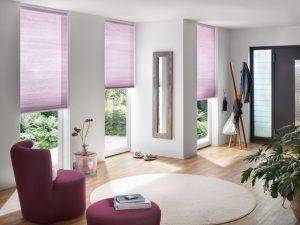
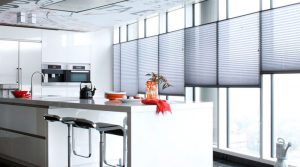
Free Hanging Pleated Blinds
Smart and contemporary free hanging pleated blinds. They also provide thermal properties which keep your home cool in the summer and warm in the winter.
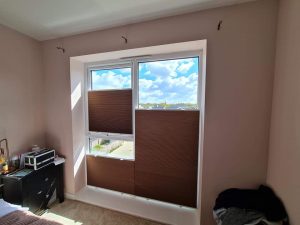
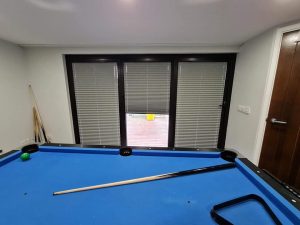
Perfect Fit Pleated Blinds
Available in a range of contemporary, neutral colours, each perfect fit pleated blind raises and lowers easily and is completely safe and child friendly as well as looking smart and sophisticated at all times.
Skylight Pleated Blinds
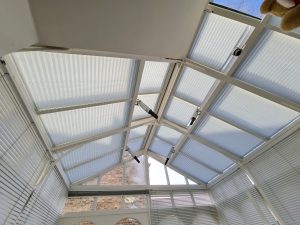
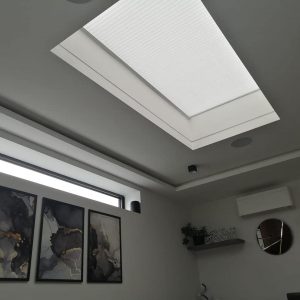
Skylight pleated blinds – also known as plissé or duette blinds– are ideal for sloping windows, roof lights and lean-to conservatory roof windows. Featuring slim top and bottom rails that draw up to the top of the window neatly when not in use, skylight pleated blinds take up less room compared to other types of blind, while still granting a room a smart, muted shading effect.
Velux Pleated Blinds
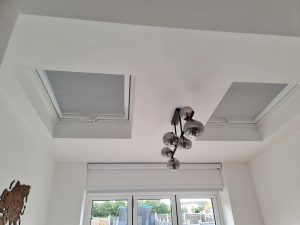
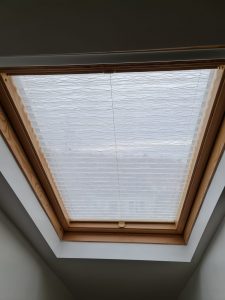
VELUX pleated blinds integrate perfectly with VELUX roof windows to offer flexible lighting and privacy protection, while bathing your room in a pleasant, soft light.


Frequently Asked Questions About Pleated Blinds
A roller blind winds its fabric around a tube at the top of the window. A pleated blind folds its fabric into a compact concertina stack with no tube. The lack of a tube gives pleated blinds a much slimmer profile when raised, which is why they fit into skylights and roof windows where a roller mechanism would not. The cord tension system also makes them more suited to angled and overhead glazing.
Yes. Pleated blinds are the standard solution for roof windows and skylights because their slim folded profile fits into spaces where a roller tube would not, and the cord tension system holds the fabric in position against a sloped glass surface without it sliding. Side channels press the fabric edge against the frame on steeply pitched windows to reduce light gaps.
A honeycomb blind, also called a cellular blind, uses a double-layer pleated fabric where each fold traps a sealed pocket of air between the two layers. This pocket acts as an insulating buffer, slowing heat loss through the window in winter and slowing heat gain in summer. Honeycomb blinds perform better thermally than single-layer pleated fabrics and are the recommended choice for conservatories and poorly insulated rooms.
Yes. Perfect fit pleated blinds clip into the rubber bead seal on a uPVC or aluminium window frame without any drilling or permanent fixings. They require a frame bead of at least 18mm and a clearance of 26mm from the frame face. They are suitable for rental properties and any window where frame drilling is not allowed.
Yes, and they are a particularly practical choice for conservatory roofs where their thermal properties reduce heat gain in summer and heat loss in winter. Each pane of conservatory glazing must be measured individually because the panels vary in size. A blind cut to an average rather than exact dimension will not lie flat or operate correctly.
Made to measure pleated blinds with quality fabric and cords typically last between five and ten years with regular use. Fabric in south-facing roof windows receives more UV exposure than vertical windows and may fade sooner, which is why UV-resistant fabrics are worth specifying for those positions. Cord replacement is the most common maintenance task and can extend the life of the blind beyond the fabric itself.
Yes. Blackout pleated fabric blocks all light through the fabric surface and is the most common fabric choice for loft bedroom skylight and dormer windows across East London. Side channels are used on steeply pitched roof windows to press the fabric edge against the frame, which reduces light entry at the sides. Even with blackout fabric and side channels, small amounts of light may enter around the very edge of the frame depending on how the window is constructed.
Top-down bottom-up is an operating option where the blind can be opened from the top as well as raised from the bottom. Lowering the top rail lets light in through the upper part of the window while the lower section stays closed for privacy. This suits ground floor rooms in Rainham and Dagenham where the lower window faces a pavement or neighbouring property.
Pleated blinds
Blinds
Pleated blinds
Pleated blinds
Pleated Blinds
Pleated Blinds
How Can We Help You?
We are ready to help you .
Our friendly customer service team are always happy to help. Whatever you may need, feel free to get in touch.