
Sloping Vertical Blinds
for Angled Windows
Home Decisions supplies and fits made-to-measure sloping vertical blinds across Rainham and East London, built to the exact angle of loft, staircase, gable, and bay windows that standard blinds will not cover
Angled Window Experts in Rainham and East London
Sloping Headrail with Articulated Hangers – Keeps Every Vane Straight Along Your Window’s Angle .
Searching for sloping vertical blinds in Rainham or East London for a window that a standard blind simply won’t close over?
Angled windows are common across East London’s housing stock, not rare. Loft dormer conversions built under Permitted Development, staircase windows cut into a sloped wall, canted bay fronts on 1930s Romford and Hornchurch semis, and sloped glazing on single-storey rear extensions all produce a window that isn’t a plain rectangle. A blind built for a straight opening gaps at one end, jams against the frame, or won’t hang level, which is exactly the problem sloping vertical blinds are built to solve.
Home Decisions supplies and installs made-to-measure sloping vertical blinds across Rainham (RM13), Romford (RM1–7), Hornchurch (RM11–12), Dagenham (RM8–10), Barking (IG11), Upminster (RM14), Ilford (IG1–3), and throughout East London and Greater London. Every blind is manufactured at our Rainham workshop and fitted by our own team, the same people who measure your window’s angle carry out the fitting. No contractors, no third-party fitters, no measurements handed off between visits.
Every job begins with a free home visit. We measure the exact slope angle and both drop heights with a level rather than eyeballing them, bring physical fabric samples so you can see them in your own room, and provide a written price before we leave. Nothing is paid or committed until you confirm the order.
What Are Sloping Vertical Blinds?
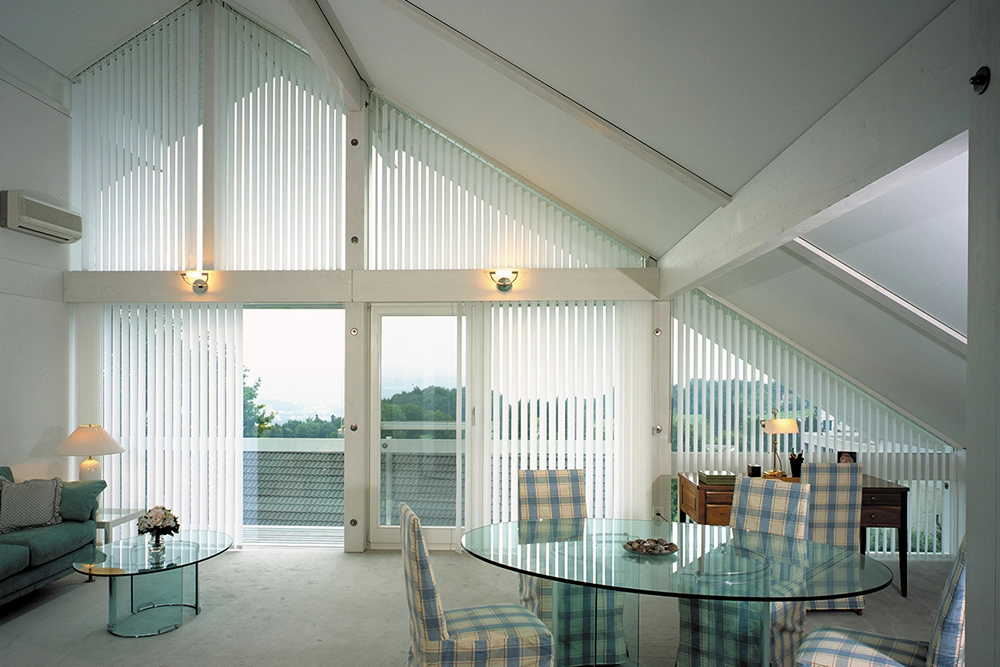
Sloping vertical blinds are a made-to-measure version of a standard vertical blind, built specifically for windows that are angled, sloped, or irregularly shaped rather than square. The headrail (the track the blind hangs from) is manufactured to follow your window’s exact pitch instead of running level, so the blind can be fitted directly onto an angled frame without leaving gaps.
Unlike a standard vertical blind, where every vane is cut to the same length, a sloping vertical blind has vanes cut to different lengths along the rail: longer at the tall end of the slope, shorter at the low end. This is what allows the bottom edge of the blind to finish level along your sill even though the headrail above it is angled. The result is a blind that looks and operates like a normal vertical blind once it’s up, on a window that could never have taken one before.
How Sloping Vertical Blinds Work
A sloping vertical blind has the same core parts as a standard vertical blind: a headrail, vanes, and a control mechanism, plus one addition that makes the whole system work, the articulated hanger.
The articulated hanger is a small pivoting joint at the top of each vane. Because the rail is cut to an angle, a vane hanging from a fixed joint would tilt sideways rather than hang straight down. The articulated hanger pivots to correct for that, so every vane hangs true to vertical no matter what angle the track above it sits at. This is the single detail that separates a sloping vertical blind from a standard blind forced onto an angled window.
Three control types are available:
Chain pull is the most common and the most cost-effective. A looped bead chain on one side draws the vanes open or closed. All chains include a child-safety breakaway clip as standard.
Wand control rotates the vanes to adjust light and privacy without drawing them fully open. Useful on staircase windows and other spots where a hanging chain would be in the way.
Motorised control removes the chain or wand entirely, operated by remote, wall switch, or smart home app. Best for loft dormers, high-level staircase windows, and any angled window that’s awkward to reach by hand.
Every blind we fit in Rainham and East London is measured to your window’s actual angle and both drop heights, not an average or an estimate. Getting the angle wrong by even a couple of degrees is the one mistake that makes a sloping vertical blind look permanently off, so we measure it directly on site every time.
Sloping Vertical Blinds vs Other Options for Angled Windows
Angled windows attract more conflicting product advice than any other window shape. A search for angled window blinds or blinds for angled windows in the UK returns Venetian blinds, roller blinds, Perfect Fit systems, pleated skylight blinds, and sloping vertical blinds, often with no explanation of which one actually suits which window. Each option below covers a genuinely different case, not a marketing variation on the same product.
Venetian blinds use horizontal aluminium or wood slats rather than vertical fabric vanes. On an angled window, a horizontal slat sits parallel to the floor while the frame above it runs on a diagonal, so the gap between the top slat and the angled frame is more visually obvious than the gap a vertical blind leaves. Venetian blinds work best on a small, individually shaped angled pane, such as a single triangular side light, rather than a full-width dormer or bay.
A roller blind is a single sheet of fabric wound onto one tube, which means it can only be cut to the shortest drop of an angled window. Anything taller than that measurement is left as an uncovered triangle of glass at the high end of the slope, unless a separate fixed panel is added to close the gap. Roller blinds for angled windows are a reasonable choice where full top-corner coverage doesn’t matter, such as an obscure-glazed side window, but not where privacy or blackout across the whole window is the goal.
Perfect Fit systems clip directly into the uPVC bead of a window frame without drilling, and the frame itself can be shaped to an angle. This makes Perfect Fit blinds for angled windows a common choice for rented properties across Ilford, Barking, and Dagenham, where drilling into the frame isn’t permitted. The trade-off is the same one that applies to hand-hemmed vertical blinds below: coverage stays even on a gentle slope, but a steep angle or a wide span shows the limits of a fixed clip-in frame rather than an articulated headrail.
Blinds for Pointed and Apex Windows
A pointed or apex window, the triangular gable-end shape found above some East London bay fronts and extensions, is a different problem from a single sloped edge, and no one continuous blind hangs cleanly across a full triangle. The usual approach is a shaped fixed panel, or two straight-edge blinds meeting at the peak, rather than one blind trying to cover both angles at once. Worth flagging directly: if your window is triangular rather than a single diagonal cut, a sloping vertical blind on its own isn’t the right product, and it’s better to know that before ordering than after.
Some advice sites recommend pleated blinds over vertical blinds for any sloped window, citing uneven gaps along the fabric edge. That’s a fair criticism of a straight headrail forced onto an angled window; it isn’t a fair criticism of a properly built sloping vertical blind, where the articulated hanger exists specifically to stop vanes hanging unevenly. Where pleated blinds do win outright is a small single roof light rather than a full dormer: a Skylight Pleated Blind gives a flatter, more space-efficient finish on that shape of window, and we’ll say so on the home visit if that applies to yours.
Hand-Hemmed Standard Vertical Blinds
Some homeowners hand-hem a standard vertical blind to fit a gentle slope themselves, buying a blind longer than the drop and trimming each vane by eye against a straight edge on the sill. On a shallow angle, with patience, this can work, at a fraction of the cost of a made-to-measure blind. It runs out of road on anything steeper than a gentle pitch, anything wider than a single drop of vanes, or a centre-split opening, where hand-cut hems start showing their unevenness exactly where a properly cut rail wouldn’t.
Which Option Actually Fits Your Window
| Your Window | Best Option |
|---|---|
| Full loft dormer, staircase, or bay window | Sloping vertical blinds |
| Single Velux-style roof light | Skylight Pleated Blind |
| Small individual angled pane | Venetian blind |
| Side window, top-corner coverage not critical | Roller blind |
| Rented uPVC frame, no drilling allowed | Perfect Fit blind |
| Triangular apex or gable window | Shaped fixed panel, or two blinds meeting at the peak |
| Gentle slope, budget the main priority | Hand-hemmed standard vertical blind |
Where We Fit Sloping Vertical Blinds
Angled windows turn up in a handful of recurring spots across East London homes. The following are the installations we carry out most often.
Loft Dormer Windows
Dormer windows follow the pitch of the roof by design, and most loft conversions in Rainham, Romford, and across Havering have gone up under Permitted Development rather than a full planning application, meaning a lot of homeowners have a new sloping window and no paperwork telling them what angle it’s cut at. That’s normal; we measure it on site rather than asking you to work it out. Side-facing loft windows also fall under obscure-glazing rules if opened below 1.7m internal height, which is worth factoring into fabric choice alongside light control.
Staircase Windows
Awkward to reach and awkward to shade, staircase windows are one of the windows people put up with unshaded for years because nothing seems to fit. A wand or chain control positioned on the accessible side means you’re not operating the blind from a step.
Angled and Curved Bay Windows
Common across the 1930s semis around Romford and Hornchurch, where the bay isn’t a flat panel but a shallow curve or canted angle. Off-the-shelf blinds are cut straight and don’t follow that shape; each pane of a bay is measured and fitted individually.
Sloped Kitchen and Extension Roofs
Single-storey rear extensions with an angled glazed section along the roofline, increasingly common across Dagenham and Barking, need the same angled-headrail approach, usually paired with a blackout or thermal-backed fabric to manage heat gain through the glass.
Conservatory Side Panels and Top-Floor Home Offices
Anywhere an angled pane sits alongside a working space and glare on a screen is the actual problem being solved, not just appearance. Light-filtering fabric is the most requested option here.
Fabric Options for Sloping Vertical Blinds
The fabric choice matters as much on a sloping vertical blind as the angle does. It determines light control, privacy, and how the blind copes with the room it’s in.
Blackout Vanes for Loft Bedrooms
Blackout fabric blocks light at the vane surface, which matters most in loft bedrooms with east-facing dormer windows where early summer sunrise disrupts sleep. This is the fabric we fit most often on loft conversions across Rainham, Romford, and Dagenham.
- Children’s loft bedrooms where early sunrise is the main complaint
- Shift-worker bedrooms across RM postcodes needing daytime darkness
- South or west-facing dormer windows in Upminster and Hornchurch getting sustained afternoon sun
PVC and Wipe-Clean Vanes for Kitchens and Conservatories
PVC-coated vanes don’t absorb moisture and wipe clean, which suits sloped kitchen extension roofs and conservatory side panels where steam and condensation are a daily issue rather than an occasional one.
- Sloped kitchen extension windows above a hob or sink in Dagenham and Barking homes
- Conservatory side panels where condensation builds on cooler mornings
- Buy-to-let properties across Ilford and Barking needing low-maintenance blinds between tenancies
Light-Filtering Fabric Vanes for Living Spaces and Offices
Light-filtering vanes let daylight through while softening glare, which is the right balance for staircase windows and top-floor home offices where you want brightness without losing all privacy or dimming the room.
- Staircase windows where full blackout isn’t needed but bare glass isn’t wanted either
- Top-floor home offices across East London where screen glare is the actual complaint
- Angled bay windows in Romford and Hornchurch front rooms facing onto the street
Made to Measure Sloping Vertical Blinds
A sloping vertical blind cannot be sold as a standard size, because no two angled windows share the same pitch. Made to measure means the headrail is manufactured to your window’s specific angle and both drop measurements, and the vanes are cut individually to match, not adjusted from a stock length.
Every sloping vertical blind supplied by Home Decisions is made to measure as standard, built from the angle and drop measurements taken on your free home visit. There is no off-the-shelf version in our range, because an angle that’s even slightly wrong is the difference between a blind that hangs level and one that visibly doesn’t.
How to Measure Sloping Windows
Getting the angle right is the one measurement that makes or breaks a sloping vertical blind, so we take it directly with a level rather than by eye. If you want to understand what we’re measuring on the home visit, here’s the process:
| Measurement | What to Do |
|---|---|
| Slope angle | Measured with a spirit level or angle finder against the top of the frame — not estimated by eye. |
| Longest drop | Measure from the top of the frame to the bottom sill at the highest point of the slope. |
| Shortest drop | Measure from the top of the frame to the bottom sill at the lowest point of the slope. |
| Width | Checked at more than one point in case the frame has moved slightly — common in older East London properties. |
| Recess or face fix | Confirm whether the blind will sit inside the recess or fix to the wall face, which changes bracket depth and headrail position. |
| Opening direction | Decide which side the blind should draw to, based on how the room is actually used. |
Because an incorrect angle can’t be corrected after manufacture, HomeDecisions provides a free home measuring visit for every sloping vertical blind order across London and Essex. Our team measures the slope directly on site before anything is ordered, removing the risk of a mismeasured angle entirely.
Other Blinds We Fit for Angled Windows
Many East London homes with an angled window also need coverage for the straight windows in the same room, or a different product for a smaller roof light. We quote and install the full range across the same visit.
Skylight Pleated Blinds suit single roof lights and Velux-style windows where a flat, space-efficient finish works better than a vertical blind. Fitted alongside sloping vertical blinds in most loft conversions across Rainham and Romford.
Vertical Blinds cover the straight windows and patio doors in the same room as a sloping vertical blind, in a matching fabric and colour for a consistent look.
Perfect Fit Blinds clip into uPVC frames without drilling — the right choice for rental properties across Ilford, Barking, and Dagenham where frame drilling isn’t allowed.
Electric Blinds motorise hard-to-reach staircase windows and high loft dormers across Rainham Riverside and Barking Riverside, controlled by remote, wall switch, or smart home app.
Curtains are made to measure for the straight windows in bay-fronted living rooms and bedrooms in Romford, Hornchurch, and Upminster, often paired with a sloping vertical blind on the angled window in the same room.
Areas We Cover in East London
We fit sloping vertical blinds across Rainham and East London from our workshop on Marsh Way, RM13. All areas below are within our standard service zone. No call-out charge, no travel fee.
Rainham and South Hornchurch (RM13)
Rainham is where we’re based. We cover every street in RM13 including South Hornchurch, Rainham Riverside, and the roads around New Road and Upminster Road, many with recent loft conversions producing exactly the dormer windows this product is built for. Being local means we can usually book your home visit within two to three days.
Romford, Hornchurch and Upminster (RM1 to RM14)
We cover Romford RM1, Gidea Park RM2, Harold Wood RM3, Collier Row RM5, Chadwell Heath RM6, Hornchurch RM11, Elm Park RM12, and Upminster RM14, an area with a high concentration of 1930s canted bay fronts alongside newer loft conversions.
Dagenham, Barking and Ilford (RM8 to IG3)
We fit sloping vertical blinds across Dagenham RM8, RM9, and RM10, Barking IG11, Ilford IG1, Gants Hill IG2, and Seven Kings IG3, including the sloped extension roofs common on single-storey rear-extended terraces in these areas. All within our standard service zone with no travel charge added to your quote.
Why Rainham Homeowners Choose Us
We are based in Rainham RM13. Our workshop is at Marsh Way, Rainham. Short distance means fast bookings, quick manufacturing, and prompt fitting.
We measure the angle ourselves, on site. A sloping vertical blind can’t be corrected after manufacture if the angle’s wrong, so we don’t take it over the phone or from a photo. We bring a level to your home.
Same team start to finish. The person who measures your window’s slope is part of the team that makes and fits your blind. Nothing gets lost between visits.
Honest about fit. If a sloping vertical blind isn’t right for your specific window, a small single roof light, for instance, we’ll say so on the visit and point you to what is, rather than fitting the wrong product because it’s the one on the van.
Child safe as standard. All chain blinds include breakaway safety clips. Wand and motorised control options have no loose cord at all. All meet BS EN 13120:2009.
Full guarantee on every fitting. If anything is wrong after we fit your blind, we come back and fix it. No charge, no questions asked.
Book Your Free Home Visit in East London
An angled window shouldn’t mean months of blinds that don’t fit, or curtains hung on a rail that was never meant for the slope. Whether it’s a loft dormer, a staircase window, or a canted bay, we measure the angle ourselves and build the blind to match it exactly.
📍 Serving London, Rainham and surrounding areas
📞 Call us at +44 1708 505379
Frequently Asked Questions
Will sloping vertical blinds hang straight if the headrail itself is angled?
Yes. Each vane hangs from an articulated hanger that pivots independently, so it stays vertical even though the track above follows your window’s slope. Vanes are cut to different lengths, longer at the tall end, shorter at the low end, so the bottom edge finishes level along the sill.
Can I still tilt sloping vertical blinds like normal vertical blinds?
Yes. Once fitted, they operate exactly like a standard vertical blind: tilt the vanes for light and privacy, or draw them to one side using a wand or chain to open the window fully. The angled headrail changes only how the blind is built, not how you use it.
What if I don't know my window's slope angle or measurements?
You don’t need to measure anything yourself. Home Decisions carries out a free home visit across Rainham and East London, using specialist tools to capture the exact angle and both drop heights before manufacturing begins, so there’s no guesswork on your part.
How much do sloping vertical blinds cost?
Costs vary by slope angle, width, drop, and fabric, since every headrail and vane is cut individually rather than to a stock size. A free home visit gives an exact, itemised quote for your specific window rather than a generic per-window estimate.
Are sloping vertical blinds a good choice for loft bedroom windows?
Yes. Loft bedrooms are one of the most common installations, especially in East London homes with dormer conversions. Blackout fabric is popular here specifically to block early morning light through east-facing roof windows, which standard curtains often can’t fully cover on an angled frame.
Can sloping vertical blinds be motorised?
Yes. Motorised control removes the chain or wand entirely and is operated by remote, wall switch, or smart home app. It’s the most practical option for high-level staircase windows and loft dormers that are awkward to reach by hand, and it removes any hanging cord.
How long does fitting take from home visit to finished installation?
Most customers in Rainham and East London have their sloping vertical blinds fitted within two weeks of the initial home visit. We contact you once the blind is ready to arrange fitting, and the installation itself usually takes under an hour.
Vertical Blinds
Vertical Blinds
Vertical Blinds
How Can We Help You?
We are ready to help you .
Our friendly customer service team are always happy to help. Whatever you may need, feel free to get in touch.