Battery powered electric blinds are the right choice for most existing homes because they need no wiring, no electrician and no redecorating, while mains powered blinds are the better choice when a room is being rewired or built from scratch, or when a blind is very large and moves many times a day. Both use the same motor in the tube and the same remotes, so the decision is about power, not performance. Battery vs mains electric blinds is the first decision on any motorised order, and this guide takes it room by room.
We fit both types from our workshop in Rainham, across East London and Essex, and the battery or mains question comes up at almost every home visit for electric blinds. This guide explains how each is powered, how long a charge really lasts, what the solar and rechargeable options are, where the cost difference sits and which rooms suit which. At the end we give our plain recommendation.
How battery powered electric blinds work and how long a charge lasts
Battery powered electric blinds have a rechargeable lithium battery built into the tubular motor inside the roller, and one charge typically lasts somewhere between three and twelve months depending on the size of the blind and how often it moves. You charge it with a USB lead plugged into a small port at the end of the headrail or tube, which takes a few hours. The remote talks to the motor by radio, so nothing needs to be in line of sight.
Because everything is inside the blind, fitting is the same as fitting a manual blind. Two brackets, a few screws, pair the remote, set the top and bottom limits and it is done. There is no cable to hide and no hole through the wall. That is why battery is the default for a finished room.
Where the battery sits
On a roller blind the battery lives inside the tube with the motor. On a pleated or cellular blind, where the headrail is slim, the battery is often a separate slim pack that clips behind the headrail or sits on top of it. On a Venetian or a Roman blind the pack usually sits in the headrail too. Wherever it is, the charging port is reachable from a step ladder without taking the blind down.
What drains it faster
Three things shorten the time between charges: weight, drop and frequency. A heavy blackout fabric on a wide window draws more current on every move than a light voile on a small one. A tall drop means the motor runs for longer each time. And a blind on a sunrise schedule that opens and closes every day will need charging more often than a spare room blind moved once a week. None of this changes whether battery is right, it just changes how often you reach for the USB lead.
How mains wired electric blinds work
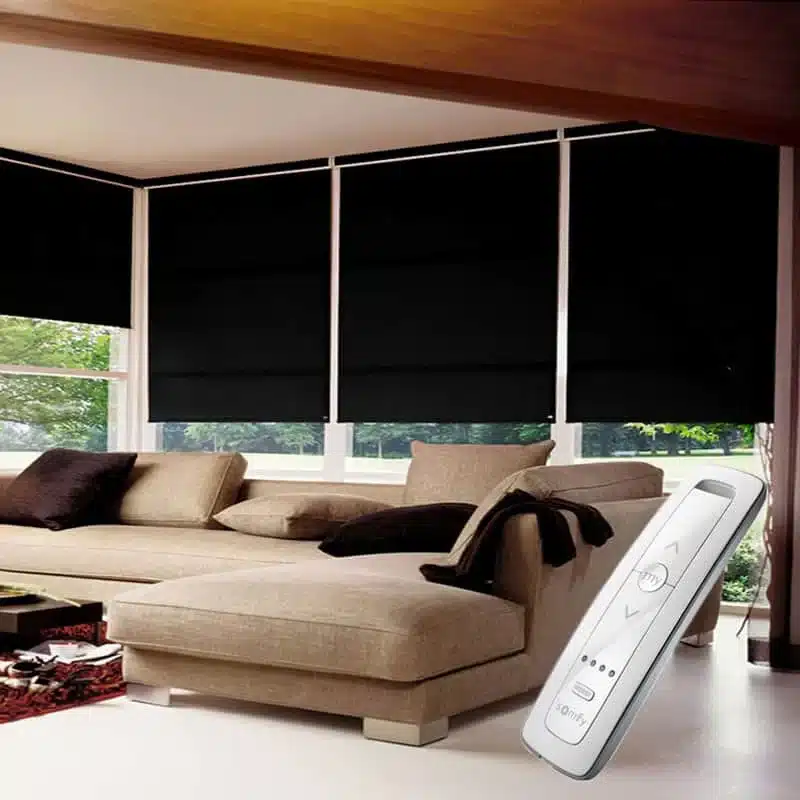
Hardwired electric blinds have a mains motor in the tube with a flex that runs to a fused spur or a concealed socket near the window, so they never need charging and are never caught flat. The cable is usually chased into the wall or run behind plaster during a refurbishment, then the blind is fitted after decorating. The motor is slightly more powerful than a battery version, which is why very large and very heavy blinds are nearly always mains.
The downside is the wiring. A qualified electrician needs to add the spur, and if the room is already finished that means a channel in the wall, making good and repainting. In a new build or an extension that is still at first fix it costs almost nothing extra because the electrician is already there. In a decorated bedroom it is the single biggest reason people choose battery instead.
When a wired blind is the only sensible option
We steer customers to mains in four situations. First, a blind over about 3 metres wide or with a very heavy fabric, where a battery motor would be working at its limit. Second, a blind that moves many times a day on an automation schedule. Third, a window that is genuinely out of reach, such as a double height hallway or a stairwell, where charging would need scaffolding or a very long ladder. Fourth, an extension or new build where the cable can be run before the plasterboard goes on. Outside those four, battery usually wins.
Solar and rechargeable options for electric blinds without wiring
Solar powered blinds are battery blinds with a slim photovoltaic strip that sticks to the glass and trickle charges the battery, so on a sunny window you may never need the USB lead at all. The strip is a few centimetres tall and runs along the top of the pane behind the blind. It needs daylight rather than direct sun to do its job, but a north facing window in winter will not keep up with a blind that moves several times a day.
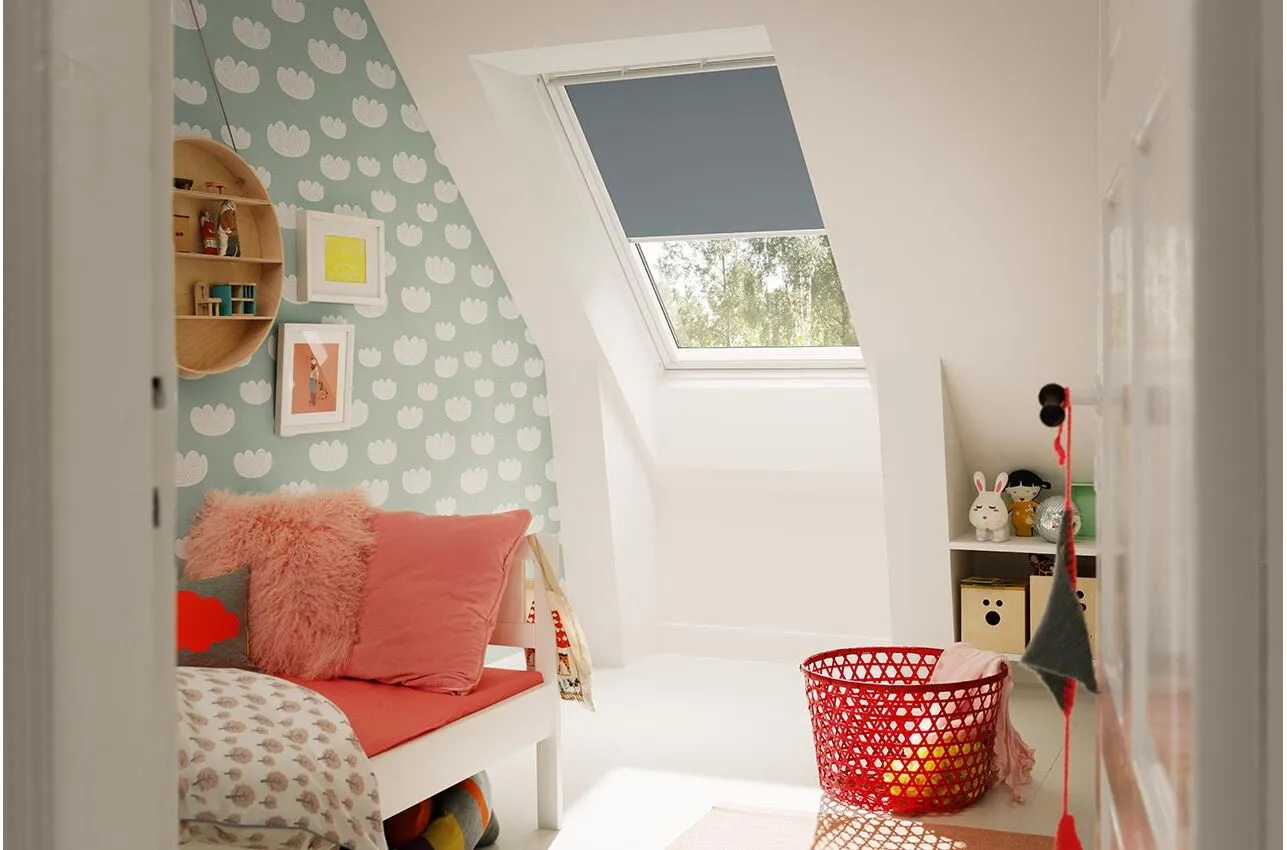
Solar makes the most sense on roof windows and skylights, where the glass gets plenty of light and a cable would be awkward to run. Our Velux blinds page covers the solar versions. On a vertical window it is a nice extra rather than essential.
External battery packs and plug in chargers
Some motors take an external rechargeable pack instead of an internal battery. The pack clips to the bracket or sits in the headrail and can be unclipped and charged on a worktop, or swapped for a spare so the blind never stops. A few systems use a small plug in charger that lives permanently behind the blind and runs to a nearby socket on a thin low voltage lead, which gives you the convenience of mains without an electrician, provided there is a socket close enough to hide the lead.
Battery or mains: the cost difference
The blind and motor cost about the same whichever power you pick, so the real difference is the wiring. A battery blind has no installation cost beyond fitting the blind. A mains blind adds an electrician’s time, the spur or socket, and any making good and decorating around the cable run. Those figures depend on the room and the trade you use, so we do not quote them here, but the written quote after your home visit sets out the blind cost clearly and tells you what the electrician will need to provide.
For the blinds themselves, our electric and motorised blinds start at £250 and most fall between £250 to £600 per blind. Adding a motor to a blind you are already buying starts at . Our electric blinds installation cost guide breaks the price down by window type.
| Cost item | Battery powered | Mains wired |
|---|---|---|
| Blind and motor | From £250 | From £250 |
| Fitting | Included in our written quote | Included in our written quote |
| Electrician | Not needed | Needed for the spur, priced by your electrician |
| Making good and decorating | None | Depends on the cable route |
| Running cost | A USB charge a few times a year | Negligible, the motor only draws power when moving |
| Extras | Optional solar strip or spare pack | Optional wall switch |
Which rooms suit battery and which suit mains
Bedrooms, living rooms, kitchens and home offices nearly always suit battery, while extensions with bifolds, double height spaces and whole house automation projects suit mains. Here is the room by room version we use when advising customers.
| Room | Usual pick | Reason |
|---|---|---|
| Main bedroom | Battery | Moves twice a day, long charge life, no cable in a finished room |
| Child’s bedroom | Battery | No chain and no cable, blackout fabric available |
| Living room, standard window | Battery | Simple retrofit, remote or app control |
| Kitchen diner with bifolds | Mains if building, battery if finished | Wide heavy blind, cable easy to add at first fix |
| Landing or stairwell | Mains | Hard to reach for charging |
| Loft room with Velux | Battery with solar | Plenty of light, awkward cable route |
| Conservatory roof | Mains or battery with solar | Several blinds moving together on hot days |
| Home office | Battery | Usually one window, moved on a schedule for glare |
Blind type matters a little too. Electric roller blinds and day and night electric blinds have room in the tube for a generous battery. Electric pleated blinds use a slimmer pack, which is fine for a normal window but worth a thought on a very large conservatory roof.
Electric blinds without wiring in flats and rented homes
If you live in a leasehold flat or a rented home, battery powered blinds are almost always the only practical option because you cannot chase cables into shared or landlord owned walls. Many leases in the newer blocks around Canary Wharf, Stratford and Barking Riverside prohibit alterations to the window frames and the fabric of the building, and a landlord is unlikely to welcome a spur being added for a tenant’s blind.
A battery blind fixed with a handful of small screws to the recess, or a Perfect Fit frame that clips to the glazing bead with no drilling at all, keeps you within the rules and can come with you when you move. For landlords fitting out a property, battery blinds also avoid any question about who certifies the electrical work. Our guide to blinds for rental properties covers the wider choices.
Battery and mains electric blinds in Rainham and East London homes
Around Rainham, Hornchurch and Upminster the houses are mostly 1930s and post war semis with deep window recesses, and battery roller or pleated blinds drop straight into them with nothing to hide. Where those houses have had a rear extension with bifolds or a lantern roof, the extension is usually the one place we suggest a mains supply, ideally planned in with the builder before the plasterboard goes on.

In Romford, Ilford and Dagenham the terraces and semis often have bay windows, and here battery wins again because three or five separate blinds in a bay would otherwise mean three or five cable runs. One remote or one app controls the whole bay as a group. In the new build flats across Stratford, Canning Town and Beam Park, floor to ceiling glazing is common. The blinds are tall but usually not heavy, and battery motors cope well, with a solar strip as a useful extra on a south or west facing balcony door.
Out towards Grays and South Ockendon the newer estates sometimes have a conservatory or garden room where several roof blinds move together on hot afternoons. That is one of the few domestic cases where we talk seriously about mains for the roof and battery for the sides. For wide patio doors in any of these homes, electric curtains on a battery track are an alternative to a very wide blind.
Our recommendation
Choose battery unless you are building or rewiring, or the blind is unusually large, heavy or high. That rule covers the great majority of homes we visit. Battery motors are quiet, hold position reliably, pair with the same remotes, apps and voice assistants as mains motors, and the charging routine is a few minutes with a USB lead two or three times a year.
Choose mains when the electrician is already coming, when the blind spans a wide bifold or a double height window, or when you are automating a whole house and want every blind to run on a schedule for years without a thought. In a mixed project, battery on the normal windows and mains in the extension is a sensible split, and both can sit on the same remote and the same app.
If you are unsure, we will tell you at the home visit which we would fit in each room and why, and the written quote will show the blind price for both options where it matters.
Every blind we make is fitted to current UK child safety rules. The Make it Safe campaign from the British Blind and Shutter Association explains what to check on blinds you already own.[1]
Frequently asked questions about battery vs mains electric blinds
Do electric blinds need an electrician?
Battery powered electric blinds do not, because the motor and battery are inside the blind and charge by USB. Mains wired blinds need an electrician to add a fused spur or concealed socket near the window.
How often do you charge the battery?
For a blind moved once or twice a day, every three to twelve months is typical. Large, heavy or frequently moved blinds sit at the shorter end, and a solar strip can extend that a long way.
Can you change the battery in electric blinds?
On motors with an internal battery the cell is designed to last many years of recharging and is replaced as part of the motor if it ever fails. On motors with an external pack the pack simply unclips and a new one clips on.
Do battery electric blinds work with Alexa?
Yes, through a small radio hub that connects the blinds to your Wi-Fi. Battery and mains motors use the same hub and the same app, so voice control does not depend on how the blind is powered.
What happens to mains electric blinds in a power cut?
They stay where they were when the power went off and work again when it returns. Battery blinds are unaffected because their power is inside the tube.
Can I switch from battery to mains later?
Yes, by swapping the motor in the tube for a mains version once the wiring is in place. The fabric, tube and brackets stay the same, so it is a motor change rather than a new blind.
Get a free home visit in Rainham and East London
If you are still deciding on battery vs mains electric blinds, if you want someone to look at your windows and say plainly whether battery or mains makes sense for each one, book a free home visit or call 01708 505379. We measure at your home across Rainham, Romford, Hornchurch, Ilford, Stratford and the rest of East London and Essex, make the blinds in our Rainham workshop and send a written quote after the visit.
References
- ^ Make it Safe from the BBSA. Make it Safe (British Blind and Shutter Association). Retrieved 25 October 2026.