The best blinds for bay windows are one blind per pane, in whichever type suits the room: vertical blinds on a single curved track for the cheapest full cover, Perfect Fit blinds for uPVC bays with no drilling, roller or day and night blinds for a clean look, and Roman blinds or shutters where the bay is the feature of the room. One wide blind across the front of a bay is rarely right, because it cuts off the sill and the window seat and does not follow the angles.
Bays are the most common window we measure, because the 1930s semis across Romford, Hornchurch, Ilford, Rainham and most of East London were built with one at the front, and often another at the back. We make the blinds in Rainham and fit them ourselves, so this guide is written from the fitting side: how a bay is measured, why one blind per pane is the normal answer, what each blind type does in a bay, how blinds compare with shutters, and what the different options cost.
How to measure a bay window for blinds
A bay window is measured one pane at a time, with the width of each pane taken at the top, middle and bottom, the drop taken at both sides, the angle between the panes recorded, and the depth of the recess checked so the blinds clear the handles and each other where they meet at the corners. The corners are what catch people out. Two blinds meeting at a 135 degree angle need room for both brackets, and if the panes are measured as if they were flat the blinds foul each other.
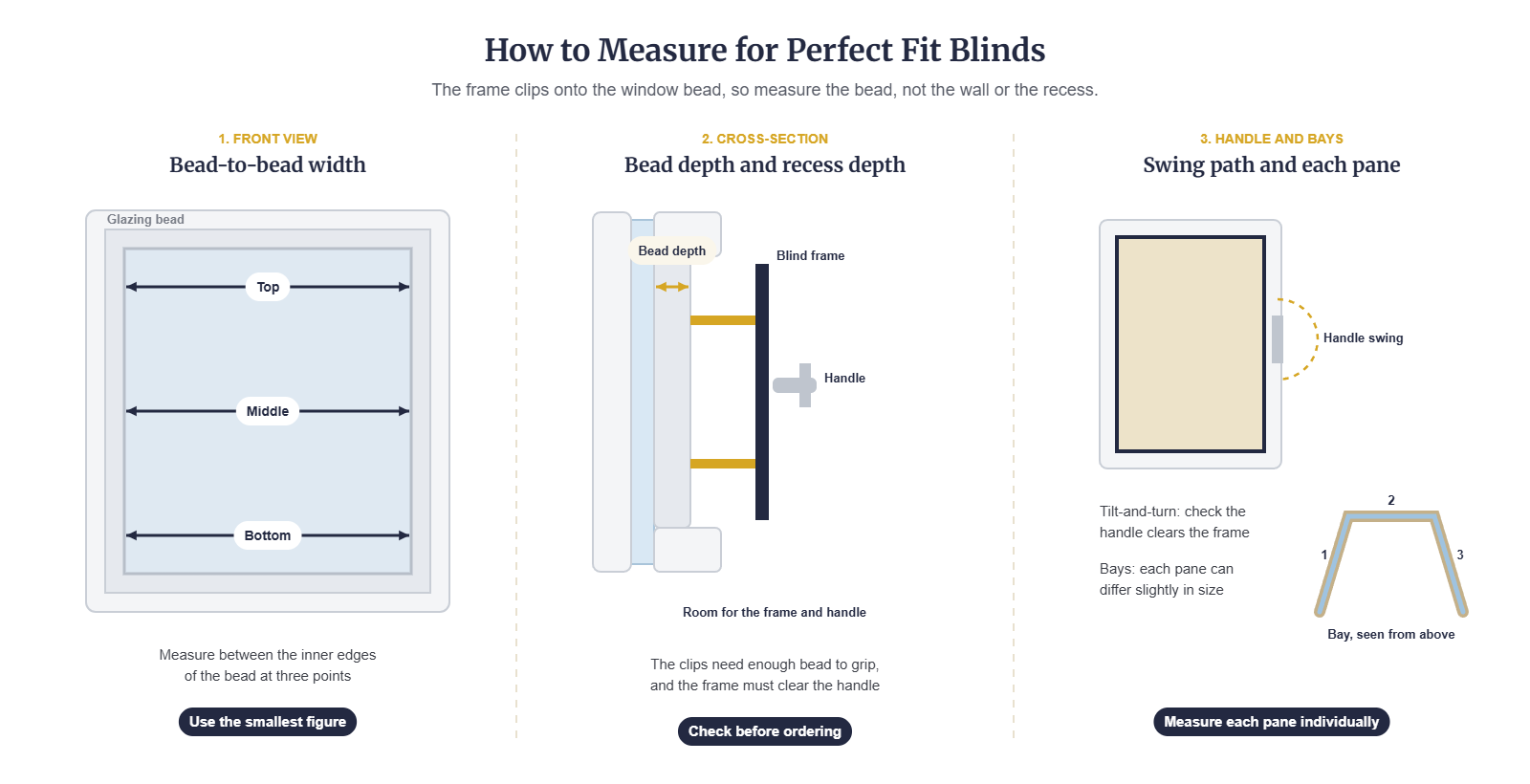
For a vertical blind on a curved track we measure the full run of the bay along the line the track will take, plus the angles, so the track can be bent to match. For Perfect Fit we measure bead to bead on each pane, as our guide on how to measure for Perfect Fit blinds explains. We do this at the free home visit, because a bay is the one window where a few millimetres on a self measured size turns into a blind that does not fit.
One blind per pane: why it is the usual answer
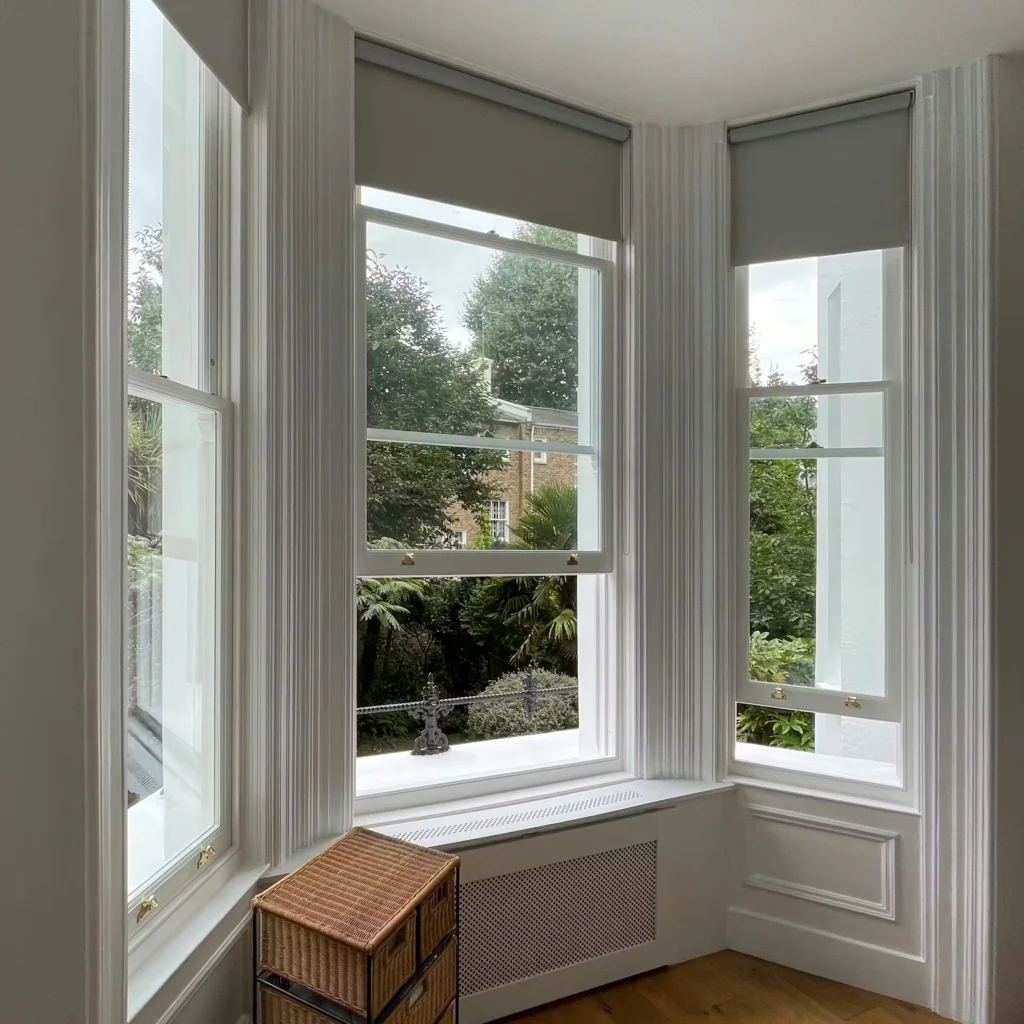
One blind per pane is the usual answer for a bay because each pane faces a different direction, so the sun reaches them at different times, and separate blinds let you drop the one that is glaring while the others stay up. It also keeps the sill, the radiator shelf or the window seat in use, follows the shape of the bay from inside and out, and means a fault on one blind never takes out the whole window.
The alternative, one straight blind fixed across the front of the bay opening, turns the bay into a flat wall. You lose the sill, the room feels smaller, and the blind has to be very wide and heavy. We only suggest it where the bay is shallow and the customer wants curtains in front anyway. For everything else the question is which type of blind goes in each pane, and the rest of this guide takes them in turn.
Vertical blinds on a curved track
Vertical blinds on a curved track cover a whole bay with one blind, one control and no gaps at the corners, because the aluminium headrail is bent to the angles of the bay and the louvres simply follow it round. They are the cheapest way to cover a bay completely, they tilt for privacy while letting light in, and the louvres draw back to one or both ends to clear the glass.
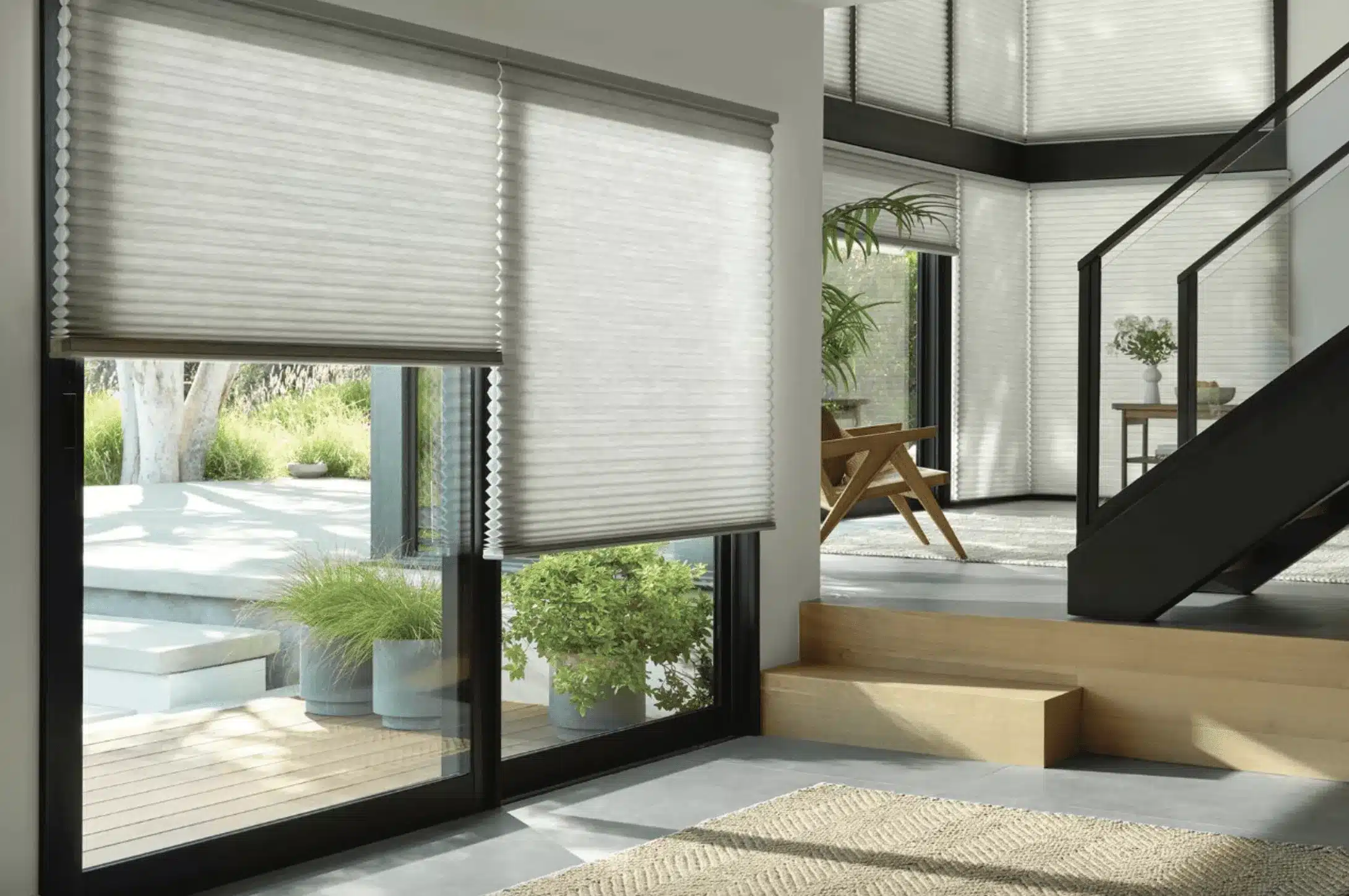
The track is bent in our workshop to the angles we measured, which is why we measure the bay ourselves. A three pane bay takes two bends, a five pane bay takes four. Wand control with no cords meets current child safety rules and suits a family living room. Fabrics run from plain to blackout and include wipe clean and rigid PVC louvres. Our vertical blinds page shows the ranges, and the curved track option is priced as part of the blind rather than as a separate extra.
When verticals are not the right pick
Vertical blinds are practical rather than pretty, and in a period living room with a feature bay many people want something softer. The louvres also swing a little in a draught from an open window. If the bay is in a bedroom and real darkness matters, blackout louvres still let light through at the overlaps, and a roller or Perfect Fit blind per pane does better.
Perfect Fit blinds for bay windows
Perfect Fit blinds suit a uPVC bay because each pane gets its own slim framed blind that clips to the glazing bead with no screws, so there are no brackets to clash at the corners, no drilling into the frame and no light gap at the edges. The blind inside the frame can be a roller, a pleated or a cellular fabric, and the frame colour matches the window.
Because the blind sits on the glass rather than in the recess, the sill stays completely clear, which is the tidiest result in a bay. Opening panes carry their blind with them. The limitation is that the bay must have a bead deep enough for the clips, which almost every uPVC bay has and almost no timber bay does. Perfect Fit blinds are what we fit most in bays on the post war estates around Elm Park, Harold Hill and Dagenham, where every window was replaced in uPVC at the same time.
Roller blinds in a bay
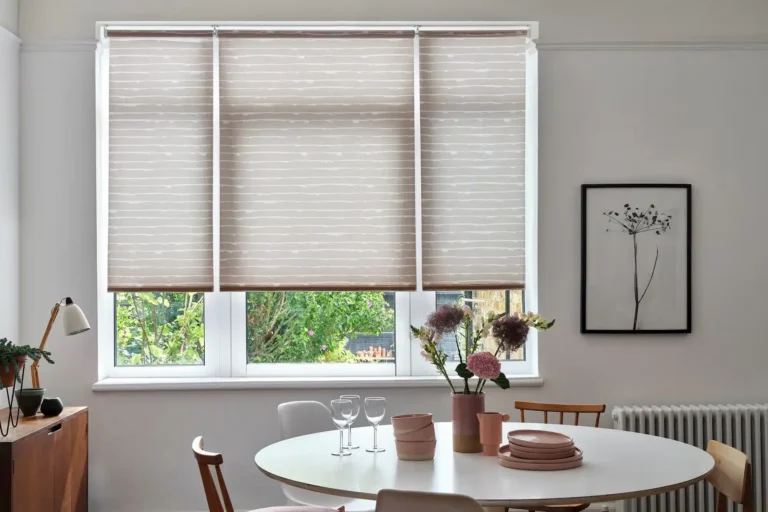
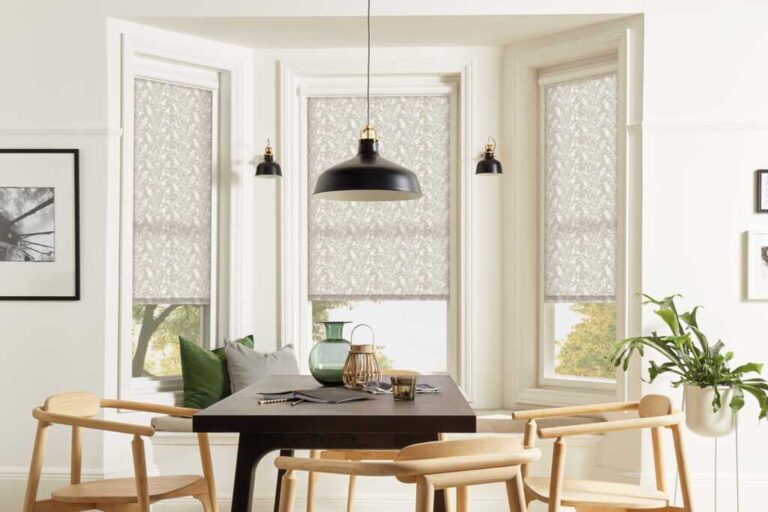
Roller blinds in a bay are fitted one per pane inside the recess, with slim brackets at the corners angled so the two tubes meet without touching, and they give the cleanest look of any bay blind when they are up. The trade off is a small light gap at each side of each blind, which matters in a bedroom and rarely matters in a living room.
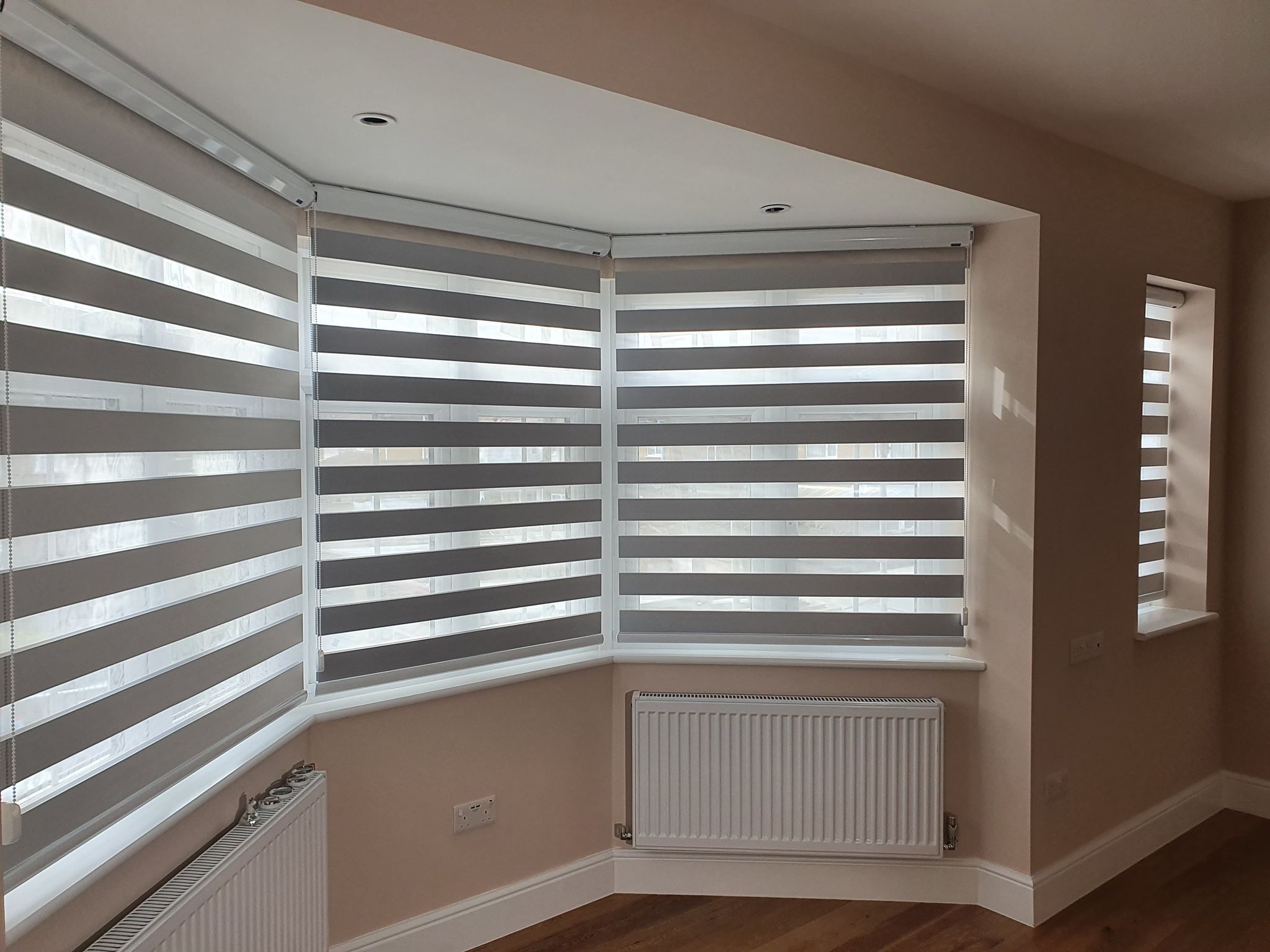
A cassette roller blind hides the roll in a headrail and runs the fabric in side channels, which closes most of the light gap and looks neater at the corners. Day and night fabrics, which are rollers with alternating sheer and opaque bands, are popular in front bays facing the street because they give privacy without losing the light. Double rollers put a sunscreen and a blackout on one bracket in each pane, which needs a deep recess. Our roller blinds page covers the fabrics and the chain, spring and electric options.
Roman blinds and curtains in a bay
Roman blinds in a bay give the softest look, one per pane in a matching fabric, and they fold up into a neat stack at the top of each window so the sill is clear when they are raised. They carry more fabric and more making time than a roller, so they cost more per pane, and in a five pane bay that adds up. They are the choice where the bay is in a living room or a dining room and the fabric is part of the scheme.
Curtains across a bay run on a track or pole bent to the shape, and they are usually paired with a blind per pane for daytime privacy, since curtains are either open or closed. A bay track needs more brackets than a straight run and is priced accordingly. We make both, and Roman blinds and curtains in the same fabric across a bay and the window beside it is a common request.
Blinds vs shutters for a bay window
Shutters suit a bay that is the centrepiece of a period room and will not be changed for many years, while blinds suit everyone who wants more fabric choice, a lower price, blackout in a bedroom or the option to change the look later. We make and fit blinds rather than shutters, so the comparison below is as even handed as we can make it.
| Point | Blinds, one per pane | Shutters |
|---|---|---|
| Light control | Full range from sheer to blackout, per pane | Louvres tilt, full blackout needs solid panels |
| Privacy with light | Day and night or vertical blinds do this well | Tilted louvres do this well |
| Look | Fabric led, easy to change in a few years | Architectural, permanent |
| Fitting into a bay | Each pane independent, follows the angles | Frames built to the bay, panels per pane |
| Cost | From £75 for a whole bay in verticals | Several times the cost of blinds for the same bay |
| Lead time | A few weeks | Often longer, usually imported |
| Cleaning | Fabric care varies by type | Wipe down the louvres |
| Changing later | Simple, fixings are small | Frames are a permanent fixture |
If the house is a long term home and the budget is there, shutters are a fair choice. If the bay is in a rental, a first home or a bedroom that needs darkness, blinds do the job for far less, and they can be swapped when tastes change.
How much do bay window blinds cost
Bay window blinds are priced per pane for roller, Perfect Fit and Roman blinds, and as one blind for a vertical on a curved track, so a three pane bay in rollers is three blinds and a five pane bay is five. Vertical blinds start at £75 and most fall between £75 to £420 per blind, with a bay at the upper end for the bent track. Per pane, roller blinds start at £65, Perfect Fit blinds at £60, day and night blinds at £175 and Roman blinds at £115.
| Bay option | How it is counted | From |
|---|---|---|
| Vertical blind on a curved track | One blind for the whole bay | £75 |
| Roller blinds | One per pane | £65 per pane |
| Day and night blinds | One per pane | £175 per pane |
| Perfect Fit blinds | One per pane | £60 per pane |
| Cassette roller blinds | One per pane | £90 per pane |
| Roman blinds | One per pane | £115 per pane |
| Electric blinds | One per pane, grouped on one remote | £250 per pane |
The written quote after the home visit lists each pane separately, so a five pane bay shows five lines and you can see exactly what each costs. Electric blinds in a bay are grouped on one remote or one app so the whole bay moves together.
Bay windows in Romford, Hornchurch and Ilford homes
The 1930s semis that fill Romford, Hornchurch, Gidea Park, Elm Park and Rainham have a three pane splayed bay at the front, often with a smaller bay above it, and most of them are now uPVC with a deep sill. That bay suits Perfect Fit blinds per pane or a vertical on a curved track, and in the front bedroom above it a blackout roller or Perfect Fit cellular blind per pane. Our pages on blinds in Romford and blinds in Hornchurch have the local detail.
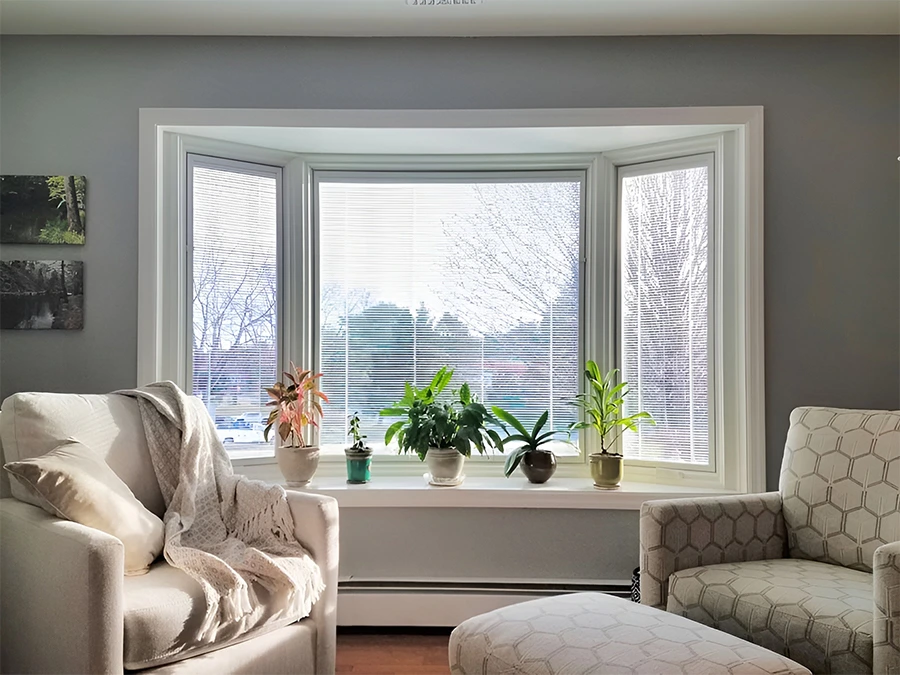
Ilford, Seven Kings, East Ham and Barking have earlier Victorian and Edwardian terraces with square or canted bays, taller and narrower, sometimes still in timber sash. Timber rules out Perfect Fit, so there it is rollers, Romans or a vertical on a bent track, fitted to the face of the frame or the ceiling of the bay.
Upminster and Harold Wood have larger detached houses with five pane bays, where a vertical on a curved track or five matching Roman blinds is the usual choice. In the newer flats around Stratford and Beam Park, bays are rare and the equivalent problem is a corner window, which we treat the same way, one blind per face meeting at the angle.
Every blind we make is fitted to current UK child safety rules. The Make it Safe campaign from the British Blind and Shutter Association explains what to check on blinds you already own.[1]
Frequently asked questions
How many blinds for a 3 pane bay?
Three, one per pane, for roller, Perfect Fit, day and night or Roman blinds. A vertical blind on a curved track counts as one blind that covers all three panes.
Can you fit a curved track?
Yes. We bend the vertical blind headrail or the curtain track to the angles we measure at your home, so it follows the bay with no gaps at the corners.
Can you put one blind across a bay window?
You can fix one straight blind across the front of the bay opening, but it loses the sill and the shape of the bay. We only suggest it for a very shallow bay with curtains in front.
What is the cheapest blind for a bay window?
A vertical blind on a curved track, from £75, because one blind covers the whole bay. Roller blinds per pane are the next most economical.
Are shutters better than blinds for a bay?
Shutters suit a long term period home where the bay is the feature. Blinds cost far less, offer more fabric choice and real blackout, and can be changed later, which suits most homes and every rental.
Do Perfect Fit blinds work in a bay window?
Yes, on a uPVC bay with a suitable glazing bead. Each pane gets its own framed blind with no drilling and no brackets to clash at the corners.
Get a free home visit in Rainham and East London
If you are still deciding on blinds for bay windows, if you have a bay window and want to see the options in it rather than on a screen, book a free home visit or call 01708 505379. We measure every pane at your home across Romford, Hornchurch, Ilford, Rainham, Dagenham and the rest of East London and Essex, make the blinds in our Rainham workshop and send a written quote after the visit.
References
- ^ Make it Safe from the BBSA. Make it Safe (British Blind and Shutter Association). Retrieved 25 October 2026.