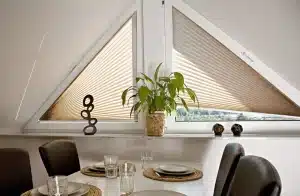
As one of the largest visual elements in any room, second only to the floors and walls, the window treatment you choose shapes how your home looks and feels every day.
In East London and Essex, that choice is rarely simple. Victorian terraces in Ilford and Barking have tall sash windows that need treatments with presence. The bay windows on 1930s semis across Romford and Hornchurch demand careful thought about scale. New builds in Rainham bring compact frames where every centimetre of glass matters.
Beyond style, the right blind or curtain solves real problems. North-facing rooms that never get direct light, street-facing windows that sacrifice privacy for daylight, older properties leaking heat through single glazing, converted flats where small windows already limit what a room can feel like.
The right choice addresses all of it.
How Blinds and Curtains Work Differently
The most important difference between blinds and curtains is where each one sits on the window.
Blinds are fitted directly to the window, either inside the recess or just above the frame. They stay close to the glass when raised or adjusted and do not extend into the room. Roller blinds roll into a compact tube. Venetian and pleated blinds stack up neatly at the top. Either way, the window space is kept clean.
Curtains hang from a pole or track positioned above the window and pull open to either side. When open, they take up wall space beside the window. When closed, they drape across the full opening. They are part of the room in a way that blinds are not.
This difference in how each treatment occupies the window drives nearly every practical consideration that follows.

Style and Aesthetic Impact
Blinds and curtains communicate different things visually, and neither is the wrong choice if it fits the room.
Roller blinds and venetian blinds have clean, flat faces that sit neatly within the window. They suit contemporary and minimalist interiors where the window covering is meant to blend into the room rather than define it. The structured lines of a blind complement modern kitchens, home offices, and open-plan spaces particularly well.
Curtains bring fabric, weight, and movement into a room. Floor-length panels hung close to the ceiling draw the eye upward and make the space feel taller. This works especially well in rooms with good ceiling height, such as the Victorian and Edwardian properties that are common across East London and Essex. Curtains add warmth and softness that blinds alone cannot replicate.
Roman blinds sit between the two. They offer the fabric texture and fold of a curtain within a blind format, making them a strong choice for rooms that need warmth without the full presence of floor-length panels.
Light Control and Privacy
Both options offer blackout, light-filtering, and sheer fabrics, so on the surface they appear equal for light control. The practical difference appears in how each one seals the window.
Curtains on a standard pole leave gaps. Light enters through the space at the top where the fabric does not reach the ceiling, through the gap between the two panels, and along the edges where the curtain does not touch the wall. These gaps are present even when curtains appear to be closed. It is one of the most common reasons people are dissatisfied with curtains in bedrooms and street-facing rooms after installation.
Blinds fitted inside the window recess cover the full opening. There is no gap at the top or sides because the blind sits within the frame. For rooms where precise light control and complete coverage matter, a well-fitted blind is more reliable.
Curtains can achieve a similar result when hung on a track with wall returns on both sides. That configuration closes the edge gaps but adds to the cost of the installation.

Warmth and Insulation
Curtains with thermal lining or interlining add meaningful insulation to a room by trapping air between the fabric and the glass. Thicker curtains with a heavy interlining perform noticeably better in this respect than a standard roller or venetian blind.
Blinds are not without insulation value. Cellular and pleated blinds trap air in their fabric cells and provide genuine thermal performance. Roller and venetian blinds with blackout or thermal lining also reduce heat loss compared to a bare window.
On modern double-glazed windows, which are now standard across most UK housing, the gap between curtains and blinds for insulation is smaller than it used to be. On older single-glazed windows, thick curtains with interlining make a more noticeable difference.
If keeping heat in is your main reason for choosing, the specific fabric and lining matter more than the blind or curtain type.
Maintenance and Cleaning
Blinds are straightforward to maintain. Dust settles on the surface and can be removed with a soft cloth or light dusting tool. Most roller and venetian blind fabrics can be wiped down in place with a damp cloth. Moisture-resistant fabrics handle kitchen and bathroom environments without issue.
Curtains require more considered maintenance. Most made-to-measure curtains cannot be machine washed. Dry cleaning is the standard process, which means removing them from the window, transporting them, having them cleaned, and rehanging. In households with pets, young children, or rooms that gather dust quickly, this becomes a recurring commitment. The labour involved is worth factoring in alongside the upfront cost.
For anyone who wants low-maintenance window coverings, particularly in high-use rooms, blinds are the more practical choice.
Which Rooms Suit Which?
Living Rooms
Curtains suit living rooms, particularly in older properties where the ceilings are higher and the room can carry the weight of full-length fabric. Hanging curtains close to the ceiling and letting them fall to the floor draws the eye upward and makes the space feel taller. In the Victorian and Edwardian houses common across East London and the RM postcodes, this works well because the proportions are there to support it.
Roman blinds are a practical middle option for living rooms where you want texture and warmth from fabric without floor-length panels.
Roller blinds suit living rooms with a contemporary, minimal style where a clean window is the goal.
Bedrooms
Both work in bedrooms. The deciding factor is usually how thoroughly you need to block light and how much maintenance you want.
A blackout roller blind fitted inside the recess is the most reliable option for a completely dark room. It covers the full opening with no gaps at the top or sides.
Blackout curtains work well and add warmth. If you are hanging them on a standard pole, expect some light at the edges unless the pole is deliberately oversized.
Kitchens and Bathrooms
Roller blinds are the right choice here. They can be made from moisture-resistant fabric that handles steam, humidity, and grease without absorbing it. Maintenance is simple.
Curtains absorb cooking smells, trap moisture, and require washing or dry cleaning at intervals. They are not a practical choice near a hob, sink, or shower window.

Can You Use Both Together?
Yes, and in some rooms it is genuinely worth it. A blind inside the recess combined with curtains on a pole either side gives two layers of control. The blind handles daytime light and privacy. The curtains add warmth, texture, and full coverage in the evening.
This works best in living rooms and bedrooms where the window is a feature of the room and you want flexibility. It adds cost and it adds something to maintain.
In smaller rooms, or anywhere you want simplicity, one good blind or one pair of well-hung curtains is enough. The “use both” answer is a genuine option in specific situations. It is not a way to avoid making a decision.
Cost
Blinds are generally the more affordable starting point. Roller blinds and venetian blinds in standard sizes are accessible at most budgets. Made-to-measure blinds cost more but still tend to come in below made-to-measure curtains for the same window.
Curtains with quality lining and fabric cost more upfront. They also carry ongoing cleaning costs that blinds do not. If you are working to a budget or covering several windows, blinds give you more for the same spend.
Frequently Asked Questions
Are blinds or curtains better for blocking light in a bedroom?
A blackout blind fitted inside the window recess gives the most complete result because it covers the entire opening with no gaps at the top or sides. Blackout curtains work well but may allow some light through at the edges depending on how they are hung. If total darkness is the goal, a blind inside the recess is the more reliable solution.
Do curtains keep a room warmer than blinds?
Curtains with thermal or interlining do add insulation, particularly on older single-glazed windows. Blinds with blackout or thermal fabric also retain warmth but generally not to the same level as thick interlined curtains. On modern double-glazed windows, the difference between the two is smaller.
Can curtains be used in a kitchen?
Not close to steam or a hob. Fabric curtains absorb cooking smells, trap moisture in the weave, and are difficult to clean thoroughly in that environment. Roller blinds made from wipeable fabric are more practical for kitchen windows. Curtains can work in a dining area that sits away from the cooking zone.
Why do curtains still let light in when they are closed?
Curtains on a standard pole leave a gap at the top, between the panels, and at the sides where the fabric does not reach the wall. To close those gaps, curtains need to be hung on a track with returns at each end, or combined with a blind fitted inside the recess. A blind inside the recess covers the full window opening without those gaps.
Making the Decision
Blinds are the practical first choice for most rooms. They are easier to maintain, better suited to wet or humid environments, and give more precise control over light. Curtains are the better choice when the room needs warmth, fabric weight, and a finish that goes beyond function.
If you are not sure which will work for your specific window, seeing both options in the room makes the decision much easier. HomeDecisions offers free home visits across Rainham, Essex, and East London. We bring fabric samples, assess your windows, and give you a clear recommendation for each room before anything is measured or ordered
Book a free home visit and get the right answer for your home.