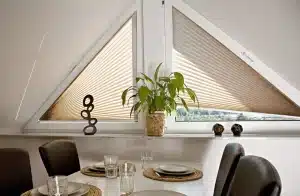
Pick up a fabric sample for a Roman blind and a roller blind. They can be the same fabric, the same colour, the same blackout lining. In a catalogue photo with both blinds down, you would struggle to tell them apart.
The difference shows when you raise them, when you try to wipe one down after cooking, and when you notice how much of a small window disappears behind a stack of folds every morning.
Most buying guides compare aesthetics. Roman blinds for traditional rooms. Roller blinds for modern ones. Style sorted, decision made. But the customers who end up unhappy with their choice almost never chose the wrong look. They chose the wrong blind for how the room actually works.
At HomeDecisions, we fit both types across homes in Essex and East London. The questions we get most often are not about style. They are about suitability. This guide answers them.
What is a Roman Blind?
A Roman blind is a flat fabric panel that folds into neat horizontal pleats when raised. When fully lowered, it sits flat across the window. When raised, the fabric stacks in soft folds that stay visible, which is part of the look.
Roman blinds are always made to measure. Because the fold pattern has to land evenly at the bottom when the blind is raised, precise measurements are essential. They are mounted inside the window recess or on a board above it, and are operated by a cord or chain on one side.
The fabric does most of the work. Roman blinds come in a wide range of fabrics, linen, cotton, woven textures, patterned weaves, and the fabric choice determines how much light they let through, how well they insulate, and how they look in the room.

What is a Roller Blind?
A roller blind is a single sheet of fabric that wraps around a tube at the top of the window when raised, and rolls down to cover the window when lowered. It sits flat against the glass when down and retracts into a neat cylinder when up.
Roller blinds can be made to any size and in a very wide range of fabrics, blackout, light-filtering, thermal, moisture-resistant, and sunscreen materials are all available. The mechanism is simple: a spring or chain operates the tube. Because of this, roller blinds are among the most reliable and lowest-maintenance window coverings available.
They are also easy to motorise. Electric roller blinds are one of the most popular upgrades for homes with hard-to-reach windows, roof lanterns, or multiple windows that need to work together.
The Main Differences Between Roman Blinds and Roller Blinds
These two products are often grouped together because they both hang flat on the window. In practice, they behave quite differently.
How They Look When Raised
A roller blind disappears into a neat roll at the top of the window, giving you a clean, minimal look with no fabric visible. A Roman blind folds into soft horizontal pleats that remain visible above the window, it is part of the room’s aesthetic even when raised.
Fabric
Roller blinds use coated or stiffened fabric that holds its shape and rolls cleanly. Roman blinds use softer, untreated fabrics, the same kind you would use for curtains. This means Roman blinds have a far wider fabric range and can be made to match or complement soft furnishings much more closely.
Cleaning
A roller blind is wiped down. A Roman blind is dry-cleaned or spot-cleaned depending on the fabric. For rooms where the blind are likely to get dirty, kitchens, children’s rooms, this is a practical distinction.
Cost
Roman blinds generally cost more than roller blinds at comparable window sizes. The fabric tends to be more expensive, and the manufacturing is more complex. For a standard window, a made-to-measure Roman blind typically costs more than a made-to-measure roller blind in an equivalent fabric.
Light Control
Both can be made in blackout fabric. However, Roman blinds are harder to fully blackout because the folds at the edges can let in light if the fabric does not stack tightly. Roller blinds in a proper cassette housing with side channels give a much cleaner blackout result.

Roman Blinds vs Roller Blinds: Room by Room
The best way to choose is to think about the specific room, how it’s used, and what you need from the window covering.
Living Room
The living room is where Roman blinds tend to perform best. They add fabric texture and softness to a room that often already has upholstered furniture, rugs, and soft furnishings. A well-chosen Roman blind fabric can tie a living room together in a way a roller blind generally cannot.
That said, a roller blind is a perfectly good choice for a living room if you prefer a cleaner, more minimal look. White or off-white light-filtering roller blinds are common in newer homes and open-plan spaces where the aesthetic is deliberately understated.
If privacy is the priority on a busy road, and this is a common situation in East London and Essex homes, a day and night blind gives you the best of both: adjustable privacy at any light level, without sacrificing the daylight.
Bedroom
For bedrooms, the most important factor is usually light control. You want a blind that works in the dark.
Roller blinds in blackout fabric, fitted in a proper cassette with side channels, give the most complete blackout available in a blind. There are no fold lines, no gaps at the edges, and no light bleed at the sides when fitted correctly to your window.
Roman blinds can be made in blackout fabric, but the folds mean light can get through at the edges when the blind is raised. For bedrooms facing east or west, and many homes in Rainham, Romford, and the surrounding RM postcodes have bedrooms that catch early or late sun, this difference is worth taking seriously.
If you want the soft fabric look in a bedroom, a Roman blind in blackout lining is still a good option provided the blind is measured to sit close against the reveal. Our team can advise on this when we visit.
Kitchen
Kitchens need blinds that are practical first. Steam, grease, and condensation affect window coverings over time. Roller blinds in moisture-resistant or wipe-clean fabric are the most sensible choice for a kitchen window above the sink or near the hob.
Roman blinds can work well in a kitchen particularly in a kitchen-diner where you want the aesthetic to carry through from the dining area but they should be in a fabric that can be spot-cleaned, and you should not fit them directly above cooking areas where steam will hit them repeatedly.

Bathroom
Bathrooms have the same practical requirements as kitchens. Moisture, steam, and condensation are the enemy of anything that cannot be wiped down.
Roller blinds in waterproof or moisture-resistant fabric are the right choice for most bathrooms. If you have a perfect fit blind on a uPVC window common in Rainham and across the RM postcodes,a perfect fit roller blind in a moisture-resistant fabric is a very clean, low-maintenance solution. No drilling, no fixings on the frame, and easy to keep clean.
Roman blinds are not recommended for bathrooms unless the room has very good ventilation and the blind will not be exposed to steam regularly.
Children’s Room
Children’s rooms need blackout and durability. Roller blinds win on both counts. They are easier to clean, harder to damage, and the mechanism is simpler and more reliable. A blackout roller blind in a cassette fitting is our standard recommendation for a child’s bedroom.
For safety, choose cordless or motorised operation. All our installations comply with UK child safety regulations (BS EN 13120). We can talk through the right options when we visit.
Home Office
A home office is often about controlling glare on a screen. Roller blinds in a sunscreen or light-filtering fabric are ideal, they reduce glare without making the room feel dark, and they look clean and unobtrusive during working hours.
Roman blinds can work in a home office, but the fabric tends to absorb and diffuse light rather than filter it in the controlled way a sunscreen roller blind does.
Which Blind Works Better in Different Property Types?
Property type shapes the choice almost as much as room type. We fit blinds across a wide range of homes, 1930s semis in Rainham, post-war terraces in Harold Hill, Edwardian houses in Hornchurch, new-build flats in Beam Park and Stratford, and the same rule does not apply everywhere.
1930s semi-detached homes. These properties typically have bay-front windows in the living room and sash windows in the bedrooms. Roman blinds suit the bay window well, a single Roman blind across each section of the bay softens the room without blocking the proportions. Roller blinds work equally well and are simpler to fit across a bay.
Post-war terraces and ex-council stock. Homes in Harold Hill, Dagenham, and similar estates often have consistent window sizes and uPVC replacement frames. Perfect fit roller blinds are particularly popular here, they clip in without drilling and can be changed without leaving any marks on the frame. Roman blinds are less common in these homes, though they work well when someone has renovated a room and wants to add a softer finish.
New-build flats. Modern flats, particularly in Beam Park, Stratford, and Canary Wharf, often have large windows, floor-to-ceiling glazing, or wide kitchen-diner openings. Roller blinds, including motorised systems, are the most practical answer for large or awkward glazing. Roman blinds can work well in a bedroom or study in a new-build flat, where the proportions are more standard.
Edwardian and Victorian terraces. Older homes with high ceilings and tall narrow windows are where Roman blinds often look their best. The proportions suit a fabric that has visual weight and texture. Roller blinds work too, but in a tall narrow window they can look understated to the point of disappearing.
Roman Blinds vs Roller Blinds: Cost Comparison
Both are made-to-measure products, so cost depends on window size, fabric, and the number of blinds being fitted.
As a general guide for supply and fit in the Rainham and East London area:
- Roller blinds: £55–£135 per blind, depending on fabric type (blackout, day and night, thermal) and window size
- Roman blinds: £115–£220 per blind, depending on fabric and window size
Roman blinds cost more because the fabric tends to be more expensive and more of it is used. A Roman blind uses more fabric than a roller blind for the same window, the pleating requires fabric depth.
If you are fitting multiple windows in one property, roller blinds are usually the more cost-effective choice without compromising on quality or appearance. For one or two key rooms where the look matters, a living room or a principal bedroom, Roman blinds are a reasonable investment.
All prices are confirmed at the time of your free home visit. We measure your windows, show you fabric options, and give you a fixed price on the day with no obligation to proceed.
Maintenance and Cleaning: Which Is Easier to Look After?
Maintenance is worth thinking about before you commit, not after.
Roller blinds are among the easiest window coverings to maintain. Most can be wiped down with a damp cloth. Fabric that gets heavily soiled can be removed from the tube and hand-washed or professionally cleaned. The mechanism, a spring or chain, rarely fails and is straightforward to replace if it does.
Roman blinds require more care. The fabric is softer and more absorbent, which means it picks up dust more readily. Dry-cleaning is recommended for most Roman blind fabrics. Attempting to machine-wash a Roman blind will damage the internal rod structure that creates the fold pattern.
In rooms with young children, pets, or high cooking activity, this difference matters. We often suggest a roller blind for practical rooms and a Roman blind for rooms where the blind is less likely to get dirty, a formal living room or a principal bedroom.
Can You Use Roman Blinds and Roller Blinds Together?
Yes, and it works well in certain situations.
A common approach in living rooms is to fit a sheer or light-filtering roller blind as a daytime layer for privacy and glare control, and a curtain or Roman blind as the evening covering for warmth and softness. This gives you flexibility across different times of day and different light conditions without one product having to do everything.
In bedrooms, some homeowners fit a blackout roller blind for sleep and a Roman blind or curtain in front for daytime aesthetics. This is more common in master bedrooms where both partners have different preferences for light levels.
If you are thinking about layering window coverings, let us know when we visit, we can advise on what works practically and what the options look like in your room.
What We Tell Customers
We fit both roller and Roman blinds across Rainham, East London, and the RM and Essex postcodes. After years of installations, our advice is usually quite simple.
If you are unsure where to start, choose a roller blind. They offer excellent versatility, a wide fabric range, and a reliable, low-maintenance design. Changing the fabric later is also straightforward and cost-effective.
Roman blinds are worth the extra investment in rooms where style and softness matter most. Living rooms with warm colours and textured furnishings often benefit from the added depth and elegance they provide.
The fabric choice is often more important than the blind type itself. A quality fabric can elevate any blind, which is why we always recommend viewing samples in your home before making a decision.
For unusual windows such as bays, roof lights, or tilt-and-turn frames, roller blinds and Perfect Fit systems are usually the most practical and flexible solution.
Frequently Asked Questions
Are Roman blinds more expensive than roller blinds?
Yes, generally. Roman blinds use more fabric and more complex manufacturing. For a comparable window in a comparable quality fabric, a Roman blind will cost more. The price gap is typically £60–£100 per window for supply and fit.
Do Roman blinds block out light as well as roller blinds?
Not as effectively, even in blackout fabric. Roman blinds have fold lines and fabric edges that can let in light at the sides when raised. Roller blinds in a properly fitted cassette with side channels give a more complete blackout result.
Which blind is better for a rented property?
Roller blinds are the standard choice for rental properties. They are durable, easy to clean, and straightforward to replace. Our perfect fit roller blinds are particularly useful for landlords, they clip into uPVC frames without drilling, so there is no damage to the frame when a tenant moves out.
Can I have a Roman blind in the bathroom?
It is not ideal. Bathrooms create steam and condensation, and most Roman blind fabrics are not designed for repeated moisture exposure. A roller blind in a moisture-resistant fabric is the better choice for bathrooms.
Which blind is easier to clean?
Roller blinds. Most roller blind fabrics can be wiped down with a damp cloth. Roman blinds typically need dry-cleaning, which makes routine maintenance more involved.
Do you offer both Roman blinds and roller blinds?
Yes. We supply and fit both, made to your exact window measurements. We bring fabric samples to your home so you can see the options in your actual room before making a decision.
Which Should You Choose?
The decision usually comes down to three things.
If the room needs to feel warm, decorated, and considered, and the window is a standard size or larger, Roman blinds are the stronger choice. They suit living rooms, bedrooms, and dining rooms particularly well.
If the room needs to be practical, easy to maintain, or the window is small, a roller blind is the better option. Kitchens, bathrooms, home offices, and children’s bedrooms all tend to favour the roller.
If you are still not sure, looking at both in the context of your actual window makes the decision much easier. At HomeDecisions, we offer free home visits across Rainham, Essex, and East London. We look at your windows, discuss what you need from each room, and give you a clear recommendation before you spend anything.
Book a free home visit and get the right blind for every room.