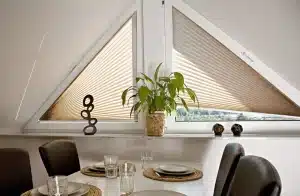
The loft conversion is finished. The new bedroom at the top of the 1930s semi has a big apex window in the gable wall, and on the first bright evening it looks brilliant. Then summer arrives, and the sun comes up before five. That triangle of glass is now the reason nobody wants to sleep up there.
This is the moment most people start searching for pleated blinds for odd shaped windows. The answers online tend to say “yes, we can shape a blind to any window” and stop there. That is true, and not very useful. What you actually need to know is which parts of the blind will move, why some shaped blinds sag within a year, what these things cost, and whether you should have thought about it before the windows were ordered.
We fit made to measure blinds across Rainham and East London, so here is the honest version.
Why do pleated blinds suit odd shaped windows?
Pleated blinds suit odd shaped windows because folded fabric can be cut and pleated to follow almost any straight angle, then held in shape by fine cords running through each pleat. The blind stacks into a slim bundle a few centimetres deep, and the headrail can be angled to match a slope, which rollers and Venetians struggle to do.
Most blinds are built around a rectangle. A roller blind needs a straight tube at the top and a straight bar at the bottom. A Venetian needs slats of equal length, or at least slats that can be tilted and lifted as one. Neither copes well with a sloping edge.
A pleated blind works differently. The fabric is a continuous concertina, so the manufacturer can cut it to a triangle or a trapezium and still keep every fold even. The cords that raise and lower it, or hold it taut, can be threaded along the angle instead of straight down.
Two other things help. Pleated fabric is light, so it can be fitted close to the glass on a steep slope without pulling itself out of shape. And when the blind is open, the stack is so thin that the window still looks like a window, which matters when the shape is the whole point of the design.
Home Decisions already fits pleated blinds on standard windows and roof glazing. Shaped versions use the same fabrics with a different frame and cord arrangement.
Which odd shaped windows can take a pleated blind?
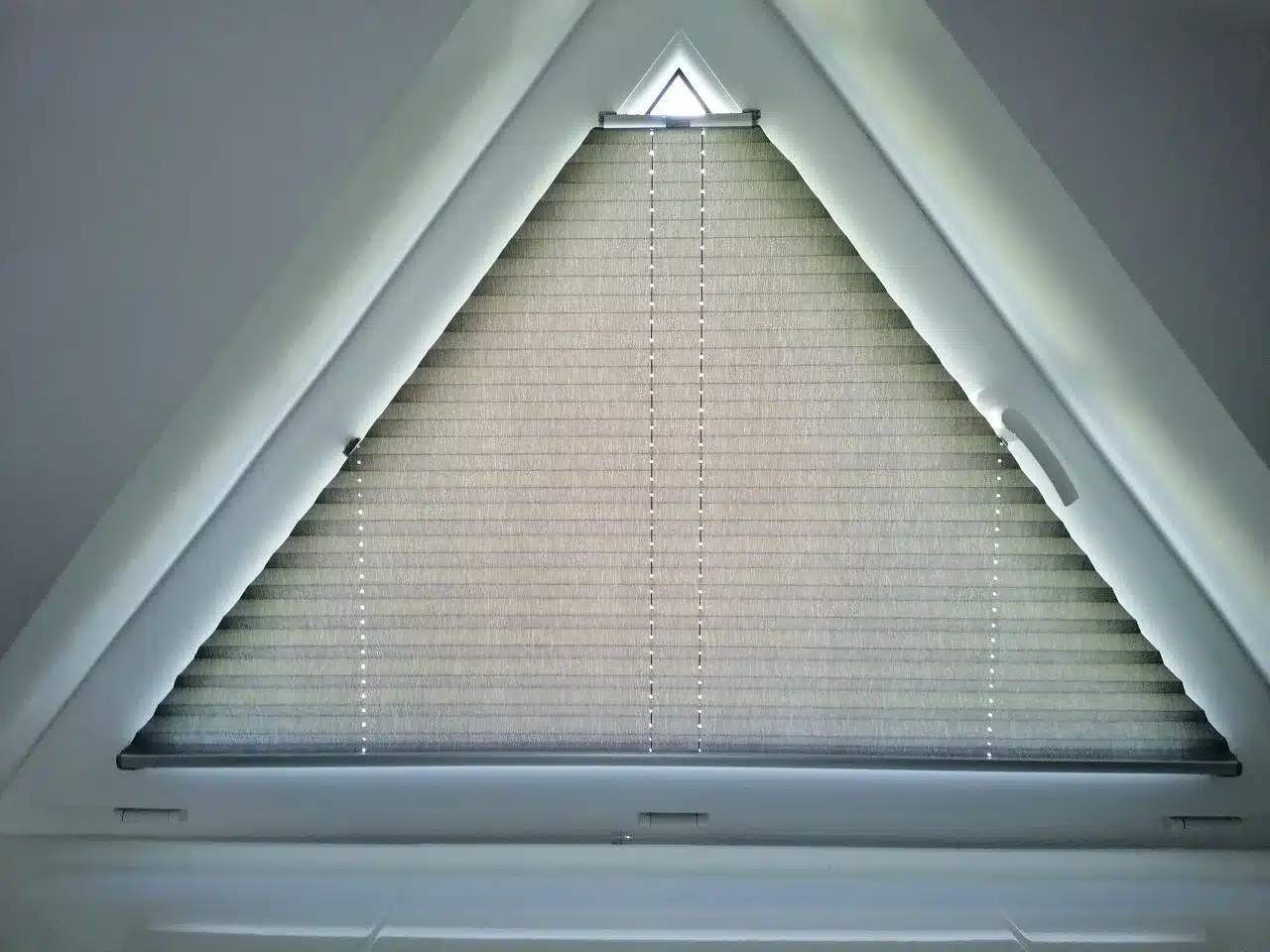
Pleated blinds can be made for right-angled triangles, apex (isosceles) triangles, trapeziums with one or two sloping edges, raked-head windows, many arches and some circles. The shape decides how the blind works: straight-sided shapes can often open partly or fully, while arches and circles are usually fixed or fan open.
| Window shape | Where it turns up in East London homes | Typical pleated set-up | What usually moves |
| Right-angled triangle | Beside a sloping ceiling in a loft, above one side of a door | Shaped pleated, top-down or on tension cords | Some systems open top-down; others stay fixed |
| Apex triangle | Gable wall of a hip-to-gable loft, vaulted rear extension | Shaped pleated or honeycomb, often motorised | Retracts along the slopes on specialist systems; otherwise fixed |
| Trapezium (one sloping side) | Conservatory side panes, glazing under a mono-pitch roof | Shaped pleated, bottom-up | Bottom rail travels up to where the slope begins |
| Trapezium (two sloping sides) | Full-height gable glazing below an apex | Shaped pleated or honeycomb | Straight section opens; angled head stays covered |
| Raked head | Top-floor flats, stair windows under a pitched roof | Shaped pleated with angled headrail | Opens up to the lowest point of the rake |
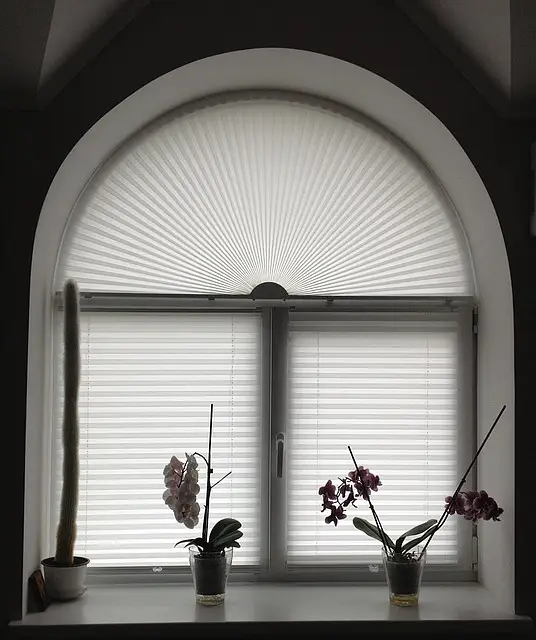
| Arch or fanlight | Victorian and Edwardian terraces, period front doors | Fan or sunburst pleated | Usually fixed or fans open; rectangle below gets its own blind |
| Circle or porthole | Bathrooms, landings, feature walls | Radial pleated panel | Usually fixed |
The final column is the one competitors tend to leave out. It is also the one that decides whether you will be happy with the result.
How much of a shaped pleated blind actually opens?
On most shaped pleated blinds, only the part of the window with parallel edges can open and close. The moving rail must stay parallel to the fixed rail, so on a trapezium it typically travels up to where the slope begins, and the angled section stays covered. Some triangle systems open top-down or retract along the slope instead.
Here is the simple way to picture it. A blind opens by moving one rail towards another. On a rectangle, the bottom rail slides up to the top rail and everything folds neatly between them. On a shape with a sloping top, the bottom rail is straight but the top is not. The rail can only travel as far as the straight part goes, because beyond that point it would have to change length, and rails do not stretch.
That gives three common outcomes:
Bottom-up to the slope. On a trapezium, the blind opens from the sill up to the start of the angle. The triangle of fabric above it stays in place. Many people like this, because the slope is often the part that lets in low sun.
Top-down or along the slope. On some right-angled triangles, the rail travels down from the slope, or specialist systems retract the whole blind up towards the angle. Wiser Interiors, a Sussex blind company, shows right-angled triangle pleated blinds working top-down in a bedroom for night-time darkness.
Fixed. On steep apexes, arches and circles, the blind is often made to stay closed. It works as a permanent shade or privacy panel, not an opening blind.
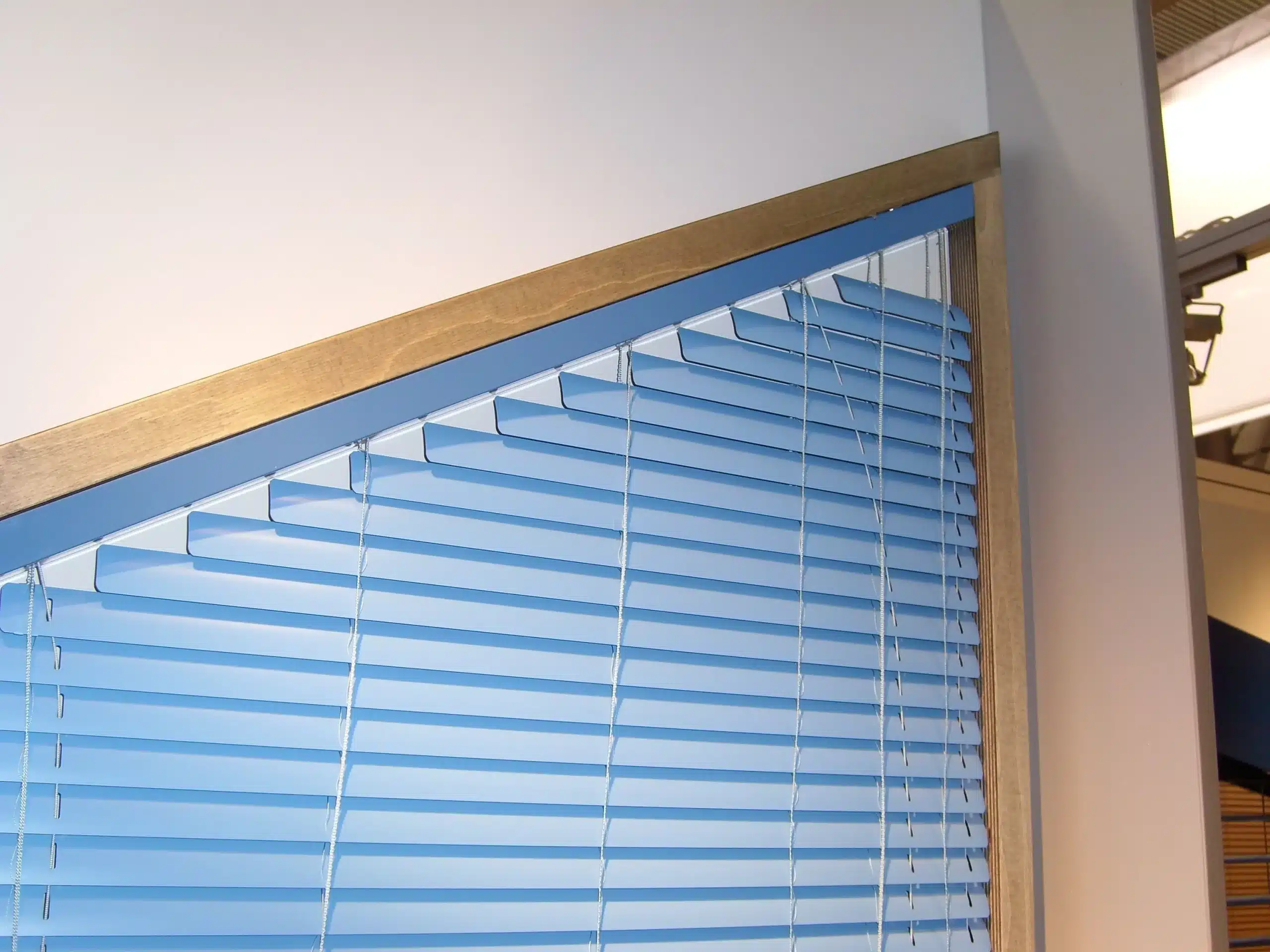
The same rule shows up in other products. Avanti Shaped, a UK shaped blind specialist, notes that true three-sided triangle Venetian blinds only tilt and never lift, and that trapezium blinds raise only to the point where the slope begins. Pleated is more flexible than a Venetian, but it cannot beat geometry.
What to ask at your survey: “Show me on the window where the rail will stop.” If the answer is vague, ask again.
Why do some shaped pleated blinds sag?
Shaped pleated blinds sag when the pleats are not tensioned. Each pleat carries the weight of every pleat below it, so over time the upper folds open wider than the lower ones. On a sloping edge that shows as a curving gap between the fabric and the frame. Good shaped systems stop it with tension cords or fixed pleat spacing.
This is the detail that separates a shaped blind that still looks crisp after several summers from one that starts to peel away from the slope.
On a rectangle, a little sagging barely matters. The pleats at the top look slightly more open than the ones at the bottom, and nobody notices. On a triangle it is a different story. Patent literature on pleated blinds describes the effect exactly: as the pleats creep, a progressively curving, tapering gap opens up between the edge of the blind and the window frame. The blind stops covering the glass it was made for.
Manufacturers deal with it in a few ways. Some run fine tension cords through the pleats so the fabric is held taut at its angle. Some fix the spacing between pleats with thread or small tags. Honeycomb fabric helps too, because its cell structure is stiffer than a single fold; Scottish Shutter Company goes as far as saying wide-cell honeycomb is mandatory for its shaped blinds on guide wires.
This is also why the craft-knife trick does not work. Cutting a standard rectangular pleated blind to an angle leaves cords with nowhere to go, a bottom rail that no longer fits, and pleats with nothing holding them at the slope. It might look acceptable on the day. It will not look acceptable in a year.
[REAL JOB] Optional: a short description, with photo, of a sagging shaped blind Home Decisions replaced, if one exists. Area only, no customer names.
Should you choose single pleat or honeycomb for an odd shaped window?
Single pleated fabric is lighter, slimmer and usually cheaper, and reflective backings suit sunny conservatory glass. Honeycomb (cellular) fabric traps air in its cells, so it insulates better, darkens rooms more effectively and holds a crisper line on steep slopes. For large gable and apex windows, honeycomb is often the stronger choice.
| Single pleat | Honeycomb (cellular) | |
| Construction | One layer of fabric folded into pleats | Two layers joined into air-filled cells |
| Stack when open | Very slim | Slightly deeper |
| Shape holding on slopes | Needs good tensioning | Stiffer, holds its line well |
| Insulation | Modest | Better; Duette, a honeycomb brand, claims up to 55% less heat loss through the glass |
| Darkness | Dim-out and blackout fabrics available | Blackout versions hide cord holes better |
| Typical use | Conservatory side panes, glare control, smaller shapes | Loft bedrooms, big gables, rooms that get cold |
| Relative cost | Lower | Higher |
For a loft bedroom with an apex window, darkness and warmth usually matter most, which points to honeycomb. For a conservatory with raked side panes, the job is usually glare and heat, where a reflective single pleat is often enough, and it keeps the budget down.
Wiser Interiors describes trapezium pleated blinds it fitted in single pleat fabric because the reflective backing mattered more than dim-out. That is a good example of choosing the fabric for the room, not the shape.
Where do odd shaped windows turn up in Rainham and East London homes?
In East London, odd shaped windows most often come from hip-to-gable loft conversions on 1920s to 1960s semis, vaulted rear extensions with triangles over the doors, arched fanlights on Victorian and Edwardian terraces, raked conservatory side panes and top-floor flats under pitched roofs. Each brings its own problem, from early sun to privacy on the stairs.
Loft conversions on 1930s semis
Across Hornchurch, Romford, Upminster, Ilford, Barking and Dagenham, the typical semi has a hipped roof. London loft builders describe the hip-to-gable conversion, usually with a rear dormer, as the standard way to turn that roof into a proper floor. The new gable wall is where apex or raked glazing tends to appear.
The problem is almost always the same: a bedroom with glass that faces the sunrise and sits too high to reach. That combination points towards honeycomb for darkness and a motor for daily use.
Rear extensions with vaulted ceilings
Knock-through kitchens with a pitched roof often end with triangles of glass above bifold or sliding doors. A standard blind covers the doors and leaves the triangles bare, so evening sun comes straight in over the top. A shaped pleated panel for each triangle, fixed or motorised, closes that gap. Specialist Blinds documents exactly this problem in a Central London home, where the previous roller blinds could not cover the triangular sections at all.
Victorian and Edwardian terraces
Parts of Ilford, East Ham and Forest Gate have terraces with arched window heads and semicircular fanlights over the front door. A fan-shaped pleated panel can shade an arch. Many fanlights, though, do not need a blind at all: they light the hallway, and a frosted film or nothing may serve you better. We would tell you that at the visit.
Conservatories
Lean-to and Victorian-style conservatories often have side frames that follow the roof pitch, which creates trapezium panes. These are among the most practical places for shaped pleated blinds, because the glass is at a reachable height and the main job is cutting glare. For roof glass, see our skylight pleated blinds.
Top-floor flats under a pitched roof
Some newer blocks and converted houses have top-floor flats with raked glazing where the ceiling follows the roof. The rake usually runs above a rectangular section, so a shaped headrail with an opening lower part works well.
[REAL JOB] Add one or two real Home Decisions shaped installs here: area (for example “a loft conversion in Hornchurch”), window shape, system chosen and why. Photos with descriptive alt text.
How do you measure an odd shaped window for a pleated blind?
To measure an odd shaped window, record every side length, the width at several heights, the angle of each slope and the recess and glazing bead depths, and note handles and trickle vents. For curves, trace a paper template against the glass. Always have the fitter re-measure on site, because small angle errors show as visible gaps.
Measuring a rectangle is forgiving. Measuring a shape is not, because a couple of degrees of error at the angle becomes a sliver of daylight along the whole slope. Use these steps to prepare for a quote, even though we will re-measure before anything is made.
Decide where the blind sits. Inside the recess, on the frame, or on the glazing beads. This changes every number that follows.
Measure each straight side. Measure along the glass or frame edge, in millimetres, and label each side on a sketch.
Measure the width at several heights. On a trapezium or triangle, take the width at the bottom, the middle and wherever the slope begins.
Record the height on both sides. Left and right heights tell a manufacturer where the slope starts and finishes.
Find the angle. A digital angle finder or a phone app laid on the frame is good enough for a first quote.
Check the depth. Measure recess depth and glazing bead depth. Some shaped systems need more room than a flat pleated blind.
Note the obstacles. Handles, restrictors, trickle vents and any wall between the window head and the ceiling.
Template curves. For arches and circles, tape paper to the glass and trace the edge. Numbers alone rarely describe a curve well enough.
Photograph it square on. One straight photo with a tape measure in shot helps us spot problems early.
Home Decisions measures for free across Rainham and East London, so you do not have to get this right yourself. The list is here so you can sense-check a quote and ask better questions.
How much do pleated blinds for odd shaped windows cost?
Pleated blinds for odd shaped windows have no set price, because each one is made as a one-off. Small, hand-operated shapes cost more than a rectangular blind of the same size, and large motorised gable blinds can run into thousands. One UK self-builder shared quotes of £5,500 to £7,800 for a 3.3 metre gable.
That forum figure shocks people, so it helps to know where the money goes.
Pattern making. Each shape has to be drawn, checked and cut individually. There is no standard size to pull off a shelf.
Hand assembly. Cords must be threaded along the angle and tensioned by hand. That is skilled, slow work.
Hardware. Angled headrails, fixed side profiles and tensioning parts are specialist components.
Motors. High gable windows usually need one, and a shaped motorised system is priced as a small engineering job.
Survey and fitting. Shaped glazing is often high, so access and time on site go up.
At the other end of the scale, some manufacturers publish entry prices for pleated blinds that can be shaped; Reynolds Blinds, for example, lists pleated from £56. A small conservatory trapezium with a manual control sits far closer to that end than to the gable end.
The honest way to control cost is to be clear about the job. A triangle that only needs to cut glare can be a fixed panel. A fixed panel is simpler than one that opens, and it does not need a motor.
We give a written quote after a free home visit, with the system, fabric and operation spelled out. Book a visit here.
Should a shaped pleated blind be motorised?
A shaped pleated blind should usually be motorised if the window sits above comfortable reach and you want to open or close it daily. Battery, solar-charged and mains motors are all available, with handset, wall switch or smart home control. For a reachable conservatory pane, or a blind that stays fixed, manual operation is fine.
Scottish Shutter Company is refreshingly frank about this: most triangular windows it is asked to dress sit too high to operate by hand every day. A telescopic pole works, but in practice people stop using it, and the blind stays in one position all year.
Power options:
Battery. Rechargeable packs, no wiring. Good for retrofits in finished loft rooms.
Solar top-up. A small panel keeps the battery charged. Wiser Interiors describes triangular pleated blinds running this way for years in a bedroom.
Mains. Best planned during a build, when an electrician can run a feed to the window head.
See our electric blinds page for the motor and control options we offer.
Planning a loft or extension? Talk about blinds before the windows are ordered
If you are planning a loft conversion or extension with shaped glazing, discuss blinds before the windows are ordered. A mullion splitting a large gable, enough recess depth and a clear space above the window head can make shaped blinds simpler, cheaper and better at blocking light. Once the glass is in, those choices are gone.
This is the most useful advice in this article, and almost nobody gets it in time. On the BuildHub forum, self-builders with finished gables said the same thing again and again: they wished they had thought about coverings at design stage.
Four things to raise with your architect or window supplier:
Add a mullion to big gables. A vertical bar in the middle splits one huge triangle into two smaller right-angled triangles. Each is easier to make, lighter to move and better at blocking light at the join.
Leave recess depth. Shaped systems need room. A deep reveal lets the blind sit inside the window rather than proud of the wall.
Think about the wall above. If there is a strip of wall between the window head and the ceiling, some neat systems will not fit. Know this before plastering.
Run a cable. If the window will be high, ask for a spur at the head. It costs little during a build and makes mains motors possible later.
A ten-minute conversation with a blind fitter at drawing stage can save a lot of money later. Send us your window drawings and we will tell you what each shape will allow.
When is a pleated blind not the right answer for an odd shaped window?
A pleated blind is not always the best answer for an odd shaped window. Sloping vertical blinds can suit very tall gable glazing, shutters suit period arches, frosted film suits fanlights that only need privacy, and some high triangles are better left bare. The right choice depends on what the window actually needs to do.
We would rather say this now than fit the wrong thing:
Very tall gables. Sloping vertical blinds run on a track that follows the slope, and the vanes rotate to manage light. On a tall, narrow apex they can be more practical than one large pleated panel.
Period arches. Shutters with a fixed arched top suit some Victorian and Edwardian rooms better than fabric.
Hallway fanlights. If the only goal is privacy, frosted or patterned film keeps the light and costs little.
High triangles that face no one. If the glass does not cause glare, heat or privacy problems, it may not need covering at all. Some owners on BuildHub decided exactly that.
Rectangular windows in awkward places. Tilt-and-turn and uPVC doors near a shaped window may be better with Perfect Fit pleated blinds, which clip into the glazing beads with no drilling.
Key takeaways
Pleated is the most adaptable blind for straight-sided odd shapes because the fabric can be cut and tensioned to an angle.
On most shapes only the part with parallel edges opens; the slope stays covered. Ask where the rail will stop.
Shaped pleated blinds must be tensioned, or the pleats sag and leave a curving gap along the slope.
Honeycomb suits big, high, cold or bedroom windows; single pleat suits reachable conservatory glare.
If your windows are not ordered yet, plan the blinds now: mullions, recess depth and a cable change everything.
Frequently asked questions
Can pleated blinds be made for odd shaped windows?
Yes. Pleated blinds are one of the few blind types that can be made to follow a triangle, trapezium, arch or raked frame, because the folded fabric can be cut and tensioned to an angle. How far the blind opens depends on the shape, so a survey should confirm which parts move and which stay fixed.
Can you open and close a shaped pleated blind?
Usually, but only within the shape’s limits. A moving rail has to stay parallel to the fixed one, so on a trapezium it normally travels up to where the slope begins, and the angled section stays covered. Some triangle systems open top-down or retract along the slope, while arches are often fixed or fan open.
How do you measure an odd shaped window for a pleated blind?
Measure every side, the width at several heights and the angle of each slope, then note recess depth, glazing bead depth and handle positions. For curves, a paper template traced against the glass is more reliable than numbers. Most fitters re-measure on site, because a small angle error shows as a visible gap.
How much do pleated blinds for odd shaped windows cost?
There is no fixed price, because every shaped blind is made as a one-off. Small, hand-operated shapes cost more than an equivalent rectangular pleated blind, while large motorised gable blinds run into thousands: one UK self-builder reported quotes of £5,500 to £7,800 for a 3.3 metre gable.
Is pleated or honeycomb better for a shaped window?
Single pleated fabric is lighter, slimmer and usually cheaper, and reflective backings suit sunny conservatory glass. Honeycomb (cellular) fabric traps air in its cells, so it insulates better and holds a crisper line on steep slopes, which is why many specialists use it for large motorised gable and apex blinds.
Can pleated blinds for shaped windows be motorised?
Yes. Shaped pleated and honeycomb blinds can run on battery, solar-charged or mains motors, controlled by handset, wall switch or a smart home system. Motorisation makes sense for apex and gable glazing that sits well above head height, where daily use by pole quickly becomes a chore people stop bothering with.
Can pleated blinds fit an arched window?
Yes, in most cases. Arched pleated blinds are often made as a fan or sunburst that fixes across the curve, while the rectangular section below takes its own operable blind. Very tight curves have limits: one UK specialist states it cannot fit blinds into a curve greater than 110 degrees.
Can I cut a rectangular pleated blind to fit a triangle?
No, not successfully. A rectangular pleated blind relies on cords running through evenly spaced holes and a straight bottom rail, so cutting it to an angle leaves loose cords, uneven pleats and a rail that cannot move. On a slope, untensioned pleats also sag and open a curving gap along the edge.
Got an awkward window? Send us a photo
Shaped windows are where a proper survey earns its keep. Home Decisions visits for free across Rainham, Hornchurch, Romford, Upminster, Dagenham, Barking, Ilford, Stratford and East Ham. We bring samples, measure every angle, show you on the window exactly what will move, and give you a written quote with no pressure to decide on the day.
Not ready for a visit? Send a straight-on photo of the window with a tape measure in shot, and we will tell you what is possible.
Book a free home visit · Call 01708 505379 · See the areas we cover