Blinds for triangular windows are made as shaped pleated blinds cut to the exact angles of the glass, either fixed in place or rising from the bottom edge, or as shaped Perfect Fit blinds whose frame clips to the glazing bead with no drilling. Roller, vertical and Venetian blinds cannot be made as a triangle, so a gable or apex window is nearly always a pleated or cellular fabric in a shaped frame.
We make shaped blinds in Rainham and fit them across East London and Essex, and triangular windows are the shape we get asked about most, usually from someone with a loft conversion in Hornchurch or a new build with a glazed gable in Grays who has been told by two other firms that nothing will fit. Something will. This guide explains the two products that work, whether to have them fixed or opening, how to get real blackout in a loft bedroom, how we measure a triangle and what the blinds cost.
Why triangular windows are hard to cover
Triangular windows are hard to cover because a blind needs a straight top to hang from and a triangle has a point instead, because the two sloping sides mean the fabric is a different width at every height, and because the window is usually high up in a gable where it is awkward to reach and gets the full sun. Standard blinds all assume a rectangle, so the fabric either has to be shaped to the glass or the window stays bare.
There is a second problem that only shows after fitting. A triangular window is often part of a larger glazed gable, with a rectangular window or doors underneath, and the blinds on the two parts need to match in fabric and line up at the join. That is a making and measuring job, not a product you can buy off a shelf.
Shaped pleated blinds for triangular windows
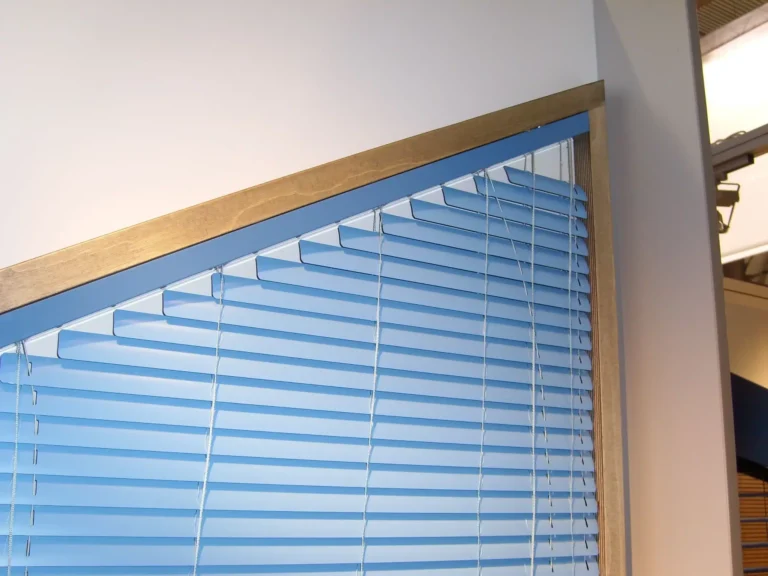
Shaped pleated blinds for triangular windows are made by cutting a pleated or cellular fabric to the three sides of the glass and holding it in slim rails along the edges, with the pleats running horizontally so each pleat is a little shorter than the one below it as the sides close towards the apex. The fabric is tensioned on fine cords that run from the base to the top, so it sits flat against the glass whatever the angle and does not sag in the heat.
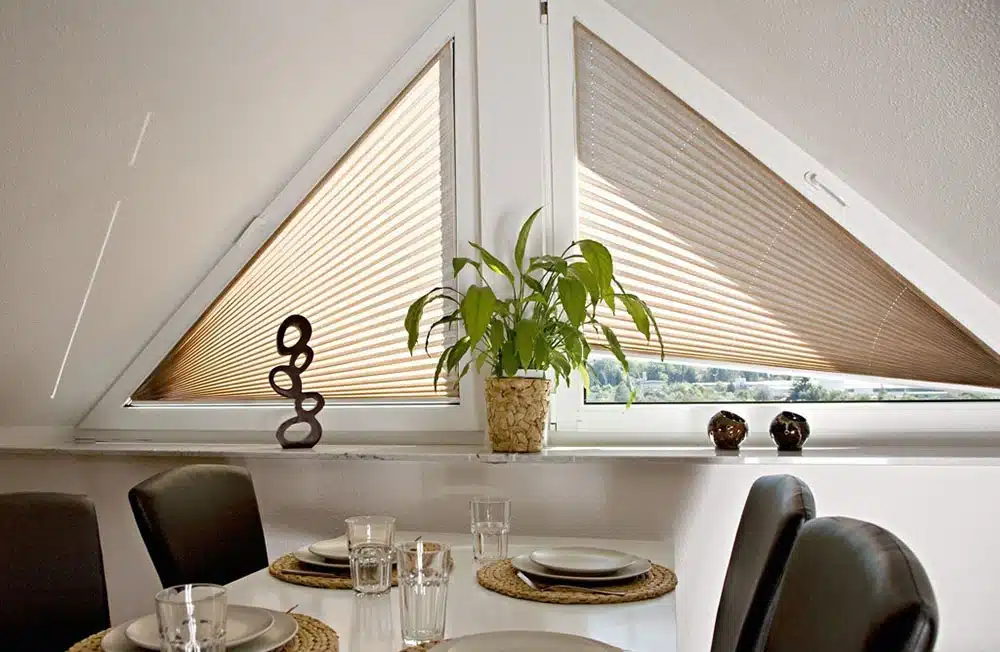
The fabric range is the same as our standard pleated blinds: voile and light filtering weaves for a landing, dimout for a living space, and blackout cellular for a bedroom. The rails come in white, anthracite and a few other colours to match the frame. Our guide to pleated blinds for odd shaped windows covers the wider family of shapes.
Right angled, isosceles and trapezium shapes
Triangular windows come in three main shapes and each is made a little differently. A right angled triangle, common beside a sloping ceiling in a dormer, has one vertical side and the blind rises from the base towards the right angle. An isosceles triangle, the classic gable apex, is symmetrical and the blind rises evenly towards the point. A trapezium, where the top of the triangle has been cut off flat, behaves almost like a rectangle with sloping sides and is the easiest to make opening. We also see triangles with a small vertical section at the base, which just adds a short straight run to the side rails.
Shaped Perfect Fit blinds for apex windows
Shaped Perfect Fit blinds for apex windows put the pleated fabric inside a slim aluminium frame cut and mitred to the triangle, and the frame clips to the uPVC or aluminium glazing bead with sprung brackets, so there are no screws and the blind sits on the glass rather than in the recess. If the window opens, the blind moves with the sash. The frame closes the light gap at all three edges, which is what makes this the best route to blackout.
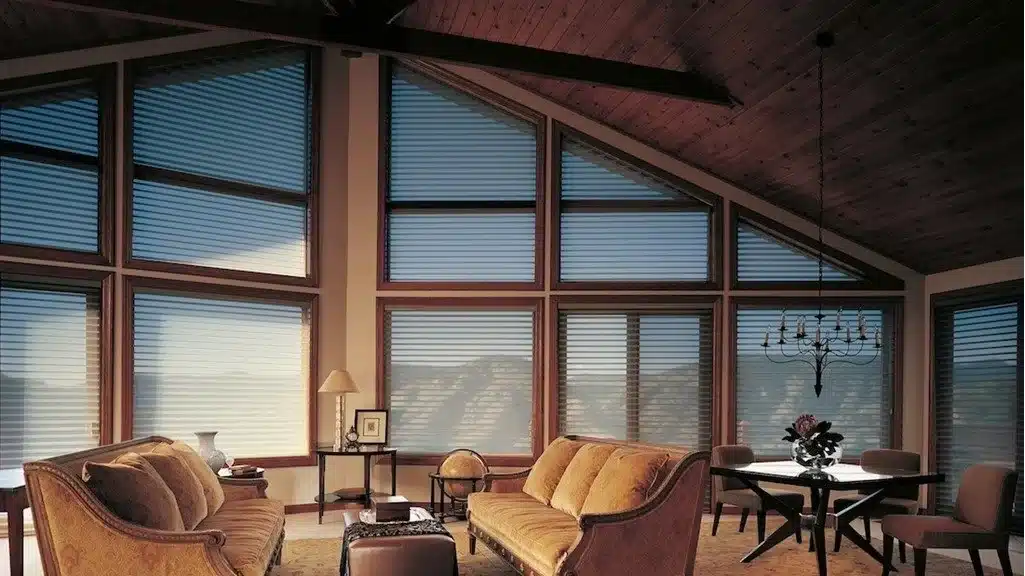
The requirement is a bead the brackets can grip, present on nearly all uPVC windows and most aluminium ones, and not present on timber. We check the bead depth at the home visit. Perfect Fit pleated blinds in a triangular frame are what we fit most on gable bedrooms, and our guide to Perfect Fit blinds for angled windows goes into the frame detail for all the angled shapes.
Fixed or opening: which to choose
A fixed triangular blind is cheaper, has no cords and suits a landing or a living room gable where the window is there for light and view, while an opening triangular blind suits a bedroom where you want the glass clear in the day and covered at night. Most gable windows in loft bedrooms end up opening, most feature gables in living spaces end up fixed.
Fixed
The fabric fills the triangle permanently. There is nothing to operate and nothing to go wrong, and in a light filtering fabric it cuts glare and heat while still letting the room feel bright. It is the usual choice for a triangle above a set of doors or a window that is out of reach.
Bottom up rising
The bottom rail rises from the base towards the apex, with the fabric gathering as it goes. Because the triangle gets narrower, the blind opens most of the glass by the time it is two thirds of the way up, and a small amount of fabric always stays at the point. It is operated by a handle on the rail or a cord, and it works best on isosceles and trapezium shapes.
Motorised
Where the apex window is high in a double height gable, a battery motor in the base rail moves the blind by remote or app, and a solar strip on the glass keeps it charged. It costs more than a cord but is the only practical way to open a blind four metres up, and it can be grouped with the blinds on the doors below.
Blackout for loft bedrooms with gable windows
Blackout on a triangular window comes from a blackout cellular fabric in a Perfect Fit frame, because the honeycomb fabric blocks the light and the frame closes the edges where a face fixed blind would leak. A shaped pleated blind on side rails in blackout fabric is the next best thing and is the option on timber frames, with a small amount of light at the rails.
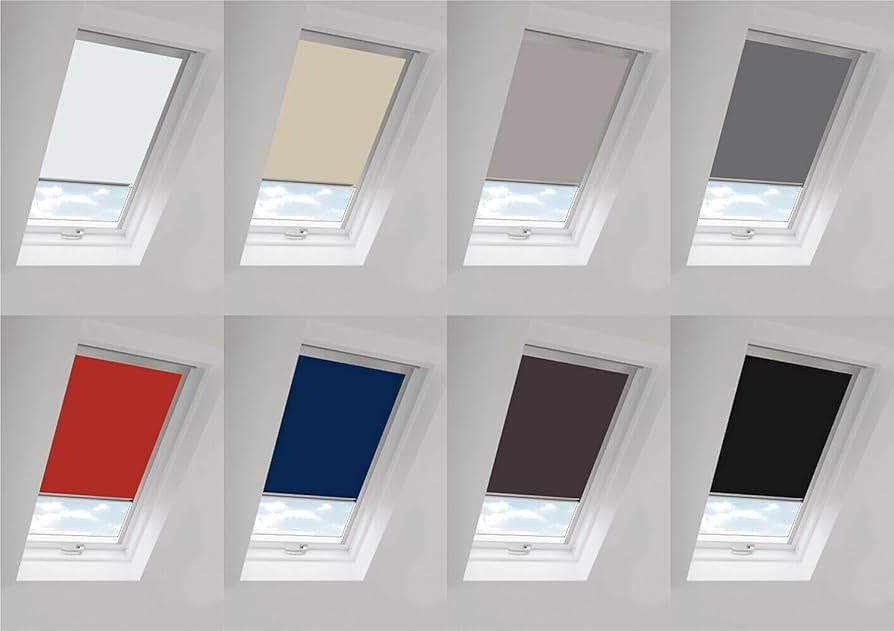
Loft bedrooms usually have a triangular gable window at one end and one or two roof windows in the slope, and the room is only dark if all of them are covered. We treat them as one job, with a triangular blind in the gable and matching Velux blinds in the roof, in the same blackout fabric. The cellular fabric also helps with heat, which matters in a loft in July. Our blackout blinds guide explains the difference between blackout fabric and a blackout result.
Measuring a triangular window with a template
We measure a triangular window by taking all three sides and at least two angles, and on anything that is not a simple right angle or an even isosceles we take a full size template on card as well, because a triangle drawn from three lengths can still be a few millimetres out at the apex. We measure to the bead for a Perfect Fit frame or to the recess for a rail mounted blind, and we check the depth so the rails clear any handle.
- Base width, measured along the bottom bead or recess edge.
- Both sloping sides, measured along the bead, and the vertical side if there is one.
- The height from the base to the apex, taken at the centre.
- The angle at each base corner, taken with a digital angle finder.
- Bead depth and recess depth, and which way the window opens if it opens at all.
If the triangle sits above a rectangular window or doors, we measure those at the same time so the fabrics and the rail colours match. We do this at the free home visit and we do not ask customers to measure or template triangles themselves.
How much do triangular window blinds cost
Triangular window blinds cost more than a rectangular blind of the same area because the fabric is hand cut to the angles, the rails or frame are mitred, and the making takes longer. Our pleated blinds start at £120 and most fall between £120 to £490 per blind, with a shaped version in the upper part of that range or above it. Perfect Fit blinds start at £60 and most fall between £60 to £75 per blind, and a triangular frame adds to that. A motor adds from .
| Option | Price basis | What moves it |
|---|---|---|
| Fixed shaped pleated blind | Pleated price, shaped | Size, fabric grade, blackout cellular or not |
| Rising shaped pleated blind | Pleated price, shaped, plus operating gear | Height to apex, cord or handle |
| Shaped Perfect Fit, fixed or rising | Perfect Fit price plus shaped frame | Total frame length, fabric |
| Motorised rising blind | Blind price plus motorised upgrade | Battery or solar, grouping with other blinds |
| Matching Velux blinds for the roof | From £80 each | Number of roof windows, blackout or not |
Every triangle is templated, so we give prices in a written quote after the visit rather than over the phone.
Gable and apex windows in East London and Essex homes
Around Rainham, Hornchurch, Elm Park and Upminster, most triangular windows are the result of loft conversions on 1930s semis, where a hip to gable conversion has created a new end wall and the builder has put a triangular window in the apex to light the stairs or the bedroom. These are usually uPVC, modest in size and reachable from the floor, so a shaped Perfect Fit pleated blind, opening and in blackout cellular fabric, is the standard answer.
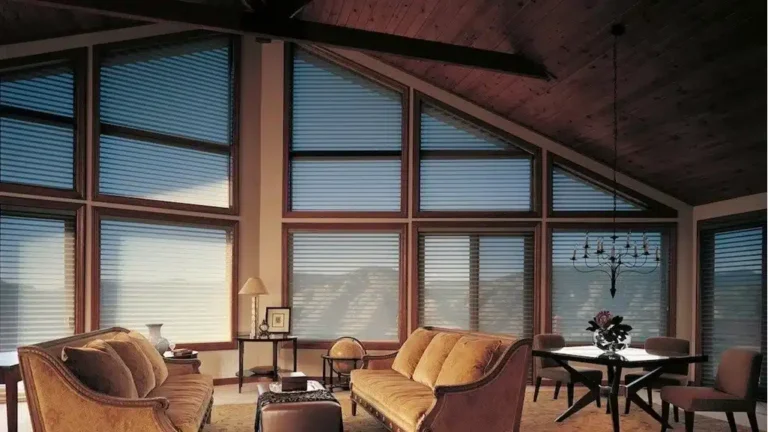
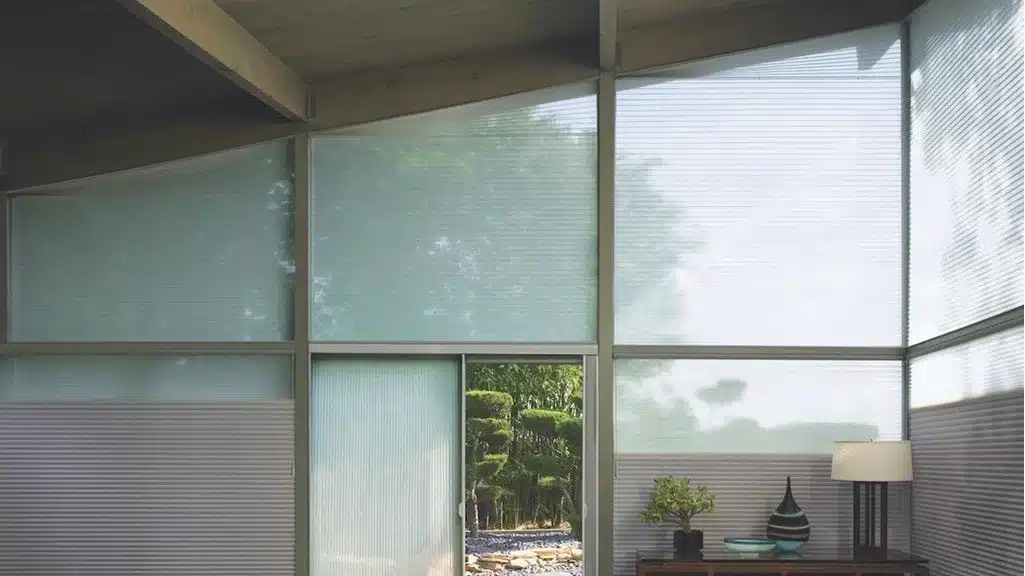
In Romford, Ilford and Dagenham the same conversions appear on terraces and the triangle is often a right angled one beside a dormer, next to a sloping ceiling. Out towards Grays, South Ockendon and the villages beyond Upminster, newer detached houses and barn style builds have full height glazed gables, two storeys tall, with a large isosceles triangle above doors or a picture window. Those are rail mounted shaped pleated blinds with a motor, matched to the blinds below. Where the triangle sits beside a sloping vertical window, sloping vertical blinds cover the rectangle with the slope and the shaped pleated blind takes the triangle. For the full range of angled shapes we see locally, our guide to the best blinds for sloping and angled windows is the place to start.
Every blind we make is fitted to current UK child safety rules. The Make it Safe campaign from the British Blind and Shutter Association explains what to check on blinds you already own.[1]
Frequently asked questions
Can a triangular blind open and close?
Yes. A rising shaped pleated or Perfect Fit blind opens from the base towards the apex by handle, cord or motor, and most of the glass is clear by the time it is two thirds up. Fixed versions are also available where opening is not needed.
Can a triangular window blind be blackout?
Yes, in a blackout cellular fabric, and the darkest result comes from a Perfect Fit frame that closes all three edges. A rail mounted blind in blackout fabric is the option on timber frames, with a little light at the rails.
Can you put a roller blind on a triangular window?
No. A roller needs a straight tube at the top and a triangle has an apex, so the only options are shaped pleated and shaped Perfect Fit blinds.
Do triangular blinds need drilling?
A shaped Perfect Fit blind clips to the glazing bead with no drilling. A rail mounted shaped pleated blind is screwed to the frame or recess with small fixings.
How do you measure a triangle window for a blind?
We measure all three sides, the height to the apex and the base angles, and take a card template on anything that is not a simple shape. This is done at the free home visit.
Can triangular window blinds be motorised?
Yes. A battery motor in the base rail moves a rising triangular blind by remote or app, with a solar strip to keep it charged, which is the usual choice for a high gable.
Get a free home visit in Rainham and East London
If you are still deciding on blinds for triangular windows, if you have a triangular, apex or gable window that nobody seems able to cover, book a free home visit or call 01708 505379. We measure and template the window at your home across Rainham, Hornchurch, Romford, Upminster, Ilford, Grays and the rest of East London and Essex, make the blind in our Rainham workshop and send a written quote after the visit.
References
- ^ Make it Safe from the BBSA. Make it Safe (British Blind and Shutter Association). Retrieved 25 October 2026.