Every angled window gets asked to solve a different problem. A dormer in a Rainham loft conversion needs to block early sun without a hanging cord over the stairs. A canted bay in a 1930s Hornchurch semi needs three panes that meet at slightly different angles to look like one job, not three. A glazed corner in a new-build at Beam Park might not be sloped at all, just wider and more open than the blind ranges most shops stock for.
That’s the honest starting point for any “best blinds for sloping and angled windows” question: there isn’t one best blind, there’s a best blind for your specific window, and the two things that decide it are the shape of the actual glass and the age and style of the property it’s set into. This guide covers both, product by product and property type by property type, drawn from what we actually fit across Rainham and East London rather than a generic product list.
What Counts as a Sloping or Angled Window
Two questions decide which blind will work: whether the glass itself is angled, and whether it’s a single slope or a true point.
A rectangular uPVC window sitting under a sloped ceiling is not an angled window in the way that matters here. The glass is still a rectangle, so a standard or Perfect Fit blind clips on exactly as it would anywhere else. It’s the wall and roofline around it that slope, not the pane.
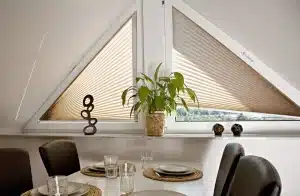
A genuinely angled pane, a single-pitch roof light, a staircase window cut into a sloped wall, a dormer top that follows the roof pitch, is a different job. There’s no straight top edge for a standard frame to sit against, so the blind has to be built to that specific pitch.
A triangular or point-topped window, a full gable-end apex, is different again. No single continuous blind hangs cleanly across two angles meeting at a peak. The usual fix is a shaped fixed panel, or two blinds meeting at the point, not one blind stretched over both sides.
If you want a hands-on way to check which of these you’ve actually got before reading further, our Perfect Fit blinds for angled windows guide has a two-minute test you can run with a straight edge or a book.
Why the Best Answer Depends on Your Property, Not Just the Window
Most guides to this topic sort by blind type and stop there. After fitting these across Rainham and East London for years, the window’s origin tells us more about what’s actually needed than the shape alone does.
Victorian and Edwardian Terraces (Barking, Ilford, East Ham)
Original canted bay fronts on these properties are almost always three separate rectangular panes meeting at fixed angles, not one continuous curve, so each pane gets measured and quoted on its own rather than as a single width. Where these houses have had a later loft conversion added, the new dormer or roof light is usually the genuinely sloped element, sitting above century-old brickwork that’s rarely perfectly square, which is why a self-measure kit designed for new-build tolerances tends to come back slightly wrong here.
1930s Semis (Romford, Hornchurch, Elm Park, Harold Hill)
The classic shallow canted bay on these streets is gentler than a Victorian one, and the loft space above is often deep enough for a full dormer conversion rather than just a roof light. Where we see both a bay and a later loft dormer on the same property, they’re almost never the same slope angle, so treating them as a matching pair and ordering identical blinds for both is a common and avoidable mistake.
Permitted Development Loft Conversions (widespread across RM postcodes)
A large share of the dormer and roof-light windows we measure across Havering went up under Permitted Development rather than a full planning application, which means there’s often no paperwork anywhere in the house telling you what angle the window was actually cut at. That’s normal, and it’s exactly why we measure on site with a level rather than asking for a number over the phone.
New-Build Developments (Beam Park, Barking Riverside)
Newer developments tend to produce a different kind of angled window altogether: large glazed corners, floor-to-ceiling sections, and windows that are technically rectangular but oversized for standard product ranges. These aren’t usually a slope problem so much as a scale and glare problem, and the products that solve them, motorised roller or wide Perfect Fit systems, are different from what solves a Victorian bay.
Best Blinds for Sloping & Angled Windows, Type by Type
Sloping Vertical Blinds: Best for a True Slope
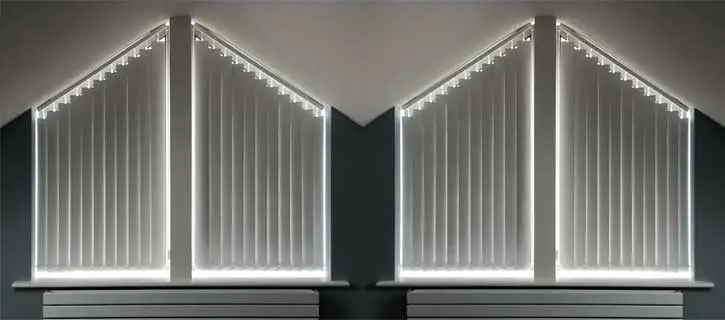
For a genuinely angled pane, a full dormer, staircase window, or gable-end drop, sloping vertical blinds are usually the strongest option. The headrail is cut to the exact pitch of the window rather than running level, and each vane hangs from a joint that keeps it vertical regardless of the angle above it, so the bottom edge finishes level along the sill even though the track above doesn’t.
They suit large or tall windows better than any other product on this list, take the widest range of fabrics including blackout, and can be motorised for high or hard-to-reach installations. The trade-off is cost and lead time: because no two angled windows share a pitch, every one is made to measure with no stock option, so it’s the most involved product here to order and the one that most depends on an accurate on-site angle measurement.
Perfect Fit Blinds: Best for a Rectangular Pane Under a Sloped Roofline
Where the confusion usually starts is realising that a lot of “angled windows” have perfectly rectangular glass, just sitting under a sloped ceiling. That’s exactly the case Perfect Fit blinds for angled windows are built for: they clip directly into the rubber bead of a uPVC window without drilling, and the frame itself can be shaped to sit inside an angled reveal even though the pane it holds is square.
This makes them the standard choice for rented properties across Ilford, Barking and Dagenham, where drilling into the frame isn’t allowed, and for the rectangular sections of most Permitted Development dormers. Where they don’t work is a genuinely sloped or triangular pane, since no UK manufacturer makes a Perfect Fit frame that clips onto an angled bead. If the straight-edge test in our Perfect Fit guide shows a gap rather than a flush fit, this isn’t the product for that window.
Skylight Pleated and Velux Blinds: Best for a Single Roof Light
A single Velux-style roof window is a smaller, simpler problem than a full dormer, and pleated blinds are usually the better fit for it. They’re lightweight, can be tensioned so the fabric stays put on a sloped pane, and give a flatter, more space-efficient finish than a vertical system would on a small window.
Where they lose ground is scale: on a large dormer or a full-width sloped section, a pleated blind loses the light control and privacy a sloping vertical blind offers, and the tensioning that works well on a small pane becomes harder to keep taut across a wider one.
Roller Blinds on Angled Windows: Use With Caution
Roller blinds are the product most homeowners ask for first, mainly because they’re familiar and inexpensive, but they’re the one that needs the clearest caveat. A roller blind is a single sheet of fabric wound onto one tube, which means it can only be cut to the shortest drop of an angled window. Anything taller than that measurement stays as an uncovered triangle of glass at the high end of the slope, unless a separate fixed panel is added to close the gap.
They work reasonably well on a genuinely mild slope, or where full top-corner coverage isn’t the priority, an obscure-glazed side window is the usual example. On a steep pitch or a wide dormer, they’re better suited to the rectangular sections of the room than the angled glass itself.
Venetian Blinds: Best for a Small Individual Angled Pane
Venetian blinds use horizontal slats rather than vertical fabric vanes, which is exactly why they suit angled windows less well than the options above in most cases: a horizontal slat sits parallel to the floor while the frame above it runs on a diagonal, so the gap at the top is more visually obvious than the gap a vertical or pleated system leaves. They earn their place on this list for one specific situation, a small, individually shaped angled pane such as a single triangular side light, where that gap is minor and the decorative slat finish suits the room.
Curtains for Sloping Windows: Best for a Softer Finish
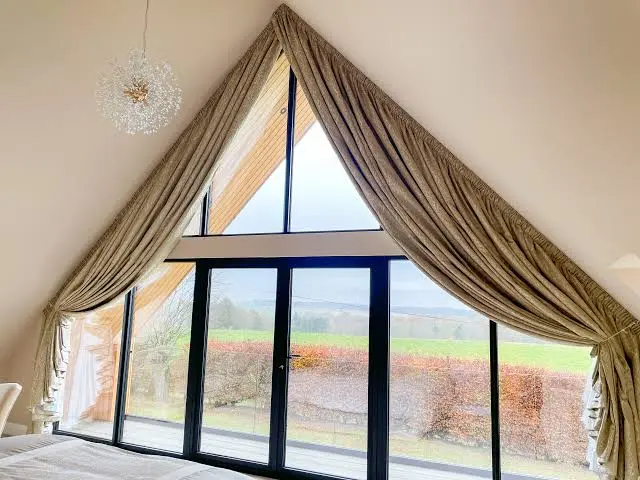
Curtains don’t attempt to follow the slope at all, which is precisely their advantage in the right room. Hung from a straight rail set below or across the angled section, curtains for sloping windows give a softer, more traditional finish for living rooms and bedrooms, usually paired with a sloping vertical or pleated blind on the angled glass itself for the light control curtains alone can’t provide on a dormer or roof light.
Which Option Actually Fits Your Window
| Your window | Best option | Why |
| Full loft dormer, staircase, or bay window | Sloping vertical blinds | Angled headrail follows the pitch exactly; widest fabric range and motorised option |
| Rectangular pane under a sloped roofline | Perfect Fit blinds | Clips to the square glass without drilling; ideal for rentals |
| Single Velux-style roof light | Skylight pleated or Velux blind | Flatter, more space-efficient finish than a vertical system on a small pane |
| Small individual angled pane | Venetian blinds | Decorative finish works where the top gap is minor |
| Side window, top-corner coverage not critical | Roller blinds | Cost-effective on a mild slope; leaves a gap on a steep one |
| Triangular apex or gable window | Shaped fixed panel, or two blinds meeting at the peak | No single continuous blind covers two angles meeting at a point |
| Living room or bedroom wanting a softer look | Curtains for sloping windows | Straight rail below the angle, usually paired with a blind on the glass itself |

What It Actually Costs
Most guides to this topic avoid a straight cost comparison because the honest answer depends on which product actually fits your window. Here’s a direct comparison across the range, using current East London pricing.
| Blind type | Typical price range | Best suited to |
| Perfect Fit (rectangular pane) | £60 to £180 | Rectangular uPVC under a sloped roofline; rental-friendly, no drilling |
| Roller (mild slope only) | £70 to £160 | Gentle slopes, obscure glazing where full coverage isn’t critical |
| Skylight pleated or Velux | £150 to £320 | Single roof lights and Velux-style windows |
| Sloping vertical (true angle) | From around £180, quoted per window | Dormers, staircase windows, canted bays, sloped extension roofs |
| Venetian (small angled pane) | £80 to £200 | A single small triangular or angled side light |
| Curtains for sloping windows | £120 to £400 or more, by fabric and track | Living rooms and bedrooms wanting a softer finish |
| Motorised upgrade, any of the above | Add roughly £80 to £150 | High-level or hard-to-reach angled windows |
All figures above include measuring and fitting by our own team. None are self-install kits, since an angle that’s even slightly wrong at the point of measuring can’t be corrected once the blind is made.
Motorised and Smart Options for Sloping Windows
Motorisation is available on most of the products above, but not all, and it’s worth knowing which before you fall for a particular fabric that can’t actually be automated on your window. Sloping vertical blinds, pleated and skylight blinds, and rollers can all be specified with motorised control, run from a remote, wall switch, or smart home app. Perfect Fit blinds are the exception: because the frame is designed to move with an opening uPVC window, most Perfect Fit systems stay manual.
Motorisation earns its cost fastest on windows that are physically awkward to reach by hand, staircase windows, high loft dormers, and anything above a stairwell where a pole or chain becomes a safety issue in its own right rather than a convenience question.
How UK Suppliers Actually Differ
Generic comparisons of “specialist,” “high street,” and “online” suppliers tend to use vague labels like low, medium, and high without saying what actually changes between them. Three things do, in practice.
Who takes the measurement. A specialist made-to-measure fitter measures the angle on site with a level. Online and DIY-chain routes rely on you measuring it yourself, which is where most angled-window returns and re-orders come from, since a small error in the angle is invisible until the blind is hung.
Who fits it. Some suppliers subcontract fitting to a separate installer network, so the person who measured your window isn’t the person who hangs the finished blind. At HomeDecisions, the same team does both, which matters most on an angled headrail, where the measuring detail and the fitting detail are the same conversation.
What happens if the angle’s wrong. This is the question worth asking before you order, not after. A sloping vertical blind can’t be corrected once manufactured if the pitch is off, so it’s worth knowing in advance whether your supplier remeasures and remakes at their cost or yours.
Where Homeowners Get This Wrong
Three patterns come up again and again, and none of them are about picking the wrong product so much as skipping a step that seems unnecessary until it isn’t.
Treating “angled window” as one single thing to search for. A homeowner with a Victorian bay and a later loft dormer will often search for one blind to cover both, when they’re usually different products at different angles, bought at different times.
Trusting a self-measure kit built for new-build tolerances. These work reasonably well on a modern, square rectangular window. On a period property, or anything measured by eye rather than with a level, the margin for error on an angled headrail is small enough that a few millimetres shows up as a visible gap once it’s hung.
Copying a case study or photo from outside the area. National suppliers often showcase striking projects from very different housing stock, a converted barn, a coastal new-build, that don’t reflect what a typical Rainham or Romford property actually needs. A shallow 1930s bay and a steep barn conversion roofline aren’t solved the same way, whatever the photo suggests.
Areas We Install Sloping & Angled Window Blinds
We fit sloping vertical, Perfect Fit, pleated and roller blinds for angled windows across Rainham and East London from our workshop on Marsh Way, RM13.
Rainham and South Hornchurch (RM13): every street in RM13, including the roads around New Road and Upminster Road, many with recent loft conversions producing exactly the dormer windows this guide covers.
Romford, Hornchurch and Upminster (RM1 to RM14): Romford RM1, Gidea Park RM2, Harold Wood RM3, Collier Row RM5, Chadwell Heath RM6, Hornchurch RM11, Elm Park RM12, and Upminster RM14, an area with a high concentration of 1930s canted bay fronts alongside newer loft conversions.
Dagenham, Barking and Ilford (RM8 to IG3): Dagenham RM8, RM9 and RM10, Barking IG11, Ilford IG1, Gants Hill IG2, and Seven Kings IG3, including the sloped extension roofs common on single-storey rear-extended terraces in these areas.
No call-out charge across any of the above.
Frequently Asked Questions
What are the best blinds for sloping and angled windows in the UK?
It depends on whether the glass itself is angled or just the room around it. Sloping vertical blinds are the strongest all-round option for a genuinely sloped dormer or staircase window, while Perfect Fit suits a rectangular pane under a sloped roofline, and pleated blinds suit a single roof light.
Can blinds be fitted to triangular or gable windows?
Not as one continuous blind. A true apex has two angles meeting at a point, which no single headrail follows cleanly. The usual solution is a shaped fixed panel, or two straight-edge blinds meeting at the peak, and we’ll confirm which suits your window on a home visit.
How much do sloping and angled window blinds cost in the UK?
Cost depends on the window type, size and fabric rather than one fixed rate, since sloping vertical, Perfect Fit and pleated systems are all priced differently. Standard Perfect Fit blinds typically start around £60, while a made-to-measure sloping vertical blind is quoted individually once measuring and fitting are included.
Are motorised blinds suitable for angled windows?
Yes, for most products. Sloping vertical, pleated and roller systems can all be motorised, run by remote, wall switch or smart home app, which suits high-level staircase windows and loft dormers that are awkward to reach by hand. Perfect Fit blinds are the exception and are mostly manual.
Do angled window blinds reduce heat and glare?
Yes. A blind that sits close to the glass, whether Perfect Fit on a rectangular section or sloping vertical on a true angle, adds a barrier against heat loss and glare. This matters most in loft conversions, where large areas of glazing can leave a room cold in winter and warm in summer.
What’s the difference between Perfect Fit blinds and sloping vertical blinds?
Perfect Fit blinds clip into the rubber bead of a rectangular uPVC window and move with it when it opens. Sloping vertical blinds use an angled headrail cut to follow a genuine slope, such as a dormer or staircase window. Which one you need comes down to whether the glass itself is angled.
How long does installation take for sloping or angled window blinds?
Once your blind is manufactured to the measured angle, fitting itself usually takes under an hour. The wait before that depends on the product: Perfect Fit and roller blinds are typically ready within one to two weeks, while a made-to-measure sloping vertical blind can take a little longer given the bespoke headrail.
Why Home Decisions Is Trusted for Sloping & Angled Window Blinds
Choosing blinds for sloping and angled windows isn’t something that can be worked out accurately from a brochure or an online size guide. It takes measuring the actual angle on site, knowing which product a given window shape rules out, and being willing to say so before taking the order rather than after.
We measure every sloping or angled window in Rainham and East London ourselves, with a level, not by eye or over the phone. Every blind we fit is made to the angle and drop of that specific window, not adapted from a standard size, and where a product on this page isn’t right for your window, we’ll say which one is on the visit.
Making the Right Choice
The best blind for a sloping or angled window is the one matched to the actual shape of your glass and the era of your property, not the one that ranks first in a generic search. A genuinely sloped dormer, a rectangular pane under a sloped ceiling, and a triangular gable end are three different problems with three different right answers, and getting that match right the first time is what determines whether the finished blind hangs level or visibly doesn’t.
If you have a sloping or angled window in Rainham or anywhere across East London, book a free home visit and we’ll measure it properly, tell you honestly which product fits, and give you a written price before anything is ordered.
📍 Serving Rainham, Romford, Hornchurch, Barking, Dagenham, Ilford and the rest of East London and Essex
📞 Call +44 1708 505379