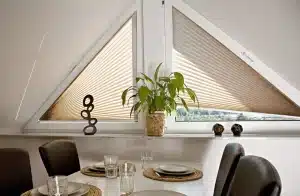
Sloping windows are one of those architectural features that look stunning—but can quickly become a design headache. Common in loft conversions, attic rooms, extensions, and modern builds, they bring in beautiful natural light while adding character to a space. The challenge? Dressing them properly.
Choosing the right curtains for sloping windows isn’t just about aesthetics. It’s about light control, privacy, insulation, ease of use, and making the room feel complete rather than awkward. Poorly chosen curtains can make the space feel unbalanced, block light unnecessarily, or simply not work day to day.
At HomeDecisions Blinds & Curtains, we’ve helped countless homeowners across Rainham and East London turn these awkward angles into stunning focal points. In this guide, we’ll walk you through expert, practical tips to help you choose the perfect curtains for sloping windows. From accurate measuring and fabric selection to hardware, styles, and professional advice, this blog is designed to help homeowners in Rainham and across East London make confident, informed decisions.
What Exactly Are Sloping Windows?
Sloping windows are windows that follow the angle of a roof or an inclined wall instead of being installed vertically. Unlike standard rectangular windows, they are designed to sit within pitched ceilings or angled structures, which makes them a common feature in homes where space has been creatively extended or modernised.
You’ll most often see sloping windows in:
- Loft and attic conversions, where windows are built directly into the roofline to maximise daylight
- Dormer extensions, where angled walls meet pitched roofs
- Rooms constructed within roof structures, such as top-floor bedrooms or home offices
- Contemporary architectural homes, where angled glazing is used as a design feature
These windows are visually striking and excellent for bringing in natural light, but their angled position changes how curtains behave compared to standard upright windows.

Why Standard Curtains Often Don’t Work on Sloping Windows
Standard curtains are designed to hang straight down from level rods or tracks. Sloping windows don’t provide that straight, balanced structure—so problems quickly appear when off-the-shelf solutions are used.
Common challenges include:
- Uneven dimensions, where the top and bottom widths don’t match, making standard curtain panels sit awkwardly
- Limited or awkward fixing points, especially where walls meet ceilings at sharp angles
- Curtains naturally slide downward as gravity pulls the fabric toward the lowest point of the slope
- Poor usability, with curtains bunching up, dragging, or refusing to open and close smoothly
These issues don’t just affect appearance—they impact daily comfort, light control, and privacy. That’s why sloping windows almost always require tailored curtain solutions, with carefully chosen fabrics, hardware, and precise measurements, rather than one-size-fits-all options.
Accurate Measuring: The Expert Starting Point for Perfect Curtains on Sloping Windows
When choosing curtains for sloping windows, accurate measuring is not just a technical step—it is the most important expert decision you will make. Because sloping windows are angled, irregular, and often positioned high within a room, even small measurement errors can prevent curtains from fitting properly or functioning as intended.
Experts always start with precise measurements because the shape of a sloping window directly affects how curtains hang, move, and cover the glass.
Why Measuring Sloping Windows Is Different From Standard Windows
Unlike straight windows, sloping windows rarely have uniform dimensions. The top of the window may be narrower than the bottom, or the angle of the ceiling may change how much space is available for curtain hardware. Measuring only the width and height is not enough.
For sloping windows, accurate measuring must account for:
- Changing widths from top to bottom
- Exact angles of the slope or roofline
- Clearance for curtain movement, especially where fabric needs to stack
- Safe and level fixing points for tracks or rods
Ignoring any of these details can lead to curtains that look uneven, slide out of place, or leave light gaps along the angled edges.
How Experts Measure Sloping Windows Correctly
Professional curtain specialists measure sloping windows using a step-by-step process designed to eliminate guesswork. This includes:
- Taking measurements at multiple points to identify variations in width
- Measuring the full length of the slope, not just the visible glass
- Allowing for overlaps to ensure full coverage and privacy
- Considering how the chosen fabric will behave when hung at an angle
This level of detail ensures the finished curtains follow the window’s shape naturally rather than fighting against it.
Why Accurate Measuring Affects the Final Result
Correct measurements influence:
- How evenly the curtains hang
- Whether light is properly blocked or filtered
- How smoothly the curtains open and close
- The overall balance and appearance of the room
Poor measurements can turn even high-quality curtains into a visual and functional problem, while accurate measuring allows sloping windows to feel purposeful and well-designed.
Expert Tip: Measure Before You Choose the Curtain Style
One common mistake homeowners make is choosing a curtain style before understanding what the window will allow. Experts always measure first, then recommend suitable styles, fabrics, and hardware based on those measurements.
Accurate measuring sets the foundation for every other choice—making it the single most important step in selecting the perfect curtains for sloping windows.

Curtain Styles That Actually Work for Sloping Windows
Not every curtain style is suitable for sloping windows. Because these windows sit at an angle, the curtain needs to work with gravity and structure—not against them. The right style will sit neatly, operate smoothly, and enhance the room rather than highlighting awkward angles. Below are curtain styles that consistently perform well on sloping windows when designed and installed correctly.
Roman Shades: Clean Lines and Reliable Control
Roman shades are one of the most practical and visually balanced options for sloping windows. They sit close to the glass, which helps maintain a tidy, uncluttered look—especially important in lofts or rooms with angled ceilings.
Because Roman shades can be custom-made to follow the exact shape of the window, they avoid common issues like sagging or uneven hems. When raised, the fabric folds neatly, and when lowered, it provides consistent coverage without drifting or pulling. This makes them ideal for bedrooms, home offices, and attic rooms where both light control and simplicity matter.
Bespoke Drapes: Softening Angles with a Tailored Fit
For homeowners who prefer a more traditional or luxurious feel, bespoke drapes are an excellent choice. Unlike ready-made curtains, custom drapes are designed specifically for the window’s angle, ensuring they hang correctly and move smoothly.
Bespoke drapes help soften strong architectural lines and add warmth to angular spaces. They can also be used to visually balance a room by drawing the eye downward, making sloping ceilings feel more intentional rather than awkward. With the right fabric and lining, they work well in both living spaces and bedrooms.
Sheer Curtains: Light-Focused and Visually Elegant
Sheer curtains are ideal for sloping windows where natural light is the main feature. They diffuse sunlight gently, reducing glare while keeping the room bright and open.
Because sheer fabrics are lightweight, they work particularly well on angled tracks or rods and are less likely to pull or bunch. They are commonly used in living rooms, stairwells, and modern extensions—and are even more effective when layered with heavier curtains for privacy in the evening.
Layered Curtain Solutions: Flexible and Practical
Layering combines function and style, making it a smart choice for sloping windows. A common approach is pairing sheer curtains with blackout or lined drapes, allowing homeowners to control light levels throughout the day.
This technique works especially well in loft bedrooms, where daylight is welcome during the day but full privacy and darkness are needed at night. Layered solutions also add depth and a more finished look to angled window areas.
Choosing the right curtain style for sloping windows is about balance—between design, function, and everyday usability. With tailored styles and thoughtful installation, even the most challenging sloping window can become a seamless part of your interior.
Heavy vs Lightweight Fabrics: What to Choose and When
Choosing the right fabric is one of the most important decisions when dressing sloping windows. Because these windows sit at an angle, fabric weight directly affects how curtains hang, move, and perform over time. The goal is to select a fabric that works with gravity, suits the room’s purpose, and remains practical for everyday use.
When Heavy Fabrics Are the Right Choice
Heavy fabrics are typically thicker, lined, and more structured. They work best in rooms where comfort, privacy, and light control are the top priorities.
Heavy fabrics are ideal when:
- The room is a bedroom or loft sleeping space, where blocking out light is essential
- Privacy is important, especially for windows facing neighbouring homes
- Thermal insulation is needed, as thicker fabrics help reduce heat loss in winter and heat gain in summer
- A more luxurious or cosy look is desired, adding visual weight to the space
However, because sloping windows naturally pull fabric downward, heavy curtains must be paired with strong, well-installed tracks or rods. Without proper support, they can become difficult to operate or sit unevenly.
When Lightweight Fabrics Work Better
Lightweight fabrics are more flexible and easier to manage on angled windows. They are especially useful in spaces where light and openness are more important than full coverage.
Lightweight fabrics are a better choice when:
- The room benefits from natural daylight, such as living rooms or open-plan areas
- Windows are high or hard to reach, making easy operation a priority
- You want a softer, more relaxed look, without visual heaviness
- Sheer or light-filtering curtains are being layered with heavier options
Because they place less strain on hardware, lightweight fabrics often move more smoothly on sloping tracks and are less likely to slip or bunch.
Finding the Right Balance for Sloping Windows
In many cases, the best solution is not choosing one over the other—but combining both. Layering lightweight sheers with heavier lined curtains allows you to enjoy natural light during the day while maintaining privacy and insulation at night.
The key is matching the fabric weight to the room’s function, the window’s angle, and how often the curtains will be used. Thoughtful fabric selection ensures your curtains don’t just look good—but work effortlessly on sloping windows every day.
Light Control Options for Different Rooms
Sloping windows often let in more direct sunlight than standard windows, which makes light control a key consideration when choosing curtains. The right level of light control depends not only on personal preference but also on how each room is used throughout the day. Selecting the appropriate fabric and lining ensures comfort, privacy, and a space that feels right at all times.
Light-Filtering Curtains: Softening Daylight Without Blocking It
Light-filtering fabrics are designed to gently diffuse sunlight rather than completely block it. They allow natural light to enter while reducing glare and harsh brightness, making rooms feel calm and welcoming.
These fabrics work best in:
- Living rooms, where a bright but comfortable atmosphere is ideal
- Dining areas, where natural light enhances the space without overpowering it
- Home offices, where reduced glare helps improve focus
On sloping windows, light-filtering curtains are especially useful because they balance strong sunlight without making the room feel closed in.
Blackout Curtains: Essential for Bedrooms and Loft Spaces
Blackout fabrics are designed to block out light almost entirely, making them the best choice for rooms where rest and privacy are priorities.
They are particularly suitable for:
- Bedrooms, especially loft or attic bedrooms with roofline windows
- Children’s rooms, where early morning light can disrupt sleep
- Media or TV rooms, where glare needs to be minimised
Because sloping windows often face the sky directly, blackout linings help prevent unwanted light from entering at dawn or late in the evening.
Thermal Linings: Comfort All Year Round
Thermal linings add an extra layer of insulation, helping to regulate indoor temperatures. This is especially important for sloping windows, which can lose heat in winter and gain heat quickly in summer.
Thermal options are ideal for:
- Top-floor rooms, where temperature fluctuations are more noticeable
- Lofts and extensions, which are often exposed to direct sunlight
- Homes looking to improve energy efficiency
Thermal linings can be combined with both light-filtering and blackout fabrics, offering flexibility without compromising comfort.
Combining Light Control Options for Maximum Flexibility
Many homeowners choose layered solutions to adapt to different times of day. Pairing sheer or light-filtering curtains with blackout or lined drapes allows you to enjoy daylight when needed and complete privacy when required.
By choosing light control options based on each room’s purpose, sloping windows can remain a design feature without sacrificing comfort or functionality.
Maintenance Matters (Especially for Hard-to-Reach Windows)
When choosing curtains for sloping windows, maintenance is often overlooked—but it’s a key expert consideration, especially when windows are positioned high, angled, or difficult to access. Curtains that look great on day one can quickly become inconvenient if they’re hard to clean, fade easily, or lose their shape over time.
Experts always factor in long-term care, not just appearance.
Why Sloping Windows Need Low-Maintenance Curtain Choices
Sloping windows are commonly found in lofts and upper floors, where reaching the curtains for cleaning or adjustments isn’t easy. Because of this, fabrics and designs that require frequent upkeep can quickly become impractical.
Poor maintenance choices can lead to:
- Dust and allergens are building up in hard-to-reach areas
- Faded fabric caused by direct sunlight
- Curtains losing structure or hanging unevenly
- Difficulty removing and rehanging curtains safely
Choosing low-maintenance options helps avoid these everyday frustrations.
Fabric Choices That Are Easier to Maintain
For sloping windows, experts recommend fabrics that:
- Resist fading, especially in sun-exposed rooms
- Hold their shape, even when hung at an angle
- Are easy to clean, such as washable or wipe-clean materials
- Do not crease easily, reducing the need for frequent care
High-quality fabrics may cost more initially, but they maintain their appearance far longer and reduce long-term effort.
Linings and Finishes That Extend Curtain Life
Proper linings do more than improve light control—they protect the main fabric from sunlight and temperature changes. Thermal or blackout linings help prevent fabric stress, which is especially important for curtains hanging at an angle.
Finishes such as reinforced hems and quality stitching also help curtains stay neat and balanced over time.
Expert Tip: Choose Function Before Fashion
For hard-to-reach sloping windows, experts recommend prioritising durability and ease of care before choosing decorative details. A simple, well-made curtain that stays clean and functional will always outperform a high-maintenance option in the long run.
Thoughtful maintenance choices ensure your curtains continue to look good and work smoothly—without becoming a hassle—making them a smart, practical solution for sloping windows.
Curtain Hardware for Sloping Windows: The Unsung Hero
Curtains on sloping windows rely on more than fabric and measurements—the hardware is what makes everything actually work. While it’s easy to focus on colours or styles, the rods and tracks behind the scenes determine whether curtains glide smoothly or constantly fight gravity.
Angled windows place very different demands on curtain hardware than standard, straight windows do.
Why Regular Curtain Rods Struggle on Sloping Windows
Most standard curtain rods are designed to sit perfectly level. When they’re installed on a slope, several problems can appear:
- Curtains naturally slide toward the lowest point
- Fabric gathers unevenly instead of hanging straight
- Opening and closing become awkward or stiff
- Brackets and fixings are placed under uneven strain
Over time, these issues can affect both the appearance and the lifespan of the curtains.
Hardware Solutions Designed for Angled Windows
Specialist hardware allows curtains to follow the window’s shape rather than resisting it. Proven solutions include:
- Adjustable rods that align with the angle of the window
- Custom-shaped poles made to match the exact slope
- Flexible curtain tracks that allow smooth movement on angled lines
- Ceiling-mounted systems that distribute weight evenly
These options keep curtains stable, balanced, and easy to operate.
Why Installation Quality Matters Just as Much as Hardware Choice
Sloping windows often require fixings to be placed into angled walls or ceilings, which demands precision. Incorrect installation can lead to loosened brackets, uneven curtain drops, or long-term damage.
Careful fitting ensures:
- Curtains remain in position
- Movement stays smooth and controlled
- Weight is properly supported
- The finished result looks clean and intentional
Expert Tip: Plan Hardware Early in the Process
Hardware decisions should be made before finalising fabric or curtain style. The type of rod or track used will influence fabric weight, curtain design, and how the curtains function day to day.
When the right hardware is chosen and installed correctly, it quietly supports everything—allowing sloping windows to look polished, practical, and well-designed without drawing attention to the challenges behind the scenes.
The Right Rods and Tracks Make All the Difference
Selecting the perfect rods and tracks is one of the most crucial steps in dressing sloping windows. While fabric and style often get most of the attention, the hardware is what determines whether your curtains will hang neatly, move smoothly, and complement the window rather than fight it. With the wrong rods or tracks, even the most carefully measured and beautifully designed curtains can look awkward or become difficult to operate.
Why Hardware Matters More Than You Might Think
Sloping windows introduce unique challenges that standard curtain rods aren’t built to handle. Because the window is angled, gravity pulls the curtain differently along the slope, which can cause:
- Fabric bunching or uneven hanging
- Curtains sliding toward the lowest edge
- Difficulty opening and closing
- Extra strain on brackets and fixings, leading to sagging over time
Choosing hardware that accommodates the window’s specific shape and angle ensures the curtains function as smoothly as they look.
Adjustable Curtain Rods: Flexibility for Any Angle
Adjustable rods are ideal for sloping windows because they allow you to match the rod’s length to the window’s specific measurements. These rods can often be fitted at slightly different angles to accommodate the slope, preventing uneven curtain drops.
Benefits include:
- Easy to customise for non-standard widths
- Simple installation without permanent modifications
- Versatility for different curtain styles, from lightweight sheers to heavier drapes
Custom-Bent Poles: Perfect for Unique Windows
For windows with a sharper or irregular slope, custom-bent poles are a game-changer. These poles are manufactured to follow the exact angle of the window, ensuring the curtain hangs naturally along the slope.
Advantages of custom-bent poles:
- Precise fit for the window’s unique shape
- Smooth movement without fabric sagging
- A polished, professional appearance that looks intentional
Flexible Curtain Tracks: Smooth Movement Made Simple
Flexible tracks are another expert favourite for sloping windows. These tracks can bend slightly along the window’s angle, allowing curtains to glide smoothly without snagging. Ceiling-mounted tracks are often used in combination with flexible systems to evenly distribute the weight of the curtain across the slope.
Why flexible tracks are ideal:
- Enable smooth operation even on tricky angles
- Reduce wear and tear on both fabric and hardware
- Ideal for motorised or automated curtain systems
Ceiling-Mounted Systems: Stability and Elegance
In rooms where wall space is limited or the slope is very steep, ceiling-mounted tracks can provide the most reliable solution. These systems transfer the curtain’s weight directly to the ceiling, keeping everything secure and even, while allowing curtains to flow naturally along the slope.
Benefits include:
- Enhanced stability for heavy fabrics
- Minimal risk of sagging or uneven drape
- Clean, modern look that integrates with the room design
Expert Tip: Plan Hardware Before Choosing Curtains
One common mistake homeowners make is selecting curtains before considering the rods or tracks. In reality, the hardware often dictates the type of curtain you can use, how heavy it can be, and how it will move. Planning hardware first ensures a harmonious combination of function and style.
Installation Tips That Prevent Everyday Frustration
Installing curtains on sloping windows is far more complex than hanging them on a standard wall. Even perfectly measured curtains with the right fabric and hardware can fail if installation isn’t done correctly. The angle of the window, limited wall space, and gravity all contribute to potential issues—but with careful planning and the right techniques, you can avoid common frustrations and ensure your curtains look and function flawlessly every day.
Start with Precise Measurements
Before any installation, double-check your measurements. Experts always measure multiple points along the window to account for:
- Top-to-bottom variations in width
- Angle of the slope
- Depth of window recess or frame
- Space needed for curtain stacking and operation
Accurate measurements ensure that your brackets or tracks are positioned correctly, preventing uneven hanging or light gaps.
Choose the Right Fixing Points
Sloping windows often offer limited options for securing rods or tracks. To avoid instability:
- Anchor into solid wall or ceiling material rather than just plasterboard
- Distribute weight evenly across multiple brackets
- Ensure brackets are aligned along the slope, not horizontally, for a balanced look
Properly placed fixings keep curtains secure and prevent them from sagging or sliding over time.
Install Hardware Level Along the Slope
Even a slight misalignment can make curtains look uneven or operate poorly. Experts recommend:
- Using a spirit level adjusted to follow the slope rather than a horizontal line
- Marking each bracket position before drilling to avoid mistakes
- Checking the track or rod’s angle before securing fully
This attention to detail ensures curtains glide smoothly and sit neatly along the window’s shape.
Consider Accessibility and Daily Use
Sloping windows are often high or awkward to reach. When installing:
- Allow enough clearance for curtains to open and close easily
- Ensure rods or tracks can handle the curtain’s weight without bending
- Consider motorised or cordless systems for windows that are difficult to access
Planning for daily use during installation prevents common frustrations and reduces wear on both fabric and hardware.
Test Before Finalising
Once the curtain is hung:
- Open and close it multiple times to check for smooth operation
- Confirm that the fabric falls evenly along the slope
- Adjust brackets or tension if needed before final tightening
This final test ensures the installation is practical, functional, and visually balanced.
Pro Tip from the Experts: If the window slope is steep or the curtains are heavy, it’s worth hiring a professional installer. Experienced specialists know the nuances of angled windows and can avoid problems that may not be obvious to a DIY approach.
With careful measuring, smart hardware placement, and precise installation, your sloping windows will have curtains that not only look stunning but operate effortlessly—making daily life easier and keeping your interior design polished.
Colour and Pattern Choices That Enhance (Not Fight) the Space
Sloping windows already draw attention due to their unusual angles and the natural light they bring in. Choosing the right colours and patterns for your curtains can either highlight the beauty of the window or create visual clutter that fights the architecture. Thoughtful colour and pattern selection help integrate sloping windows seamlessly into your room while enhancing the overall design.
Use Colour to Complement the Room and Mood
Colour plays a huge role in how a space feels, and sloping windows amplify its impact. Here’s how to approach it:
- Light and neutral colours like cream, soft grey, or pastel tones make angled ceilings feel more open and airy. They reflect natural light and prevent the space from feeling closed in.
- Bold or dark colours can create a dramatic effect, but they work best when paired with lighter walls or when the curtain is a focal point.
- Room purpose should guide your colour choice: calm tones for bedrooms, energising hues for living areas, or rich shades for cosy attic spaces.
Experts often recommend coordinating curtain colours with other elements in the room, such as walls, furniture, or flooring, to create a harmonious flow.
Patterns: Add Interest Without Overpowering
Patterns can bring personality to a space, but on sloping windows, overcomplicated designs can feel chaotic. Consider these tips:
- Subtle patterns like stripes, gentle geometrics, or soft florals can accentuate the window without competing with the architecture.
- Vertical patterns can help draw the eye upward, emphasising height and making sloping ceilings appear taller.
- Repeating motifs should be scaled appropriately so they don’t look distorted along the angled fabric.
If you’re layering curtains, combining a subtle patterned curtain with a plain fabric can create depth while keeping the focus on the window’s shape.
Light-Reflective and Fabric Textures
The type of fabric also affects how colour and pattern appear. Slightly reflective or textured fabrics can add dimension and catch sunlight in a flattering way, enhancing the natural flow of light from sloping windows.
- Sheer fabrics let the room glow with diffused daylight, ideal for living spaces or stairwells.
- Matte fabrics work well in bedrooms or media rooms to reduce glare.
- Textured weaves or jacquard patterns can add visual interest without overwhelming the slope.
Expert Tip: Test Samples in the Room
Before committing, it’s wise to test curtain swatches in the room at different times of day. Sunlight angles change throughout the day, and colours or patterns that look perfect in the store may appear different in your space.
Choosing colours and patterns thoughtfully ensures your sloping windows enhance the room’s aesthetics, highlight natural light, and complement the architecture, rather than fighting against the unique angles of the window.
Functionality and Practicality: Curtains That Work Every Day
Sloping windows may look stunning, but they also pose practical challenges that standard curtains can’t always handle. Choosing curtains that combine style with everyday functionality ensures your investment looks good while making daily use effortless. Experts always balance aesthetics with convenience, especially for hard-to-reach or uniquely angled windows.
Ease of Use: Smooth Operation Matters
One of the biggest complaints with sloping windows is that curtains can be difficult to open and close. Gravity, weight, and angles all influence movement. To make everyday use smooth:
- Motorised or automated curtains are ideal for high or awkwardly angled windows. They allow effortless operation at the touch of a button.
- Cordless or pulley systems work well for lighter fabrics, reducing tangling or snagging.
- Flexible tracks and gliders ensure curtains move smoothly along angled rods without bunching.
The goal is simple: the curtains should operate easily every day, not just look good when installed.
Consider the Weight of the Curtains
Heavy fabrics can look luxurious, but on sloping windows, they can pull downward, strain hardware, and become difficult to handle. Conversely, very light fabrics may flap or fail to fully cover the window. Experts recommend:
- Matching fabric weight to hardware strength
- Using lined or reinforced curtains for heavier materials
- Combining lightweight sheers with heavier drapes for layering without excessive bulk
A correct balance ensures the curtains hang evenly and stay in place without extra effort.
Accessibility for Maintenance and Adjustment
Sloping windows are often installed in lofts or upper floors, making access tricky. Consider practical solutions that make adjustments and cleaning easier:
- Removable tracks or rods for easy curtain removal
- Machine-washable fabrics to simplify maintenance
- Motorised or long-reach operating poles for windows you can’t reach by hand
A functional system reduces daily hassle while maintaining a polished appearance.
Practical Considerations for Light and Privacy
Sloping windows often receive direct sunlight at unusual angles, which can impact comfort, privacy, and furniture placement. Practical curtains address these concerns without compromising style:
- Layered solutions allow light filtering during the day and full privacy at night
- Blackout or thermal linings improve sleep quality and energy efficiency
- Sheers or semi-opaque fabrics maintain natural light while softening glare
By addressing both functionality and aesthetics, your curtains become a long-term solution that enhances the room’s comfort, usability, and beauty.
Expert Tip: Always plan the curtain operation and weight before choosing fabric or style. A visually stunning curtain is wasted if it can’t be opened easily or doesn’t provide the intended light control. Practicality and design must work hand-in-hand, especially for sloping windows.
How Colour Affects Sloping Rooms
Colour is one of the most powerful tools when it comes to designing spaces with sloping windows. Because these windows often sit in lofts, attic conversions, or angled ceilings, the walls and ceiling lines can feel more pronounced. The right colour choices can enhance natural light, create a sense of height, and make the room feel harmonious, while poor choices can make a space feel cramped, dark, or visually chaotic.
Light Colours to Open Up the Space
For rooms with low ceilings or sharp slopes, light and neutral shades are highly effective:
- Whites, creams, and soft pastels reflect natural light, making the room feel brighter and more spacious.
- Subtle tones can create a seamless flow between walls and sloped ceilings, softening the angles without drawing attention to them.
- Monochromatic palettes (varying shades of one colour) can visually elongate the space, reducing the feeling of awkward angles.
Experts often recommend light tones for loft bedrooms, home offices, or attic extensions, where sloping ceilings could otherwise feel imposing.
Bold Colours for Drama and Focal Points
Dark or vibrant colours can work beautifully if used intentionally:
- Accent walls behind the window or on the slope itself can draw attention to architectural features.
- Deep blues, greens, or charcoal greys create a cozy, intimate atmosphere—especially suitable for bedrooms or media rooms.
- Pair bold shades with lighter surrounding walls to prevent the room from feeling closed in.
The key is balance: on sloping windows, bold colours can highlight the structure rather than compete with it.
Colour and Natural Light
Sloping windows often capture sunlight at unusual angles. The colour of curtains and walls can dramatically affect how that light behaves:
- Light-coloured curtains diffuse sunlight softly, reducing glare while maintaining brightness.
- Reflective or slightly textured fabrics bounce light deeper into the room, enhancing the feeling of openness.
- Darker fabrics provide contrast and can help control sunlight during peak hours, which is useful for loft bedrooms or home cinemas.
Patterns and Colour Interaction
Patterns and colour work hand-in-hand. When using patterned curtains on sloping windows:
- Ensure the scale of the pattern matches the window size to avoid visual distortion.
- Pair neutral backgrounds with subtle patterns for a balanced, airy look.
- Use contrasting trims or borders to emphasise architectural lines intentionally rather than fighting the slope.
Expert Tip: Always test swatches in the room at different times of day. Sunlight direction and intensity change throughout the day, and colours that seem perfect in the store may appear darker, warmer, or cooler in your space.
With careful colour choices, sloping rooms can feel bright, spacious, and visually cohesive, allowing both the window and the curtains to complement the room’s design rather than compete with it.
Smart Solutions for Hard-to-Reach Windows
Sloping windows often sit high in lofts, attics, or roofline extensions, which can make accessing them for opening, closing, or cleaning a challenge. Experts recommend smart solutions that combine convenience, safety, and style, ensuring your curtains work perfectly without daily frustration.
Motorised Curtains: Convenience at the Touch of a Button
Motorised or automated curtain systems are a game-changer for hard-to-reach windows. These solutions allow you to:
- Open and close curtains remotely via switch, remote, or smartphone app
- Set timed schedules for light control, perfect for loft bedrooms or sun-exposed rooms
- Reduce wear and tear, as smooth motorised operation prevents pulling or snagging
Motorised systems are particularly valuable for heavy drapes or large layered curtains, where manual operation could be cumbersome or unsafe.
Cordless and Pulley Systems: Manual but Practical
For homeowners who prefer non-electric solutions, cordless or pulley-operated systems offer manual control without reaching:
- Cordless rods use sliding mechanisms to move curtains smoothly along angled tracks
- Pulley systems allow control from a lower position, ideal for sloped skylights or dormer windows
- These systems reduce the need for ladders or climbing, improving safety and usability
Flexible and Ceiling-Mounted Tracks: Smooth Operation on Angles
Flexible curtain tracks are perfect for sloping windows because they can bend to follow the slope. When combined with ceiling-mounted systems, they:
- Ensure curtains hang evenly along angled windows
- Distribute the weight evenly, reducing stress on brackets
- Allow curtains to glide effortlessly, even in awkward or high positions
Experts often pair these tracks with light-weight fabrics for optimal movement or motorised systems for hard-to-access locations.
Accessibility and Safety Considerations
High or angled windows introduce safety concerns when adjusting curtains manually. Smart solutions help:
- Avoid climbing ladders or stretching unsafely
- Minimise the risk of damage to delicate fabrics
- Make daily operation simple and consistent
Expert Tip: Combine Functionality with Design
When planning curtains for hard-to-reach sloping windows, don’t compromise on style for convenience. Layered fabrics, bold colours, and tailored lengths can all work with motorised, cordless, or flexible-track systems. The key is to integrate smart hardware solutions with the chosen curtain style, ensuring both beauty and functionality.
With the right smart solutions, even the trickiest sloping windows become easy to manage, fully functional, and visually stunning—turning a potentially frustrating feature into a design highlight.
Layering Curtains for Flexibility and Style
Layering curtains is an expert strategy that adds depth, texture, and visual interest to sloping windows, making them feel intentional and polished rather than awkward or unfinished. For angled windows, layering isn’t just decorative—it also enhances functionality, allowing for flexible light control, privacy, and insulation.
Why Layering Works for Sloping Windows
Sloping windows present unique challenges: uneven light exposure, gravity pulling the fabric downward, and angles that make single-layer curtains look incomplete. Layering solves these problems by:
- Adding dimension, making the window a feature rather than just a functional opening
- Combining different fabrics to control light, temperature, and privacy simultaneously
- Softening the appearance of angles and creating a balanced visual flow
Layered curtains also allow homeowners to mix styles, textures, and colours without overwhelming the room.
Basic Layering Combinations
Experts recommend starting with a foundation layer and building additional layers on top. Common combinations include:
- Sheer + Blackout Curtains
- Sheers filter natural light during the day, maintaining brightness and openness.
- Blackout drapes provide privacy and block sunlight when needed, ideal for bedrooms or loft spaces.
- Lightweight Fabric + Heavier Drapes
- Lightweight fabrics move easily along sloping rods or tracks, ensuring smooth operation.
- Heavier drapes add elegance, insulation, and a polished look.
- Patterned Curtain + Plain Layer
- A subtly patterned curtain adds personality and visual interest.
- A plain underlayer balances the design, preventing the window from feeling busy.
Incorporating Valances and Pelmets
Valances or pelmets are small, horizontal fabric treatments placed at the top of the window. On sloping windows, they can:
- Hide hardware, making rods or tracks invisible
- Add a finished, professional appearance
- Frame the window, drawing attention to its shape while softening sharp angles
Choosing a valance that follows the slope can unify the look and prevent the window from appearing disconnected from the room.
Fabric and Colour Coordination
Layering also allows for creative colour and texture combinations:
- Mix soft neutrals with bold accent colours to complement the room’s palette
- Combine smooth fabrics with textured ones to add depth
- Use contrasting linings to enhance the visual effect and functionality, like a light-filtering sheer behind a rich, opaque drape
Experts often suggest testing layered samples in the room to ensure colours and textures work with the natural light from the sloping window.
Expert Tip: Plan Layers for Functionality, Not Just Looks
While layering adds style, it should also enhance usability. Make sure the layers:
- Open and close without interference
- Don’t add excessive weight to the hardware
- Maintain smooth movement along angled rods or tracks
When done correctly, layering transforms sloping windows into a focal point that’s both practical and visually stunning, combining elegance with everyday functionality.
Popular Layering Combinations for Sloping Windows
Layering curtains is one of the most effective ways to add style, functionality, and depth to sloping windows. Done correctly, layering not only enhances aesthetics but also improves light control, privacy, and insulation. Experts often combine different fabrics, weights, and textures to create practical yet visually appealing solutions.
1. Sheer + Blackout Curtains
This is one of the most popular combinations for sloping windows:
- Sheer Layer: Soft, lightweight fabrics that allow natural light to filter in during the day, creating a bright and airy feel. Sheers are especially effective in lofts or attics where sunlight can be intense.
- Blackout Layer: Heavy, opaque curtains that block light completely when needed. Ideal for bedrooms, media rooms, or rooms that get strong afternoon sun.
Benefits:
- Maximum control over light and privacy
- Maintains natural daylight while offering full blackout when required
- Adds depth and dimension to the window
2. Lightweight Fabric + Heavier Drapes
Combining fabrics of different weights allows for flexibility and elegance:
- Lightweight Fabric: Easy to move and hang, often used on inner layers to soften the window and allow light in.
- Heavier Drapes: Positioned on the outer layer to add drama, insulation, and a polished finish.
Benefits:
- Balances the challenges of sloping windows without overloading the hardware
- Prevents heavy curtains from sagging or pulling downward
- Enhances the luxurious look of the window treatment
3. Patterned Curtain + Plain Underlayer
This combination is perfect for adding visual interest without overwhelming the space:
- Patterned Layer: Adds personality, texture, and style to the room. Patterns can be subtle geometrics, florals, or stripes that complement the room’s decor.
- Plain Layer: Provides a neutral balance, ensuring the patterned curtain doesn’t compete with the room or the window’s architectural angles.
Benefits:
- Highlights the unique shape of the sloping window
- Adds texture and character to the room
- Allows flexibility in changing styles without replacing all layers
4. Sheer + Thermal or Insulated Curtains
For lofts or rooms with angled ceilings that may experience temperature fluctuations:
- Sheer Layer: Allows daylight while maintaining a soft, airy feel
- Thermal or Insulated Layer: Retains heat in winter and blocks heat in summer, improving energy efficiency
Benefits:
- Combines light control with climate control
- Adds a functional layer for comfort without compromising style
- Ideal for sloped windows with strong sun exposure or poor insulation
Expert Tip: Mix Textures and Colours Thoughtfully
When layering, consider the texture, weight, and colour of each layer. Smooth fabrics paired with textured drapes, or neutral tones paired with a subtle patterned layer, can create a balanced, intentional look. Testing swatches in natural light ensures the layers work well together and enhance the window rather than clash with it.
Layering is not just about looks—it’s about function, balance, and enhancing the character of sloping windows. By choosing the right combinations, you can achieve a window treatment that is both practical and a design focal point in your home.
Valances and Finishing Touches: Elevating the Look of Sloping Windows
Valances and finishing touches may seem like minor details, but for sloping windows, they can completely transform the appearance of the room. They not only hide hardware and provide a polished look but also enhance the overall design by softening angles and adding depth. Experts often consider these final touches as the difference between a good installation and a truly professional finish.
What Are Valances and Why Do They Matter
A valance is a short decorative panel placed at the top of the window. On sloping windows, valances serve multiple purposes:
- Hide hardware: Conceals rods, tracks, or brackets for a seamless appearance.
- Frame the window: Draws attention to the shape and size of the window in a flattering way.
- Soften angles: Reduces the visual sharpness of sloping lines, making the room feel more balanced.
In addition to aesthetics, valances can contribute to insulation by reducing drafts near the top of the window.
Types of Valances Suitable for Sloping Windows
Experts often recommend choosing valances that complement the window’s angle:
- Box or Pelmet Valances
- Structured, often made of wood or stiff fabric
- Ideal for modern, minimalist interiors
- Creates a sharp, clean-lined finish
- Soft Fabric Valances
- Lightly draped fabric for a more casual, elegant look
- Adds texture and softness, balancing the angular lines of the window
- Works well with layered curtains
- Tailored Valances
- Custom-made to fit the exact slope of the window
- Provides a precise, professional finish that emphasizes craftsmanship
Coordinating Colours and Fabrics
The valance should tie together the rest of the window treatment:
- Match or complement the main curtain layers to create a cohesive look.
- Use contrasting textures to add depth without overwhelming the window.
- For patterned curtains, a solid valance can ground the design and prevent visual clutter.
Extra Finishing Touches
Beyond valances, subtle details can elevate sloping windows:
- Tiebacks or holdbacks: Allow curtains to be drawn neatly, especially important on angled windows.
- Trims and borders: Add definition to the curtain edge for a tailored, finished look.
- Decorative hardware: Finials or brackets in materials that complement the room’s style can subtly enhance the overall aesthetic.
Expert Tip: Think of Finishing Touches as the “Frame”
Just as a frame enhances a painting, valances and finishing touches highlight your curtains and the window itself. Even small adjustments, like perfectly aligned tiebacks or carefully chosen trims, can make sloping windows look intentional, elegant, and professionally styled.
Consulting with Professionals: When to Call in the Experts
Sloping windows are undeniably beautiful, but their unique angles, heights, and design quirks can make selecting and installing curtains a real challenge. While some homeowners enjoy DIY projects, there are situations where calling in a professional ensures perfect results, safety, and long-term satisfaction. Understanding when to seek expert help can save time, stress, and costly mistakes.
When Professional Advice Makes a Difference
Even with careful planning, some aspects of sloping window curtains benefit from expert guidance:
- Complex or unusually angled windows – When the slope is steep or irregular, professionals can suggest rods, tracks, or motorised systems that work perfectly with the window’s shape.
- Heavy or layered curtains – Installing multiple layers, blackout fabrics, or insulated drapes requires hardware that can handle weight without sagging or pulling.
- High or hard-to-reach windows – Professionals have the tools and experience to safely install curtains in lofts, attic conversions, or rooms with angled ceilings.
- Integrated design goals – Experts can help you coordinate fabrics, colours, and layers so the curtains enhance the room’s aesthetics rather than compete with architectural lines.
What to Expect from Curtain Specialists
When you consult a curtain specialist, the process typically includes:
- On-site assessment
- Measuring windows accurately
- Examining angles, slopes, and surrounding space
- Recommending suitable fabrics, rods, or tracks
- Design and product selection
- Choosing curtain styles, layers, and colours
- Advising on patterns and finishes that complement your interior
- Professional installation
- Installing rods, tracks, or motorised systems securely
- Ensuring curtains hang evenly and operate smoothly
- Adjusting layers and finishing touches for a polished look
- Post-installation support
- Maintenance tips for cleaning and care
- Troubleshooting curtain movement or hardware issues
Why Local Experts Matter
Working with local professionals, such as HomeDecisions Blinds & Curtains in Rainham and East London, comes with added advantages:
- Familiarity with local homes and building styles
- Quick response times for consultations, installations, or adjustments
- Access to tailored solutions for popular local window types like loft conversions and dormers
Local expertise ensures that your sloping windows are treated with both design sense and practical know-how, giving results that are stylish, functional, and long-lasting.
Expert Tip: Don’t Wait Until Installation Problems Arise
Many homeowners try to tackle sloping windows themselves and only call for help when the curtains don’t hang evenly or when the hardware fails. Consulting a professional early in the planning stage can:
- Prevent costly mistakes
- Ensure smooth daily operation
- Maximise the aesthetic impact of your curtains
Calling in experts isn’t just about convenience—it’s about protecting your investment and achieving results that look effortless and professional. For homeowners in Rainham and East London, working with a trusted team like HomeDecisions Blinds & Curtains ensures that every detail is handled with precision, leaving you with curtains that are both functional and beautiful.
Your Local Experts in Rainham & East London
At HomeDecisions Blinds & Curtains, we’ve spent years working with homes that don’t follow standard rules—especially those with sloping and angled windows.
We take a calm, practical approach. No pressure, no rushed decisions. Just thoughtful advice based on how you actually live in your space. From understanding how light moves through your room to making sure every angle is measured properly, we focus on details that genuinely matter.
You’ll deal with real people from start to finish—people who care about how your curtains look, how they work, and how they feel in your home. From early design conversations to careful installation, everything is handled with patience and pride.
Real Results from Local Homes
We’ve helped homeowners transform awkward loft windows into standout features. From blackout curtains in attic bedrooms to elegant sheers in modern extensions, our bespoke solutions consistently deliver both style and practicality.
What our customers say:
“The sloping windows in our loft were impossible to dress—until HomeDecisions stepped in. The fit is perfect, and the room finally feels complete.”
“Professional, knowledgeable, and the finish is flawless. Highly recommended for tricky windows.”
Conclusion
Sloping windows shouldn’t be an architectural “puzzle” that leaves you stressed—they should be the crowning jewel of your home. While the angles might be tricky and gravity can be a bit of a bully, the right approach transforms these windows from a design dilemma into a breathtaking feature. By prioritizing precision measurements, selecting hardware that’s up to the task, and choosing fabrics that drape like a dream, you can achieve a look that is both functional and beautiful.
Don’t let awkward angles dim your home’s potential. Whether you’re looking for the elegance of bespoke drapes or the clean lines of Roman shades, we’re here to make sure your vision comes to life without the guesswork.
Ready to find the perfect curtains for your sloping windows? We’d love to help you nail that tricky angle! Connect with our local experts at HomeDecisions Blinds & Curtains to book your personalized home consultation. You can explore our full range of styles online or pop into our Rainham showroom to see our custom solutions in person. Let’s turn those “difficult” windows into your favorite part of the house!
Your windows aren’t standard—and your curtains shouldn’t be either.