It’s gone half past nine on a June morning in Rainham and you’ve just finished a night shift. The bedroom should be dark. It isn’t. The blackout blind you bought six months ago is doing something, the room isn’t bright but that strip of daylight running down the left side of the window is enough to stop you sleeping. You bought “blackout.” You got dimmer.
This is the most common complaint about blackout blinds, and it comes up constantly on parenting forums and home improvement threads in very similar words: “so-called blackout blinds that don’t keep the bloody light out.” The frustrating part is that the fabric usually is doing its job. The problem is almost never the fabric.
This guide covers what blackout actually means, why light still gets around the edges, which blind style works for which window, what it costs, and what UK law says about blinds in a child’s room. No sales angles, just what we see every week measuring and fitting blackout blinds across East London.
What Makes a Blind Actually Blackout?
The word “blackout” refers to the fabric’s opacity rating, not to how dark the room will go. A genuine blackout fabric has a foam or acrylic coating applied to the back, the side facing the glass, that stops light passing through the material itself. Hold a true blackout fabric up to a bright window and you should not be able to see daylight through the weave at all.
“Room darkening” or “dimout” fabric is different, even when it sits alongside blackout ranges on the same website page. Dimout fabric reduces and softens light without fully blocking it. It is the right choice if you want a calmer, less glaring room during the day. It is the wrong choice if you need real darkness for a nursery nap or a day-sleeping shift worker.
The distinction matters because “blackout” is used loosely by some retailers. A fabric labelled blackout from one supplier may have a heavier coating than one from another. The reliable test is the hold-to-light check: if you can see any daylight through the fabric in a well-lit room, it is not a true blackout fabric regardless of what the label says.
Why Do Blackout Blinds Still Let Light in?
Here is the thing most buying guides skip: the fabric blocking light through the material and the room going dark are two separate outcomes, and achieving the first does not guarantee the second.
Every roller blind, whether blackout or not, needs a small clearance between the edge of the fabric and the window frame so the mechanism can operate without the fabric catching. That clearance is where the light comes in. It is not a manufacturing defect and it is not a fault with the blind. It is a structural consequence of how fabric window blinds work.
Users who end up sticking Gro-blinds directly to the glass, or running a line of Velcro down the frame to seal the edge, are responding to exactly this problem. The workaround works, but it signals a fitting decision that went the wrong direction at the start.
There are two honest solutions, and which one suits your window depends on what you have.
Outside mounting with wide overlap means fixing the blind to the wall above the window rather than inside the recess, with the fabric extending several centimetres past the frame on each side. The overlap is what blocks the light, not the fabric alone. This works well on deep-recess Victorian terrace windows in Ilford and Dagenham where there is wall space above and to the sides of the frame.
Perfect Fit fitting clips the blind directly into the rubber bead seal around a uPVC window frame, so there is no gap between the frame and the blind to begin with. It is not an outside mount and it is not inside the recess in the traditional sense. The blind sits flush with the frame itself. This is a structural fix to the gap problem rather than a compensation for it, and it works particularly well on the large uPVC units common in the newer builds at Beam Park and Rainham Riverside where the frames are clean and the bead is the right depth.
Neither method is better in every situation. It depends on your window type, recess depth, and whether the property is rented. Getting that decision right is what a measuring visit is for.
A Quick Check You Can Do at Home
Stand in the room after dark with a light on outside (or wait for first light in the morning) and look along each edge of the blind. A visible glow at the side means a clearance gap is letting light through. A glow at the top means the headrail is not sitting flush with the top of the recess. A glow at the bottom means the blind is stopping short of the sill.
All three have specific solutions, but they are different solutions. Buying a “more blackout” fabric will not fix a gap problem.

Which Blind Style Works for Blackout?
Blackout is a fabric property, not a blind category. Most blind types can be made in blackout fabric, but some mounting methods give better results than others.
Blackout Roller Blinds
Roller blinds are the most common blackout choice. They suit standard rectangular bedroom windows well and are available in a wide range of blackout fabrics. Outside mounting with generous overlap gives the best light-blocking result on windows with enough wall space around the recess. For a fully enclosed cassette finish that also helps at the top of the blind, cassette roller blinds enclose the tube and reduce top-of-blind light entry.
Perfect Fit Blackout Blinds
Perfect Fit blinds clip into the uPVC frame bead without drilling, which makes them a strong option for blackout in rented properties where wall fixings are not permitted. The clip-in fit reduces the side-gap problem at source rather than compensating for it with fabric overlap. They require a uPVC or aluminium frame with a rubber bead seal of at least 18mm. They do not work on wooden frames.
Blackout Pleated Blinds
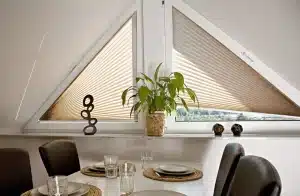
Pleated blinds in blackout fabric are used mainly for roof windows, Velux units, and conservatory panes where a roller mechanism does not fit. The concertina fold and side-channel tensioning system holds the fabric close to the glass on angled surfaces. For loft skylights and skylight pleated blinds, the side channels press the fabric edge against the frame, which reduces the gap problem specific to angled glazing.
Blackout Day and Night Blinds
Day and night blinds use alternating sheer and opaque bands, which is useful for adjusting the quality of light through the day but does not achieve the same total light blocking as a dedicated blackout blind. The opaque bands block light through the fabric, but the sheer bands always allow some light through when the blind is in the open position. If total darkness is the goal, a dedicated blackout roller or Perfect Fit blind will always outperform a day and night blind.

Blackout Velux and Skylight Blinds
If your room has a sloped ceiling window, a Velux unit, or an angled dormer, Velux blinds and sloping vertical blinds cover the specific window types that standard roller blinds cannot. Blackout fabric is available across these categories. Loft conversion bedrooms in Hornchurch in particular tend to need this approach, since the dormer window usually combines a vertical section and a sloped section, each needing its own blind.
Electric Blackout Blinds
If reaching up to adjust a blind every morning is the problem rather than just the darkness, electric roller blinds and the wider electric blinds range are available in blackout fabrics and can be set to open and close at fixed times via remote or smart home app.
Room by Room: What Actually Matters
Bedrooms
The two things that drive the choice in a bedroom are how complete the darkness needs to be and what mounting method suits the window. A south or west-facing bedroom in a terrace in Ilford gets sustained afternoon and evening sun; an outside-mounted blackout roller with a wide overlap handles that better than an inside-fit blind on the same window. A north-facing bedroom on a new-build flat with a uPVC frame is where Perfect Fit blackout tends to give the best result with the least disruption to the clean finish.
Blackout fabric is also denser than standard fabric, so it does reduce some heat transfer through the window. This is a real effect but a modest one, worth mentioning as a secondary benefit in rooms that run warm in summer rather than as the main reason to choose blackout.
Nurseries and Young Children’s Rooms
The case for blackout in a nursery is about nap times as much as nights. A room that goes dark on demand, regardless of what is happening outside, gives parents control over sleep windows during the day that makes a meaningful difference to routines.
Safety matters here before anything else, and the cord question comes up consistently in forum discussions and from parents asking during home visits. UK regulations on this are covered below.
For the window choice specifically, cordless blackout options remove the cord question entirely. Perfect Fit blackout blinds are a popular choice in children’s rooms because they operate without any accessible cord and the clip-in system means there is nothing mounted within reach of a cot or toddler bed.
Shift Workers
For day-sleeping shift workers in Barking, Dagenham, and across the surrounding postcodes, the requirement is as close to total coverage as a window blind can deliver. Blackout fabric was first developed at scale for hotel rooms specifically because travellers and irregular-hours workers needed reliable darkness on demand. The same logic applies: the mounting method matters as much as the fabric, and a properly outside-mounted blind with side overlap will outperform an inside-recess fit in the same fabric on every south or east-facing bedroom window.
Conservatories and Large Glass Extensions
Conservatories and kitchen extensions with significant glazed areas have a different problem. It is rarely about achieving complete darkness — it is about cutting the heat and glare that comes through a large area of glass, particularly on south-facing rear extensions in East London terrace housing. Blackout fabric does reduce heat transmission more than light-filtering fabric because it is denser. For roof lanterns and overhead glazing, electric pleated blinds in blackout or heavy light-filtering fabrics give the most practical solution since reaching an overhead blind manually every day is not realistic.

Child Safety: What UK Regulation Says
Blind cord safety in the UK has been covered by law since 2014. BS EN 13120 and the General Product Safety Regulations 2005 require that blinds sold for UK homes either have no accessible operating cords, or include specific safety devices — cord cleats, tensioners, or breakaway connectors — that prevent the cord from forming a loop a child can reach.
Any blind bought from a reputable UK supplier today should already meet this standard. The responsibility sits with the manufacturer and retailer, not the homeowner, to supply a compliant product.
For a nursery or young child’s room specifically, the safest option is a cordless or wand-operated blind, since no cord is present at any point. Cordless spring roller blinds and Perfect Fit blinds (which operate on a finger-push mechanism with no cord at all) are the two most common recommendations for this reason. If you already have an older blind with a free-hanging cord, a cord cleat fixed to the wall at a minimum height of 1.5 metres from the floor, with the cord wound around it, meets the minimum standard. A cordless replacement is the better long-term approach in a room where children are regularly present.
This is a practical matter, not a scare tactic. The regulation exists because cord-related incidents have happened, and the cordless options available today are genuinely usable day to day rather than a compromise.
Does Blackout Fabric Actually Help With Energy Bills?
Honestly, yes, to a modest degree. Blackout fabric is denser and heavier than standard blind fabric because the foam or acrylic backing adds mass, and denser materials slow the transfer of heat through a window surface. In winter, that reduces some cold radiating from the glass into the room. In summer, it reduces some of the solar heat gain through south and west-facing windows.
The effect is real but not dramatic. It adds up over a year rather than making an obvious difference to a single month’s bill. Some retailers quote specific percentage reductions in heat loss for blackout blinds. These figures vary significantly between products and independent testing does not always support the higher claims. If energy performance is the main reason for wanting a blackout blind, a cellular honeycomb pleated fabric will outperform a standard blackout roller fabric on thermal insulation because of its air-pocket construction. If total darkness is the main need and the thermal benefit is a welcome addition, a blackout roller or Perfect Fit blind in a standard coating gives a result worth having.
What Blackout Blinds Cost
Price depends on the blind style, window size, and whether professional fitting is included. The blackout fabric itself adds a modest amount to most base prices typically £5 to £15 over the light-filtering equivalent in the same blind style. The bigger cost variables are the style and the fitting method.
| Blind style | Typical price range per window, supply and fit | Best suited to |
| Blackout roller blind (inside recess) | £55 to £95 | Standard rectangular windows with good recess depth |
| Blackout roller blind (outside mount) | £65 to £110 | Windows needing maximum edge coverage, south-facing bedrooms |
| Perfect Fit blackout blind | £75 to £130 | uPVC windows, rented properties, tilt-and-turn frames |
| Blackout pleated blind (skylight or Velux) | £90 to £160 | Roof windows, angled dormers, conservatory panes |
| Electric blackout roller blind | £180 and upward | Hard-to-reach windows, smart home setups, wide spans |
Larger windows, patio door spans, and multiple blinds ordered together will move these figures. The only way to get an accurate number for your own window is to have it measured and quoted in person.
How We Measure and Fit Blackout Blinds Across East London
The measuring visit is what determines whether a blackout blind will actually perform as expected. Two identical fabrics on two identical-looking windows can give different results depending on how the blind was sized and how it was mounted.
On the newer builds around Beam Park and Rainham Riverside, the large uPVC units with clean modern frames are well suited to Perfect Fit blackout blinds. The clip-in system works reliably when the frame bead is the right depth, and it leaves no marks on the woodwork.
In older Victorian terrace bedrooms in Ilford and Barking, recesses tend to be deeper and the walls around the window frame give enough room for an outside-mounted roller with a proper overlap. The recess on older properties is rarely perfectly square, which is why we measure width at three points and use the narrowest figure rather than a single measurement.
In rented flats, Perfect Fit is usually the answer because it does not require wall fixings, which matters under most standard tenancy agreements.
Loft conversion bedrooms across Hornchurch are their own situation. A dormer window, or a room with a sloped ceiling window, needs the sloping or skylight approach rather than a standard roller. Blackout fabric is available on those systems, but the measuring process is different and the mounting has to account for the angle of the glass.
It is difficult to say much more specifically than that without actually seeing your window, which is exactly why we measure in person.
Frequently Asked Questions
Do blackout blinds really block out all light?
Blackout fabric blocks light through the material almost completely, but every blind needs a small clearance to operate, so light can leak around the edges. An outside-mounted blind with generous overlap, or a Perfect Fit blind clipped into the window frame, closes that gap far more effectively than a standard inside-recess fit on the same fabric.
What is the difference between blackout and dimout blinds?
Blackout fabric blocks close to 100% of light passing through the material itself, using a foam or acrylic coating on the back of the fabric. Dimout, or “room darkening,” fabric reduces and softens light without fully blocking it. For a nursery, shift-worker bedroom, or any room where total darkness matters, blackout fabric is the right specification. Dimout will not achieve the same result.
Are blackout blinds safe for a baby’s nursery?
Yes, when fitted correctly. UK regulations under BS EN 13120, in force since 2014, require blinds to have no accessible cords or to include safety devices such as cleats and tensioners. For nurseries, cordless or wand-operated blackout blinds remove the cord risk entirely and are what most fitters recommend for rooms where young children are regularly present.
Do blackout blinds help with heat and energy bills?
Blackout fabric is denser than standard fabric, so it does reduce some heat loss in winter and heat gain through south-facing windows in summer. It is a genuine secondary benefit rather than a replacement for insulation or double glazing, and it adds up over the course of a year rather than producing a dramatic monthly saving.
How much do made-to-measure blackout blinds cost?
The blackout fabric itself adds a modest amount to most base prices, typically £5 to £15 over a standard fabric in the same blind style. A single blackout roller blind for a standard bedroom window typically starts from around £55 to £95 supply and fit, with Perfect Fit and larger window sizes costing more. An accurate figure requires measuring the window first.
Which blind is best for a completely dark bedroom?
A blackout roller blind outside-mounted with a wide overlap, or a Perfect Fit blackout blind clipped into the window frame, both give strong results. Which suits your window depends on the recess depth, frame material, and whether the property is rented. A measuring visit answers that question more reliably than the fabric choice alone.
Can I get a blackout blind for a Velux or roof window?
Yes. Velux pleated blinds, skylight pleated blinds, and the relevant electric variants are all available in blackout fabric. The fitting approach for roof and angled windows is different from a standard vertical window, and the side-channel tensioning system used on skylight blinds is what holds the fabric in position against the slope of the glass.
Do blackout blinds reduce noise?
Slightly. Blackout fabric is denser than standard fabric, and denser materials absorb some sound energy rather than allowing it to pass through. The effect is modest and nothing like acoustic panels or double glazing, but in a room facing a busy road or near an area with ambient outdoor noise, it is a small additional benefit.
Book a Free Home Visit
If you are weighing up blackout blinds for a bedroom, nursery, or any room across Rainham, Beam Park, Hornchurch, Barking, Dagenham, or Ilford, we can bring samples to your property, measure the window properly, and tell you which mounting method will actually give you a dark room. There is no obligation and no pressure.
Call us on +44 1708 505379 or book your free home visit here.