The best conservatory roof blinds are tensioned pleated blinds in a heat reflective fabric, fitted one per roof panel and run on cords or a motor, because they are the only blind that holds flat against a sloping glass roof, cuts the heat where it comes in and still looks tidy from below.
For a flat roof lantern the same idea becomes a lantern blind, a single tensioned pleated or cellular blind that closes the whole opening, and for both the electric version is worth it as soon as there is more than a couple of blinds to move. If you are weighing up the best blinds for conservatory roof panes, the choice comes down to pleated, electric pleated or lantern blinds, and this guide compares them.
We make conservatory and lantern blinds in our Rainham workshop and fit them across East London and Essex, where the conservatory on the back of a 1930s semi and the lantern over a new kitchen extension are both everyday jobs. This guide explains why the roof is the part to deal with first, how pleated, electric and lantern roof blinds differ, which fabrics actually reflect heat, what to put on the side windows, what it all costs and how the blinds are fitted without touching the glass.
Why the conservatory roof matters most
The roof matters most because the sun is overhead for the hottest part of the day, so most of the heat that makes a conservatory unusable in summer comes straight down through the roof glass, not through the sides. Shade the roof and the room drops several degrees. Shade only the sides and it barely changes. The same is true in winter in reverse, where an uncovered glass roof lets the warmth out overnight.
That is why we always suggest starting with the roof when the budget will not stretch to everything at once. Side blinds can follow later and match. A conservatory with roof blinds and bare sides is a usable room in July. One with side blinds and a bare roof is still a greenhouse.
Pleated conservatory roof blinds
Pleated conservatory roof blinds are made one per roof panel, with the pleated fabric held flat against the slope by fine tension cords running from the top rail to the bottom rail, so the blind stays put at any angle and does not sag in the heat. Each blind is fixed to the glazing bars either side of the panel, never to the glass, and can be drawn open or closed by a cord or a pole from the floor.
Because every panel gets its own blind, you can shade the sunny side of the roof and leave the shaded side open, which is handy in a Victorian style conservatory where the roof faces several directions. Pleated fabric is light, folds into a slim stack at the top of the panel and comes in heat reflective and blackout grades. Our pleated blinds page covers the standard fabric ranges, and the roof versions use the same books.
Shaped panels at the ends
Most conservatory roofs are not all rectangles. A Victorian or Edwardian roof has triangular and trapezium panels at the bay end, a lean to has rectangles but often a sloping edge against the house, and a gable fronted roof has a triangle over the doors. Each of those panels gets a shaped pleated blind cut to its exact outline, templated at the measuring visit. The shaped panels cost more than the rectangles because of the hand cutting, and they are the reason a roof blind job is measured by us rather than from a drawing.
Electric pleated roof blinds
Electric pleated roof blinds use a slim motor in the top rail of each blind, run on battery or mains, and are moved by remote, wall switch, app or voice, with all the roof blinds grouped so one press shades the whole roof. On a roof with eight or ten panels that is the difference between blinds that get used every day and blinds that stay in one position because reaching each cord with a pole is a chore.
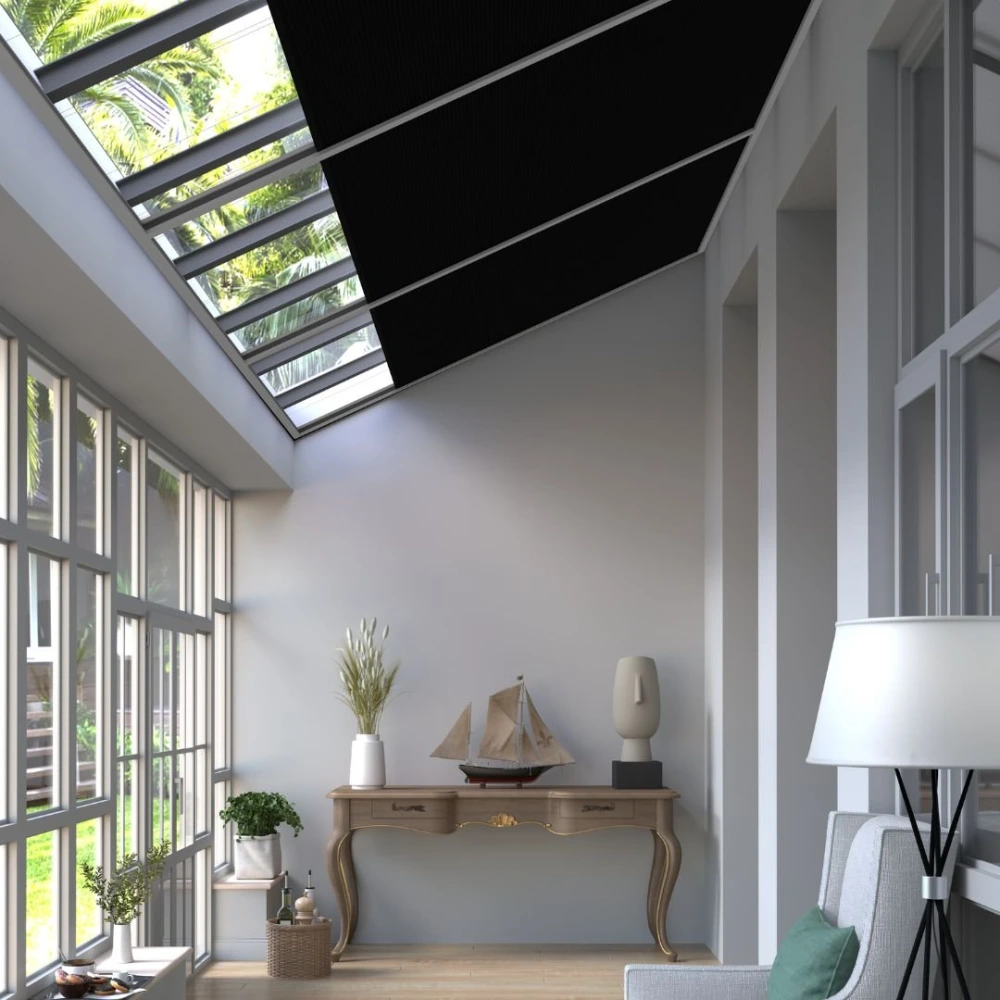
Battery motors charge by USB and, on a roof, a solar strip on the glass keeps them topped up with very little attention. Mains motors need a cable run along the glazing bars to a supply, which is neat if planned when the conservatory is built and fiddly afterwards. Schedules are where electric roof blinds earn their keep: close at midday in summer, open at four, and close again at dusk in winter to keep the warmth in. Our electric pleated blinds page explains the motor options, and the wider electric blinds page covers remotes, hubs and apps.
Lantern roof blinds
Lantern roof blinds close off a flat roof lantern from below with a single tensioned pleated or cellular blind that runs horizontally across the opening on side wires, so the lantern can be shaded or blacked out without blinds on each sloping glass face. Most are electric, because the lantern is usually in a ceiling three metres up over a kitchen island, and most are in a heat reflective or cellular fabric because a lantern over a kitchen gets very hot.
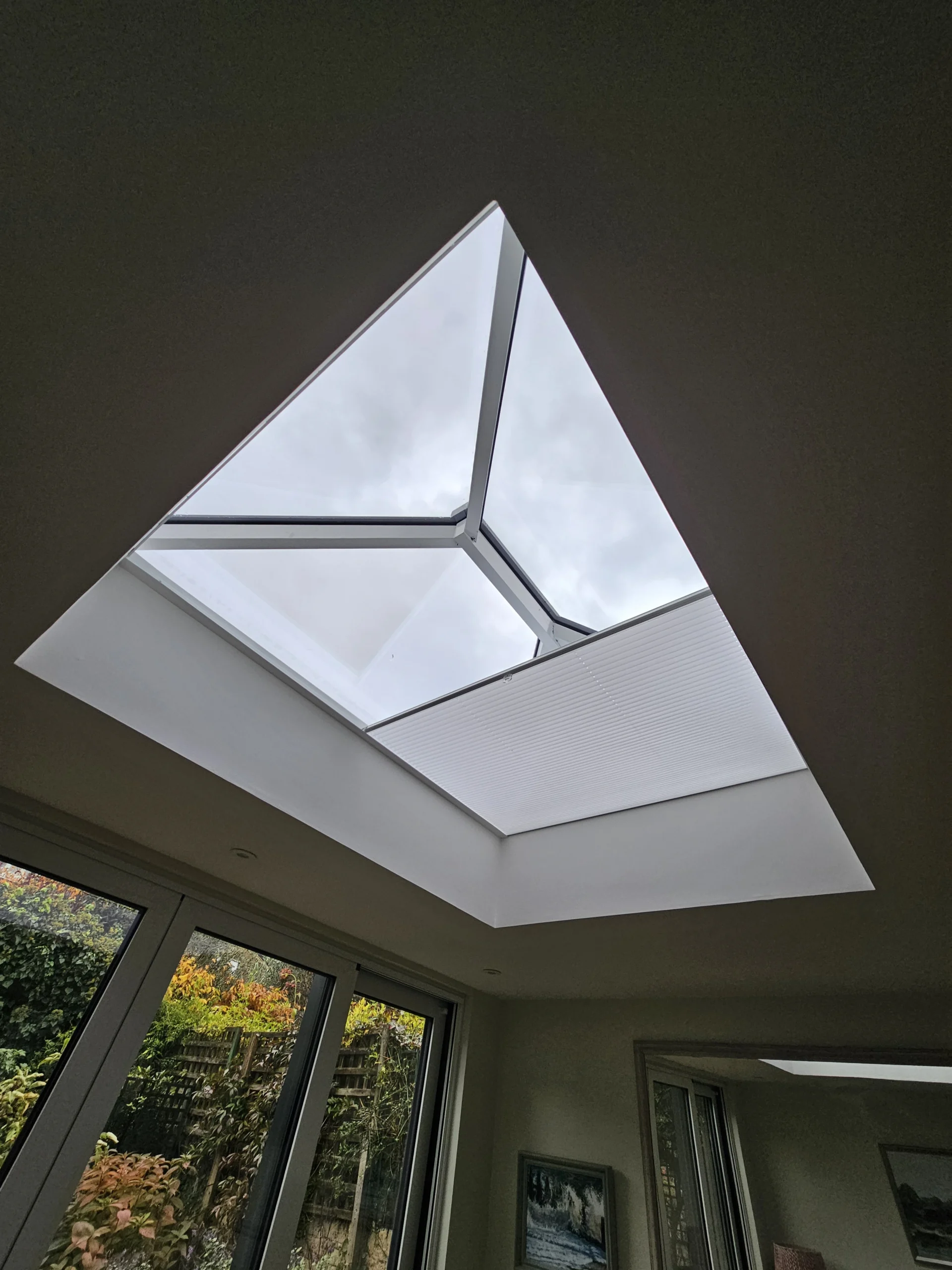
The blind fixes to the upstand or the ceiling around the lantern opening, so it does not touch the lantern frame or glass, and it draws from one end to the other or from both ends to the middle on a large lantern. The photo above shows motorised lantern blinds fitted to a flat roof lantern. Our lantern blinds page has the fabric and motor options, and very large lanterns are split into two blinds on one remote.
Heat reflective fabrics for conservatory roof blinds
Heat reflective fabrics for conservatory roof blinds have a metallised or pearlised backing that faces the glass and bounces a share of the sun’s heat back out before it reaches the room, and they make a bigger difference on a roof than the colour or weight of the fabric. The side that faces the room can be any colour from the range, so the conservatory does not have to look like foil from inside.
- Pleated with a reflective backing: the standard roof fabric, light, folds slim, good heat rejection.
- Cellular or honeycomb: two layers trapping air, the best for keeping warmth in during winter and good at blocking heat in summer, slightly bulkier stack.
- Blackout cellular: for a conservatory used as a television room or a bedroom extension, blocks light as well as heat.
- Light filtering voile: softens glare but does little for heat, best kept for the sides or a north facing roof.
Pale room facing colours reflect more and keep the room brighter, dark colours absorb more and make the fabric itself warm. On a south or west facing roof we steer customers to a reflective backed pleated or a cellular fabric in a light colour. The written quote names the fabric so you can check its backing before ordering.
Side blinds to go with the roof
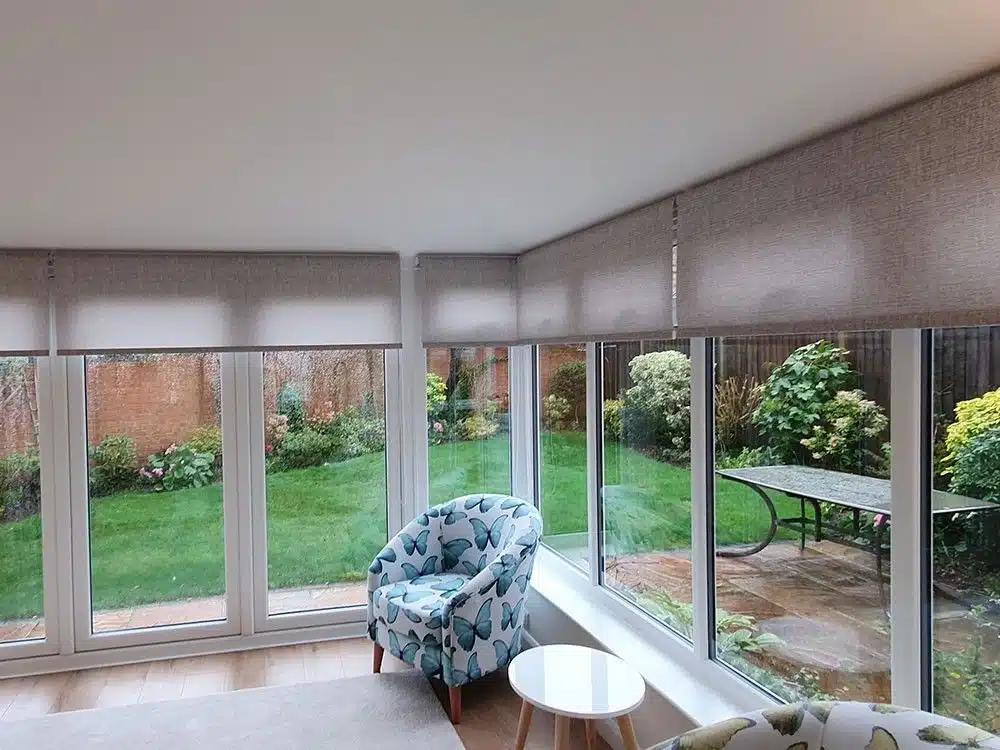
Side blinds for a conservatory are usually Perfect Fit pleated blinds on uPVC frames, because they clip to the glazing bead with no drilling, tilt open with the windows and match the roof fabric, with vertical blinds or free hanging pleated blinds as the alternatives on timber or aluminium frames. The sides matter for privacy and glare in the morning and evening when the sun is low, which the roof blinds cannot help with.
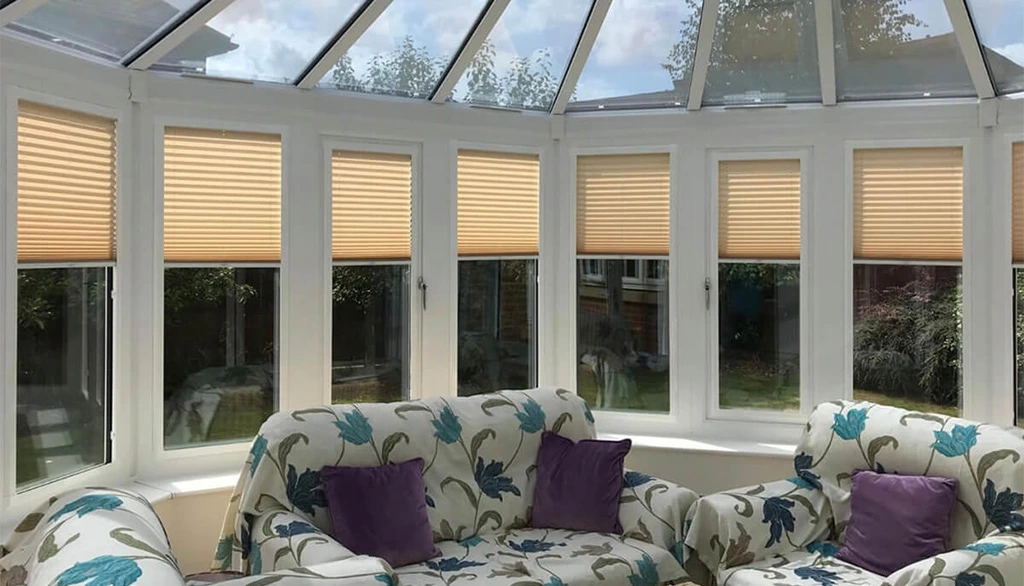
Our guide to Perfect Fit conservatory blinds covers the side windows in detail and Perfect Fit pleated blinds are the product most often used. On a conservatory with French doors, the doors get the same Perfect Fit treatment so they open with the blind in place. Vertical blinds on the sides suit a larger, more open plan garden room where the glass runs floor to ceiling.
How much do conservatory roof blinds cost
Conservatory roof blinds are priced per roof panel, so the number of panels and how many are shaped sets the figure more than the overall size of the conservatory. Our pleated blinds, including conservatory roof blinds, start at £120 per blind and most fall between £120 to £490 per blind, with shaped end panels in the upper part of that range. Adding a motor to a roof blind starts at £80 per blind, and electric and motorised blinds as a complete product start at £250.
| Item | Counted as | From |
|---|---|---|
| Pleated roof blind, rectangular panel | One per panel | £120 |
| Pleated roof blind, shaped panel | One per panel, upper range | £120 |
| Motorised upgrade per roof blind | Added to each blind | £80 |
| Lantern roof blind | One blind per lantern, two if very large | £250 |
| Perfect Fit side blinds | One per pane or door | £60 |
| Vertical side blinds | One per run of glass | £75 |
A typical lean to with six roof panels is a smaller job than a Victorian roof with twelve panels, four of them shaped, and the written quote lists every panel so you can see where the money sits. Fitting is included, and the home visit to measure and template is free.
How conservatory roof blinds are fitted
Conservatory roof blinds are fitted to the glazing bars between the roof panels, using small brackets screwed into the bar caps or clipped under them, so nothing is ever fixed into the glass and the roof seals are not disturbed. Each blind is tensioned on its cords once it is up, so it sits flat whatever the slope, and the cords or motors are set so every blind stops at the same point.
On a polycarbonate roof we check the bar caps will take a fixing, and on an aluminium roof we use the fixings the roof maker intended. Fitting a full roof takes most of a day, longer with shaped panels and motors, and we work from inside on steps or a platform, so the garden is not involved. Lantern blinds fix to the plasterboard upstand or the ceiling and need sound fixings there, which we check at the visit. For roof windows in a solid roof rather than a glass one, skylight pleated blinds are the equivalent product.
Conservatory roof blinds in East London and Essex homes
Around Rainham, Hornchurch, Elm Park and Dagenham the typical conservatory is a uPVC lean to or small Victorian style added to the back of a 1930s semi, with a polycarbonate or glass roof of six to ten panels facing the garden, and those take cord operated or battery electric pleated roof blinds in a reflective fabric with Perfect Fit sides. Upminster, Harold Wood and the larger houses towards Brentwood have bigger Edwardian and gable fronted conservatories with more shaped panels, where electric roof blinds on a schedule are the norm.
Across Romford, Ilford and Barking, and in the newer houses in Grays and South Ockendon, the conservatory is giving way to the kitchen extension with a flat roof lantern or two, and there the job is a motorised lantern blind per lantern with electric blinds or curtains over the bifolds below. Orangeries, with a solid roof and a central lantern, get the same lantern blind. Whatever the roof, we measure and template every panel ourselves, make the blinds in Rainham and fit them, so the shaped end panels and the tension are right first time.
Every blind we make is fitted to current UK child safety rules. The Make it Safe campaign from the British Blind and Shutter Association explains what to check on blinds you already own.[1]
Frequently asked questions about best blinds for conservatory roof
Do conservatory roof blinds reduce heat?
Yes. Most summer heat enters through the roof glass, and a reflective backed pleated or cellular roof blind bounces a share of it back out before it reaches the room, which makes a noticeable difference on a sunny afternoon.
Can conservatory roof blinds be remote controlled?
Yes. Electric pleated roof blinds have a motor in each top rail, grouped on one remote, wall switch or app, and can run on a schedule or by voice through a hub.
Do roof blinds work on a sloping glass roof?
Yes. Tension cords hold the pleated fabric flat against the slope at any angle, so the blind stays where it is put and does not sag.
Can you fit blinds to a roof lantern?
Yes. A lantern blind runs horizontally across the opening from below on side wires, fixed to the upstand or ceiling, and is usually motorised because of the height.
Do conservatory roof blinds keep the room warmer in winter?
They help, especially cellular fabrics, which trap a layer of air under the glass and slow the heat escaping overnight. Closing them at dusk makes the most difference.
How are conservatory roof blinds cleaned?
A soft brush or the upholstery tool on a vacuum removes dust, and most pleated fabrics can be wiped with a damp cloth. They are out of reach of splashes and need little attention.
Get a free home visit in Rainham and East London
If you are still deciding on best blinds for conservatory roof, if your conservatory is too hot in summer or too cold in winter, or you have a roof lantern that needs shading, book a free home visit or call 01708 505379. We measure and template the roof at your home across Rainham, Hornchurch, Upminster, Romford, Ilford, Grays and the rest of East London and Essex, make the blinds in our Rainham workshop and send a written quote after the visit.
References
- ^ Make it Safe from the BBSA. Make it Safe (British Blind and Shutter Association). Retrieved 25 October 2026.