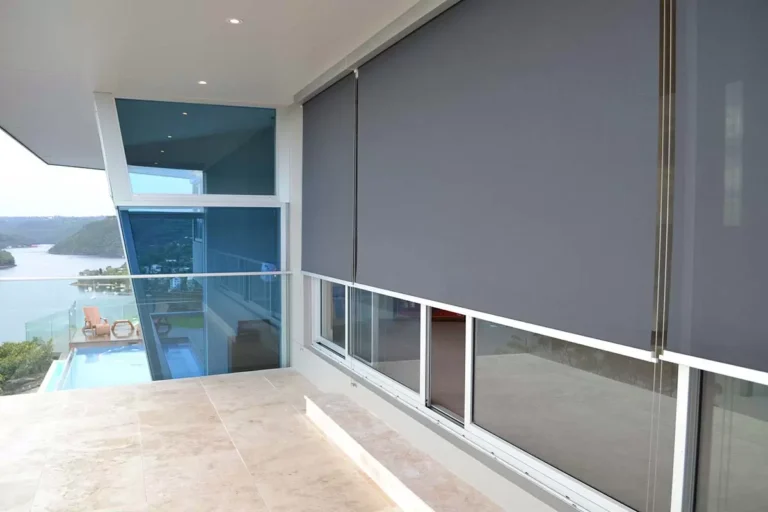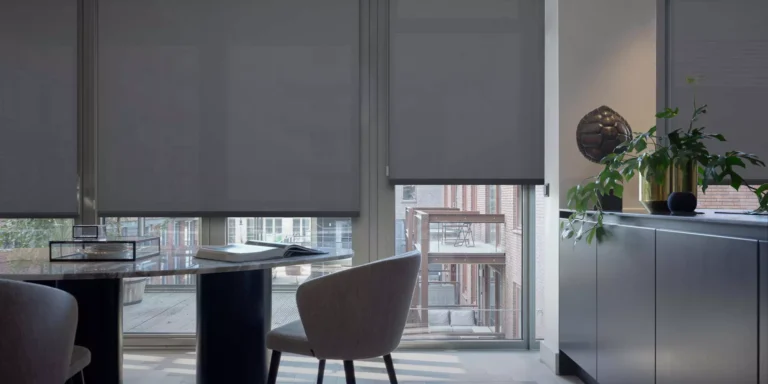
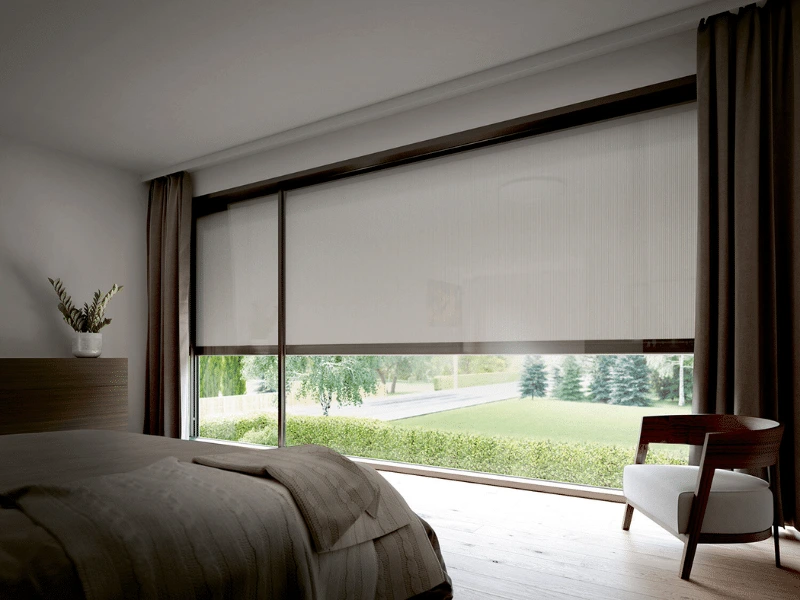
Smart blinds are made to measure electric blinds whose motor connects to your home Wi-Fi through a small hub, so you can move them by voice through Alexa or Google Home, from an app on your phone, or automatically on a timer. The blind itself is the same roller, pleated, vertical or day and night blind we make in Rainham, with a motor in place of the chain.
We fit smart blinds across East London and Essex, from flats in Canary Wharf and Stratford to semis in Hornchurch and Upminster, and the questions are always the same: what do I need to buy, does it need a hub, will it work with the speaker I already have, and what does it cost. This guide answers each of those in plain words, then explains which blind types can be made smart and what we would set up in a typical home.
What makes a blind a smart blind
A blind becomes smart when its motor can receive commands from the internet rather than only from a handheld remote. The motor sits inside the tube or headrail, exactly as on any electric blinds we fit. On its own it listens to a radio remote. Add a hub that speaks the motor’s radio language on one side and Wi-Fi on the other, and the blind can be reached by an app, by Alexa or Google, and by schedules that run whether you are home or not.
Remote only or smart
Plenty of customers are happy with a remote on the bedside table and never want more. That is a motorised blind, not a smart blind, and it is a perfectly good choice. The step to smart is the hub, and because the motors are the same, you can fit the blinds with a remote today and add the hub later without touching the blinds. We usually suggest that route to anyone unsure whether they will use the app.
Smart blinds with Alexa, Google Home and Apple HomeKit
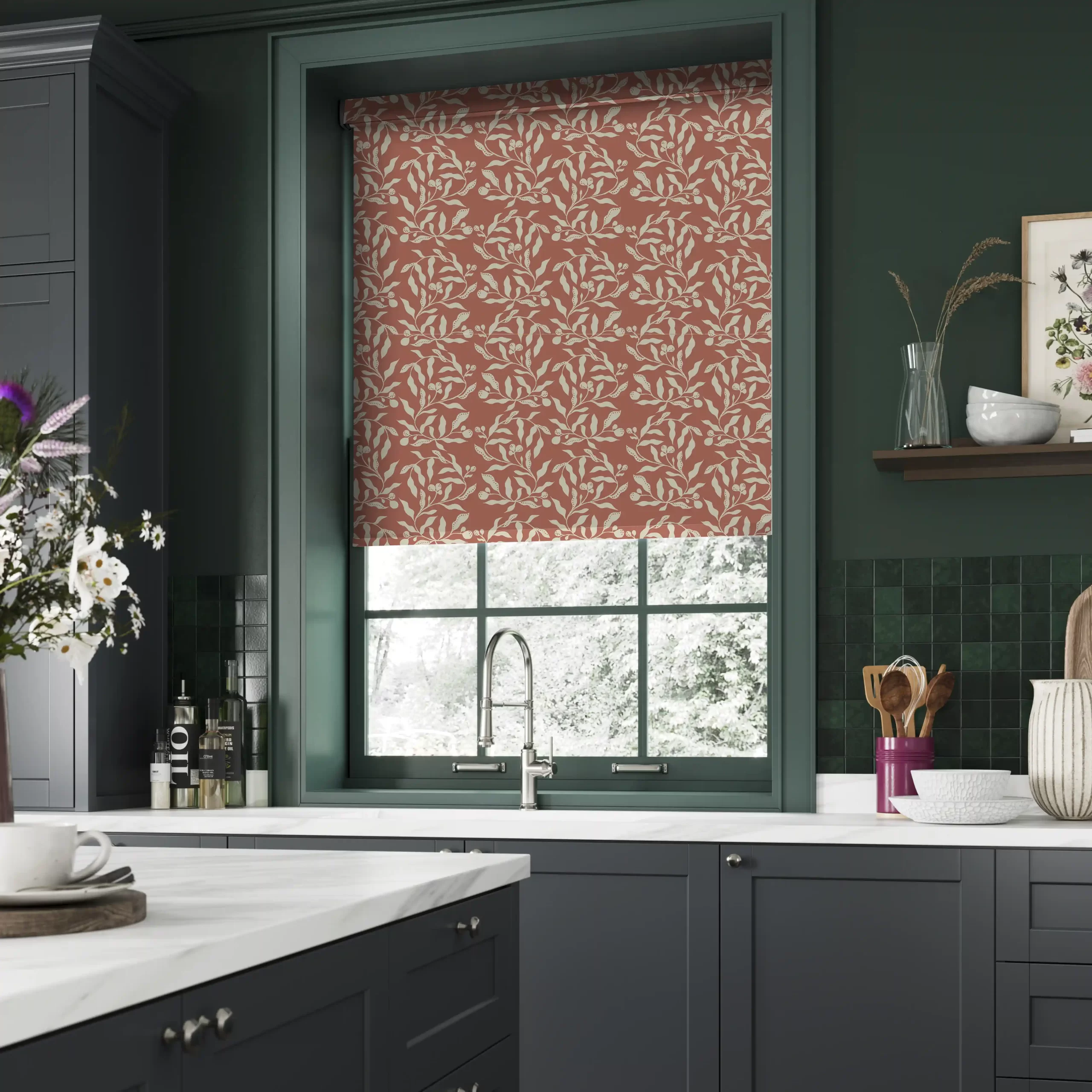
Smart blinds work with Alexa and Google Home by linking the blind maker’s app to your Amazon or Google account, after which each blind appears as a device you can name and command by voice. You say the name you gave the blind or the room, and a position. Asking for the bedroom blinds to close, or the kitchen blind to go to half, is handled by the hub, which passes the command to the motor over radio.
Alexa and Google both support open, close, stop and a percentage position, and both let you group blinds with lights and heating into routines. Apple HomeKit support depends on the motor brand and hub. Some hubs are HomeKit certified and show up in the Home app with Siri control, others reach Apple devices only through a bridge. If HomeKit matters to you, say so at the measuring visit and we will specify a system that supports it directly.
What you can and cannot say
Voice control is good at simple instructions and groups. It is less good at fine adjustments, where the app or the remote is quicker. Most people end up using voice for the big daily moves, the app for schedules and the remote for the odd nudge. All three work side by side, and a blind moved by remote shows its new position in the app a moment later.
Do smart blinds need a hub
Yes, almost all smart blinds need a hub, because the motors in the blinds use a low power radio rather than Wi-Fi, and the hub is the translator between that radio and your router. The hub is a small box, about the size of a plug adaptor, that sits anywhere central in the home and plugs into a socket. One hub covers a normal house, and a larger home or a home with thick walls may need a second.
A few motors now have Wi-Fi built in and skip the hub. They work, but they draw more battery and each blind becomes another device on your router, so for a house full of blinds we still prefer a hub. A remote only installation needs no hub at all. Our motorised blinds in London page covers the remote and switch options if that is all you want.
App controlled blinds: timers, sunrise schedules and scenes
App controlled blinds let you set each blind to move at a fixed time, at sunrise or sunset adjusted for your postcode, or as part of a scene with other devices. A schedule runs on the hub, so it keeps working if your phone is off or you are away, which is useful for making a house look occupied.
Routines we set up most often
- Bedroom blackout blind opens a few minutes after a weekday alarm and stays shut at the weekend.
- Living room blinds close at sunset all year, which moves with the seasons without being touched.
- Kitchen diner blinds drop to half height on summer afternoons when the sun comes round to the bifolds.
- A home office blind closes while a meeting room scene turns on a lamp and dims the glare.
- Holiday mode moves blinds at slightly random times so the house does not look empty.
Most apps also store a favourite position per blind, so a single tap sends a blind to the height you use most. The sunrise and sunset times are worked out from your location, so a blind in Grays and a blind in Greenwich on the same account will move at the right local moment.
Which blind types can be made smart
Roller, day and night, pleated, cellular, vertical and Venetian blinds can all be motorised and connected to a hub, and so can curtain tracks. The motor and the hub are the smart part, so the choice of fabric and style is as wide as for any manual blind.
- Electric roller blinds are the simplest and the most common, with blackout, dimout and sunscreen fabrics.
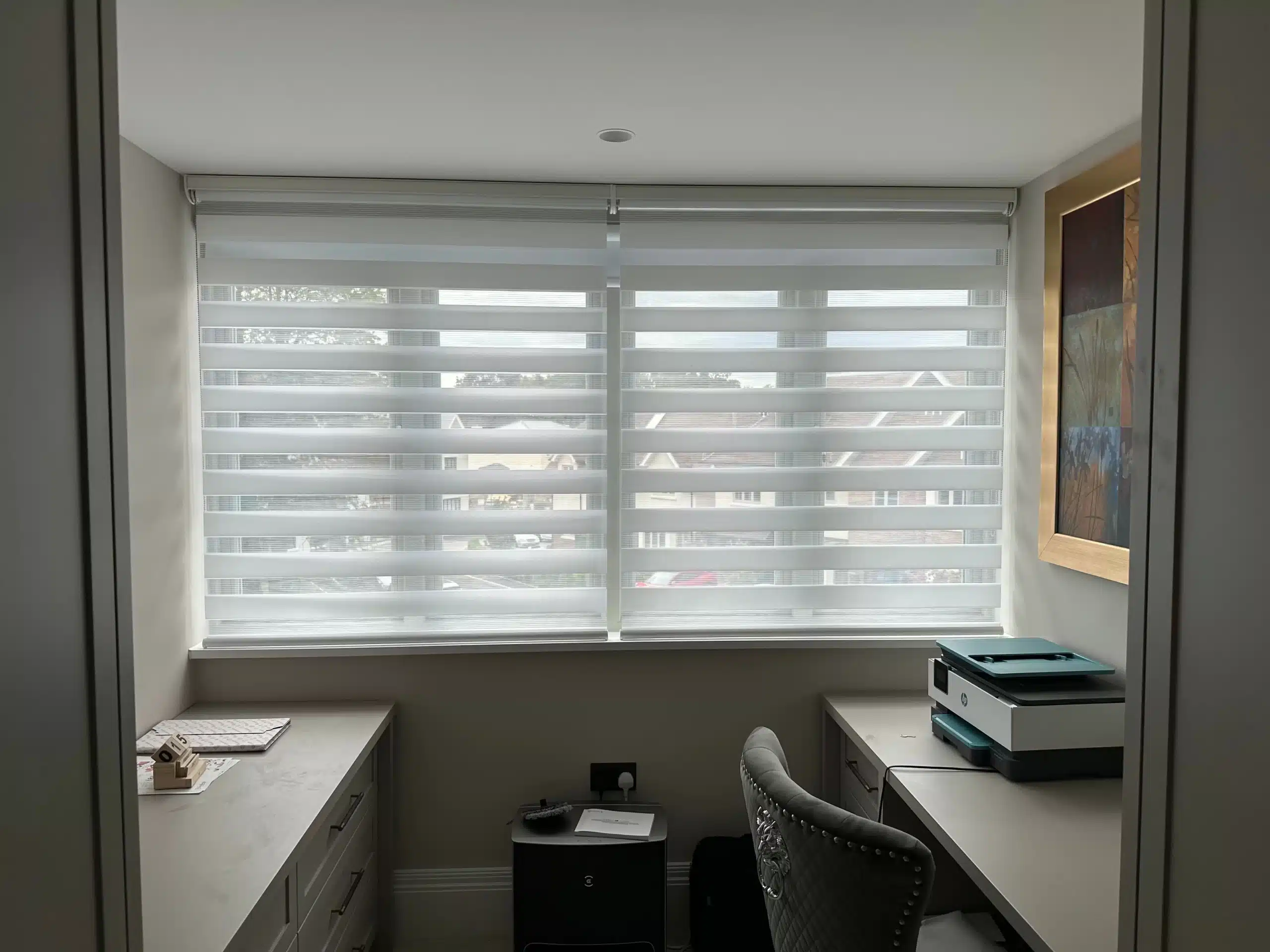
- Day and night electric blinds give you privacy with light during the day and are popular in living rooms facing the street.
- Electric pleated blinds suit conservatory roofs, roof lanterns and shaped windows, and are often run as a group.
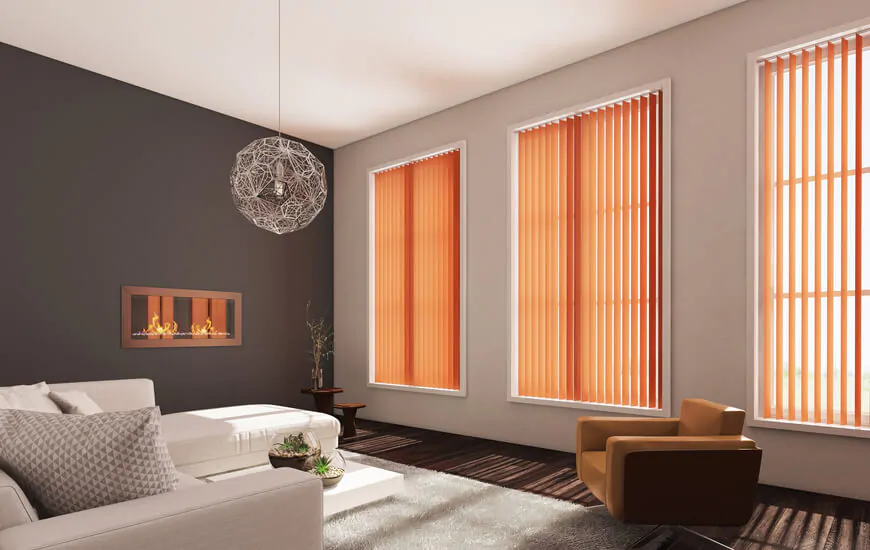
- Electric vertical blinds cover wide patio doors and office style windows, and tilt as well as draw.
- Electric curtains on a motorised track pair with blinds in the same app for bedrooms and living rooms.
- Cassette electric blinds hide the roll in a neat headrail and are a good fit for new build flats.
How much do smart blinds cost
The cost of smart blinds is the cost of the electric blind plus a hub, and the hub is a one off purchase for the whole home rather than per blind. Our electric and motorised blinds start at £250 and most fall between £250 to £600 per blind. Adding a motor to a blind you are already buying starts at .
The hub price depends on the system and whether it supports HomeKit, so we show it as a separate line in the written quote rather than guess here. There is no subscription on the systems we fit, and the apps are free. For a room by room breakdown of the blinds themselves, see our electric blinds installation cost guide.
| What you are paying for | How it is priced | Notes |
|---|---|---|
| Electric blind with motor | From £250 per blind | Size, fabric and blind type set the figure |
| Motorised upgrade to a manual blind | From | Battery motor swapped for the chain |
| Smart hub | One per home, shown in the quote | Not needed for remote only |
| Remote or wall switch | Usually included with the first blind | Extra remotes are optional |
| Fitting and set up | Included in our written quote | We pair the hub and app before we leave |
Adding smart control to blinds you already have
If you already have electric blinds with a remote, you can usually make them smart by adding a hub from the same system, with no change to the blinds. If you have manual chain blinds, the answer depends on the tube. A roller with a reasonably sized tube and a good fabric can take a battery motor in place of the clutch. A small tube, a worn fabric or a blind that was cheap to begin with is better replaced with a new electric blind, because the motor would cost more than the blind is worth.
What a retrofit involves
For a roller that is worth converting, we take the blind down, remove the chain clutch and idle end, slide a battery motor into the tube with the right crown and drive adaptor, and refit it on new brackets that take the motor head. The fabric is not touched. We then pair the remote, set the limits and, if you have a hub, add the blind to the app. It is normally done in well under an hour per blind, and the result is the same as a new electric blind apart from the age of the fabric.
Pleated and Venetian blinds are harder to retrofit because the motor has to match the headrail, so those are nearly always new blinds. We will tell you honestly at the home visit which of your existing blinds are worth converting and which are not.
Smart blinds in East London homes: flats, semis and extensions
In the new build flats around Canary Wharf, Stratford, Canning Town and Barking Riverside, smart blinds are mostly battery roller or cassette blinds on floor to ceiling glazing, grouped by room and run on a sunset schedule. Leases in these blocks often restrict drilling into the window frames, so we fix into the ceiling or the recess, or use a Perfect Fit frame on the bead, and the hub sits by the router.
In the 1930s semis across Rainham, Hornchurch, Elm Park and Romford, the typical job is a blackout roller in each bedroom on an alarm schedule and a day and night blind in the bay at the front, all on one hub. Bays work well because the app groups the three or five blinds as one. Rear extensions in Upminster, Grays and South Ockendon bring bifolds and lantern roofs, where electric pleated roof blinds and a wide roller or electric curtain over the doors are set to react to the afternoon sun.
Older terraces in Ilford, East Ham and Barking have smaller windows and slimmer reveals, and here a battery roller fixed to the face of the frame keeps things tidy. Wherever the home is, we measure in person, make the blinds in our Rainham workshop, fit them and set up the hub, the app and the voice assistant before we leave, so you are not left with a box of parts and a manual.
Every blind we make is fitted to current UK child safety rules. The Make it Safe campaign from the British Blind and Shutter Association explains what to check on blinds you already own.[1]
Frequently asked questions
Do smart blinds need a hub?
Yes for voice and app control, because the motors use a low power radio and the hub links that radio to your Wi-Fi. A remote only installation does not need one.
Can I add smart control later?
Yes. The motors are the same whether or not a hub is present, so you can fit electric blinds with a remote now and add the hub and app at any time without changing the blinds.
Do smart blinds work without Wi-Fi?
The remote keeps working with no Wi-Fi at all, and schedules stored on the hub carry on. Voice control and the app from outside the home need the internet.
Can smart blinds open on a timer?
Yes. You can set fixed times, sunrise and sunset for your postcode, different weekday and weekend rules, and scenes that move several blinds together.
Are smart blinds battery or mains?
Either. Battery motors charge by USB a few times a year and need no wiring, mains motors suit new builds and very large blinds. Both connect to the same hub and app.
Can one app control blinds in every room?
Yes, as long as the blinds are on the same system. One hub covers a normal house, and the app lets you group blinds by room or by the whole home.
Get a free home visit in Rainham and East London
If you are still deciding on smart blinds, if you would like smart blinds that work with the speaker and phone you already have, book a free home visit or call 01708 505379. We measure at your home across Rainham, Romford, Hornchurch, Ilford, Stratford, Canary Wharf and the rest of East London and Essex, make the blinds in Rainham, fit them, set up the hub and app, and send a written quote after the visit.
References
- ^ Make it Safe from the BBSA. Make it Safe (British Blind and Shutter Association). Retrieved 25 October 2026.