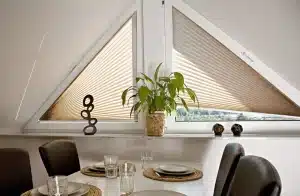
Loft conversions, dormer windows and 1930s bay fronts all get called “angled windows,” but they’re not the same problem, and that matters if you’re asking whether Perfect Fit blinds will work on yours.
Perfect Fit blinds clip into the rubber beading of a standard uPVC window, and that system is built for flat, rectangular glass. If your window has a rectangular opening below or beside a sloped section, Perfect Fit will usually cover the rectangular part perfectly well. If the whole pane itself is angled or triangular, such as a roof light or a gable end apex window, Perfect Fit isn’t the right system, and no UK manufacturer we’re aware of makes one that clips onto a genuinely sloped uPVC bead. That’s not us being cautious, it’s the same answer you’d get from any fitter who’s honest about how the frame is engineered.
What we use instead for a true slope is a sloping vertical blind, where the headrail itself is cut to follow the pitch of the window. Below, there’s a quick way to check which one you’ve actually got.
What “angled window” actually means in your house
People searching for this usually mean one of three different things, and knowing which one you’ve got changes the whole answer.
The first is a rectangular window with a sloped section above or beside it, common in loft conversions where a dormer creates a standard uPVC unit under a pitched roofline. The glass you’d actually cover is still a rectangle, even if the room around it isn’t.
The second is a genuinely sloped or triangular pane, where the glass itself follows the roof pitch or comes to a point, such as a single-slope roof light, a staircase window set into an angled wall, or a triangular gable end apex. There’s no straight, flat rectangle to clip a frame onto.
The third is something people mix up with the other two: an angled bead profile. uPVC windows use either a squared or a chamfered (angled) bead to hold the glass in place, which affects which Perfect Fit bracket you need, but has nothing to do with whether the window itself is sloped. A window with a chamfered bead can still be perfectly rectangular.
If you’re not sure which of the three you’re looking at, the checklist further down will help.

How the clip-in frame works, and why shape matters
Perfect Fit blinds don’t attach to the wall or the window frame with screws. Small brackets slide between the glass and the rubber gasket that holds the pane in place, and a slim frame then clips onto those brackets. Once it’s on, the blind sits inside that frame and moves with the window when it opens or tilts.
That system depends on four straight edges and four right angles. The frame components, the corner joints, the straight rails, are manufactured to fit a rectangle. On a genuine slope, there’s no straight top edge for the frame to clip along, and no manufacturer makes a bendable or pre-angled Perfect Fit rail. This is the same limitation you’ll find stated by Perfect Fit suppliers across the UK, not something specific to us.
Where the system works well on an angled-window property
None of this means Perfect Fit is off the table in a house with angled windows, most homes like this have a mix.
It works well on the rectangular sections of a dormer, where the main window is a standard uPVC unit and the slope belongs to the roof or ceiling around it, not the glass. It also works on angled bay windows where each individual pane is a separate rectangular uPVC unit set at an angle to its neighbours, since Perfect Fit only needs to clip to one pane at a time. And it works on tilt-and-turn windows fitted into an angled wall reveal, as long as the window unit itself is square.
In other words, it’s the shape of the glass that matters, not the shape of the room or the wall it sits in.

Where it doesn’t, and what we fit instead
Where the glass itself is sloped or triangular, such as a single-pitch roof light, a staircase window following the roofline, or a triangular gable end, Perfect Fit isn’t the right fit, and we’ll say so rather than trying to make it work.
For these, we usually recommend sloping vertical blinds, which use an angled aluminium headrail cut to the exact pitch of your window, so the vanes hang evenly along the slope instead of drooping under gravity the way a standard blind would. For a Velux or other roof window specifically, our Velux blinds range is built for that fitting rather than a wall-mounted uPVC frame.
There’s no single blind that suits every angled window in a house, and anyone who tells you otherwise is probably selling you the wrong thing for at least one of your windows.
A two-minute way to check which one you’ve got
Before you get in touch, this’ll tell you roughly what you’re dealing with.
- Lay a straight edge, or just a book, flat against the top of the window. If it sits flush all the way along, the pane is rectangular, even if the wall around it slopes.
- If the straight edge rocks or leaves a gap at one end, the glass itself is angled, and you’re likely looking at a sloping vertical blind rather than Perfect Fit.
- Check whether the window opens or tilts. Perfect Fit is built to move with an opening uPVC window, so this only applies if the pane is also rectangular.
- If you’ve got a triangular or point-topped window, that’s always a sloped-glass case, not a Perfect Fit one.
If you’re still not sure, that’s exactly what the free home visit is for, we’d rather look at it than guess over the phone.
What we see fitting across Rainham and East London
Angled windows show up differently depending on the property. On the newer builds at Beam Park, we’re regularly fitting Perfect Fit to large rectangular uPVC units set into angled glazed corners, standard glass, unusual layout. In the loft conversions we see across Hornchurch, it’s almost always a dormer with a rectangular window and a sloped ceiling, which is a straightforward Perfect Fit job once you know that’s what it is. And in the older bay-fronted terraces around Barking, the angled bay panes are individually rectangular, so each one takes its own Perfect Fit blind rather than one blind trying to wrap the whole bay.
The genuinely sloped cases, staircase windows and roof lights mostly, are the ones where we’re fitting sloping vertical blinds instead, and they turn up in roughly the same mix of properties.
What it costs
Price depends on the size of the glass and the fabric you choose, rather than on whether the property has other angled windows elsewhere, since each blind is quoted on the pane it’s actually fitted to. Here’s roughly what to expect for a Perfect Fit window in 2026:
| Window or style | Typical price |
| Small top-opener or fanlight roller (approx. 40 to 60cm) | From £68 |
| Standard Perfect Fit blind, Roller, Venetian or Pleated | £60 to £180 |
| Premium thermal, faux wood Venetian, or larger patio doors | £220+ |
For the full breakdown by window type and fabric, our Perfect Fit price guide covers what to expect. A sloping vertical blind is priced separately, based on the drop and the pitch of the slope, and we’ll give you both figures at the same visit if your windows are a mix of the two.
How we measure and fit yours
We measure every window by hand during a free home visit, bringing our full sample range so you can see fabrics in your own light before deciding. What we actually measure depends on which type of window you’ve got:
| Window type | What we measure |
| Rectangular Perfect Fit window | Width and drop, taken in three places to allow for any movement in the frame |
| Genuinely sloped or triangular window | Width, plus the longest drop at the tallest point and the shortest drop at the lowest point, to capture the exact pitch |
Once you’ve chosen your fabric and frame colour, your blinds are made to measure in the UK, and we’ll book a fitting date in advance so you know when to expect us. Everything is measured and fitted by our own team, no subcontractors, so the same person who measured your windows is the one who fits them. Before we leave, we’ll show you how everything operates, and we’re easy to reach afterwards if you need adjustments or advice.
What people ask us about angled windows
Can Perfect Fit blinds be fitted to angled or sloped windows?
Perfect Fit blinds clip into the beading of a uPVC window, which works best on flat, rectangular openings. Genuinely sloped or triangular glass, such as loft roof lights or apex gables, usually needs a different system. Sloping vertical or pleated blinds are built to follow that kind of angle instead.
What’s the difference between Perfect Fit blinds and sloping vertical blinds?
Perfect Fit blinds clip directly onto a rectangular uPVC window or door, moving with it when opened. Sloping vertical blinds use an angled headrail that follows the pitch of a loft, staircase, or bay window. Choosing between them comes down to whether your window is a standard shape or genuinely angled.
Do angled window blinds help with insulation?
Yes. A blind that sits close to angled glass, whether Perfect Fit on a rectangular section or a sloping vertical on the angled part, creates a barrier against heat loss. This matters most in loft conversions, where large areas of glazing can make a room cold in winter and warm in summer.
How do you measure an angled window for blinds?
You need two drop measurements, the longest point and the shortest point of the slope, plus the width. For a genuinely sloped or triangular window, the angle itself also has to be recorded. This is why we measure by hand during a free home visit rather than relying on a self-measure.
Can Perfect Fit blinds be motorised for hard-to-reach angled windows?
Perfect Fit systems are mostly manual, since the frame is designed for reach-friendly rectangular windows. For angled windows positioned high up, such as a stairwell or gable end, a motorised sloping vertical or pleated blind is usually the more practical choice, and we can talk you through both at your free visit.
Book your free home visit
If your property has a mix of window shapes, the easiest way to sort out which blind goes where is to have us look at it in person. We’ll bring samples, measure everything properly, and tell you honestly which windows are a Perfect Fit job and which need something built for the slope. Get in touch to book your free home visit across Rainham, Romford, Hornchurch, Barking, Dagenham, Ilford and the rest of East London.