Made to measure curtains from HomeDecisions start at £160 per pair including the track or pole and fitting, and most windows fall between £160 to £890 per pair. The figure is driven by how much fabric the window needs, the fabric grade, the lining and the heading style, which is why a small bedroom window and a wide bay can differ by several times. That is the short answer on made to measure curtains cost.
We make curtains in our workshop in Rainham and fit them across East London and Essex, from Romford and Hornchurch to Ilford and Stratford. This guide explains what each part of a pair of curtains adds to the price, how fabric quantity is worked out, what poles, tracks and fitting involve, and why a made pair costs more than a ready made pair from a shop. Everything here comes from our own price list, and the written quote after a home visit gives the exact figure for your windows.
How much do made to measure curtains cost per window
Per window, a pair of made to measure curtains from us costs from £160, with the track or pole and the fitting included, and the price rises with the width of the window, the drop, the fabric you choose and the lining. A small bedroom window in a plain cotton with standard lining sits at the bottom of the range. A floor length pair across a three pane bay in a heavier fabric with blackout lining and a pinch pleat heading sits at the top.
Our price is per pair, not per curtain, and it is the fitted price. There is no extra for the measuring visit, no extra for hanging and no extra for taking away the packaging. If a pole is dearer than our standard range, or you want an electric track, that shows as a separate line on the quote so you can see it.
Fabric, lining and heading: what each adds to the cost
Fabric is the largest part of the cost of a pair of curtains, lining is the second, and the heading style decides how much fabric you need in the first place. Change any one of the three and the price moves.
Fabric grade
Fabrics are priced per metre, and the difference between a plain polyester cotton and a woven linen, a velvet or a designer print is large. A pair of curtains for a 2 metre window can use five or six metres of fabric, so a change of a few pounds a metre at the sample stage becomes a noticeable change on the quote. We bring sample books to the home visit, and we will always say which fabrics are at the cheaper end if the budget matters.
Lining choices
Standard cotton sateen lining is included in our base price. Blackout lining adds a little per metre and is worth it in a bedroom, because it also helps with noise and warmth. Thermal lining and interlining, which is a soft layer between the fabric and the lining, add more again, and interlining also uses more labour because it is hand stitched in. Unlined curtains save money but hang less well and fade faster on a sunny window, so we rarely suggest them except for voiles.
Heading styles
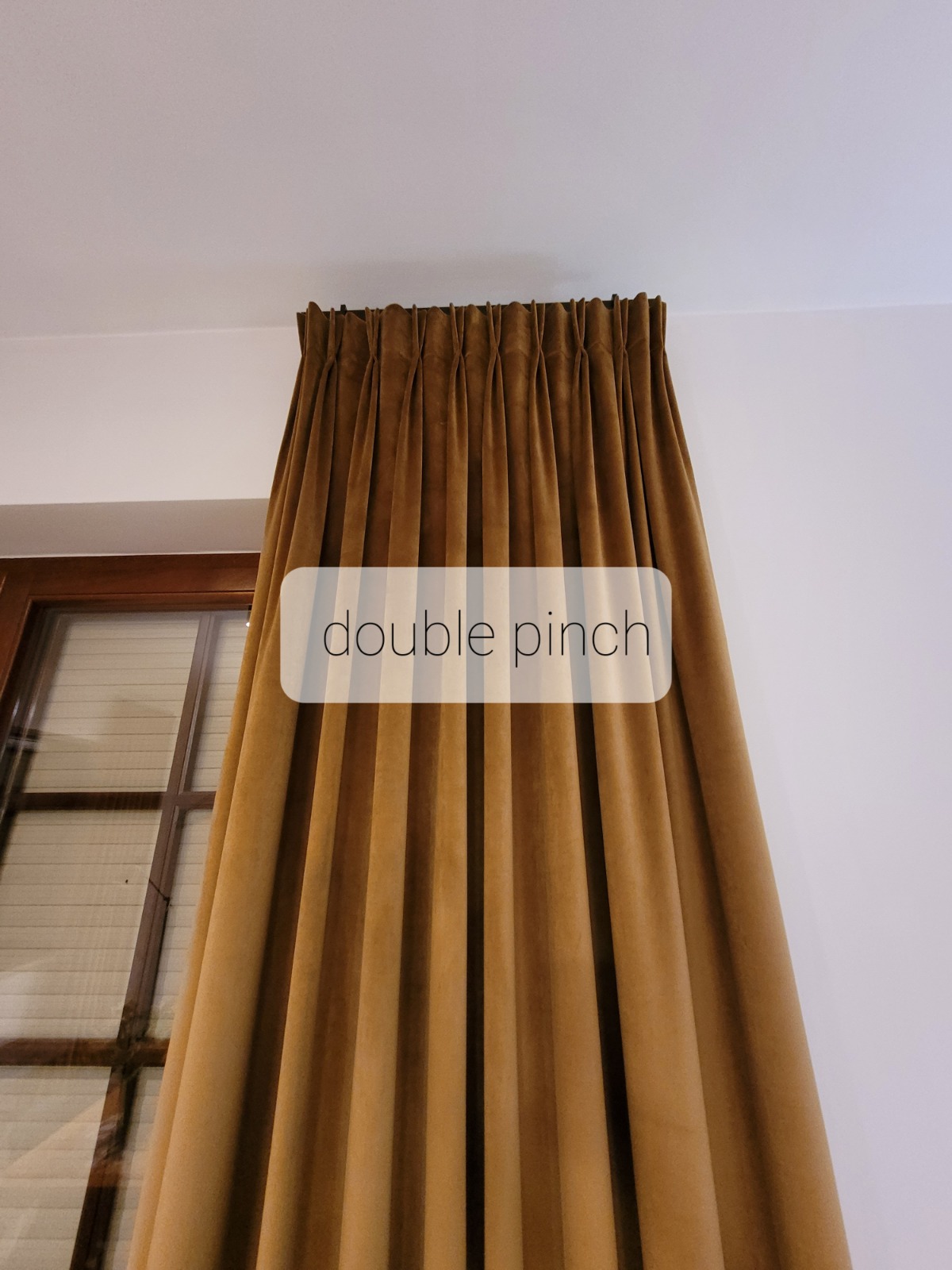
The heading is the top of the curtain, and it sets the fullness. Pencil pleat is the standard and uses around twice the track width in fabric. Eyelet curtains hang on a pole, use a little less fabric and are quick to make. Pinch pleat, double pinch and triple pinch use more fabric, up to two and a half times the width, and take longer to make by hand, so they cost more. Wave heading on a track uses a special tape and gliders and sits between pencil and pinch on price. The heading also decides whether you need a pole or a track.
Curtains price per metre: how fabric quantity is worked out
The fabric for a pair of curtains is worked out by multiplying the pole or track width by the fullness of the heading, dividing by the fabric width to get the number of drops, and multiplying that by the finished length plus hems and pattern repeat. That is why curtains are not priced per square metre like a blind, and why a patterned fabric with a large repeat costs more than a plain one of the same price per metre.
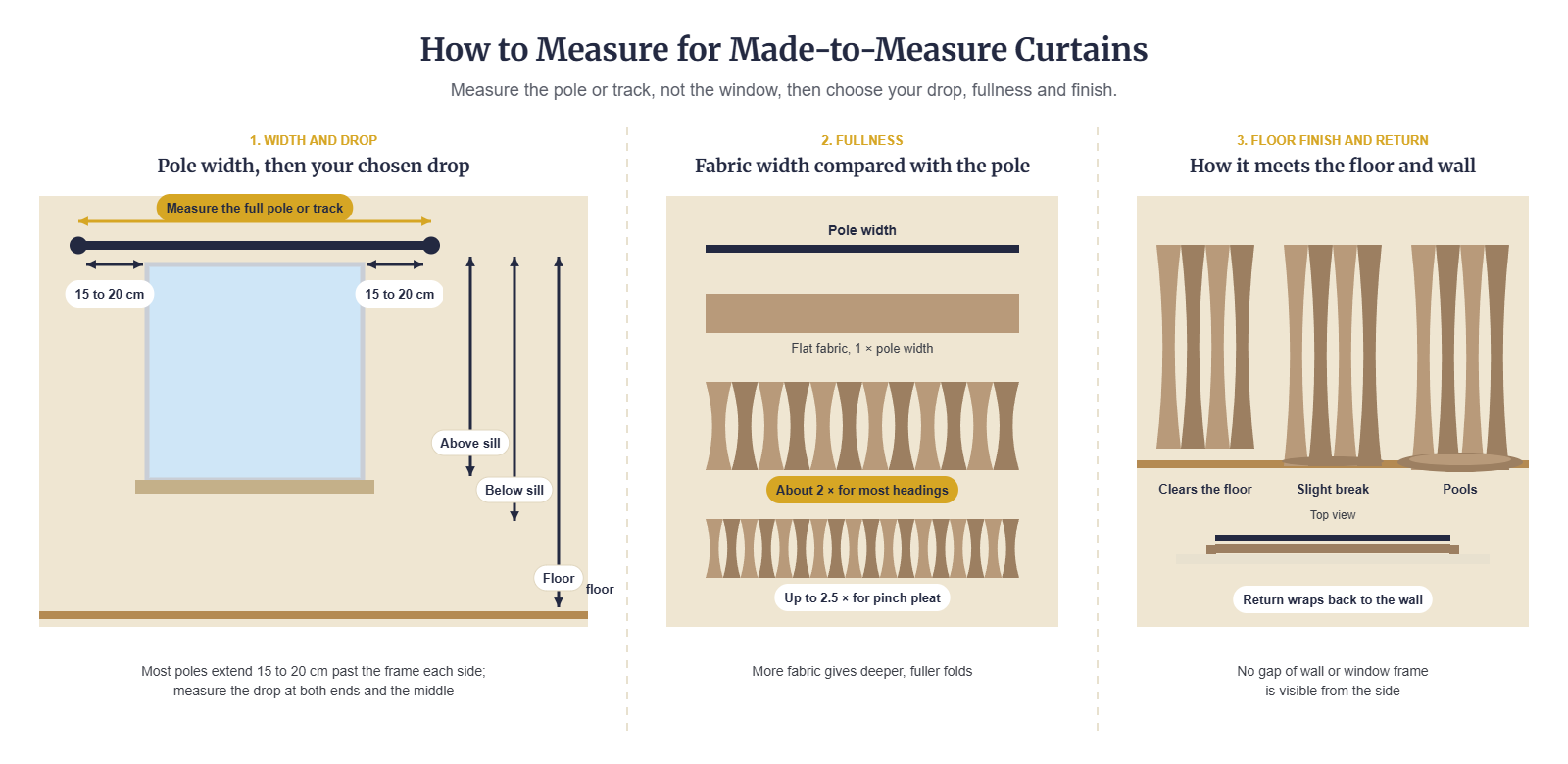
The pole or track usually extends 15 to 20 centimetres past the frame on each side, so the curtains clear the glass when open, and that extra width is in the calculation too. A floor length drop uses more fabric than a sill length one. If you are measuring yourself to get a rough idea, our guide to window curtains walks through it, but the quote is based on our own measurements at the visit.
Per window examples
Three typical windows show how the same fabric produces three different prices. We give them as positions in our range rather than fixed figures, because the fabric you pick moves each one.
| Window | Typical spec | Where it sits |
|---|---|---|
| Small bedroom window, about 1.2 metres wide, sill length | Pencil pleat, plain fabric, blackout lining, standard track | Near the starting price of £160 |
| Living room window, about 2 metres wide, floor length | Eyelet or pencil pleat, mid grade fabric, standard lining, pole | Middle of £160 to £890 per pair |
| Three pane bay, about 3.5 metres round, floor length | Pinch pleat, heavier fabric, blackout lining, bent track | Upper part of the range or above it |
Moving from sill length to floor length on the same window adds fabric but no labour, so it is a smaller jump than moving from pencil pleat to pinch pleat, which adds both. Swapping standard lining for blackout is the cheapest upgrade with the biggest effect in a bedroom.
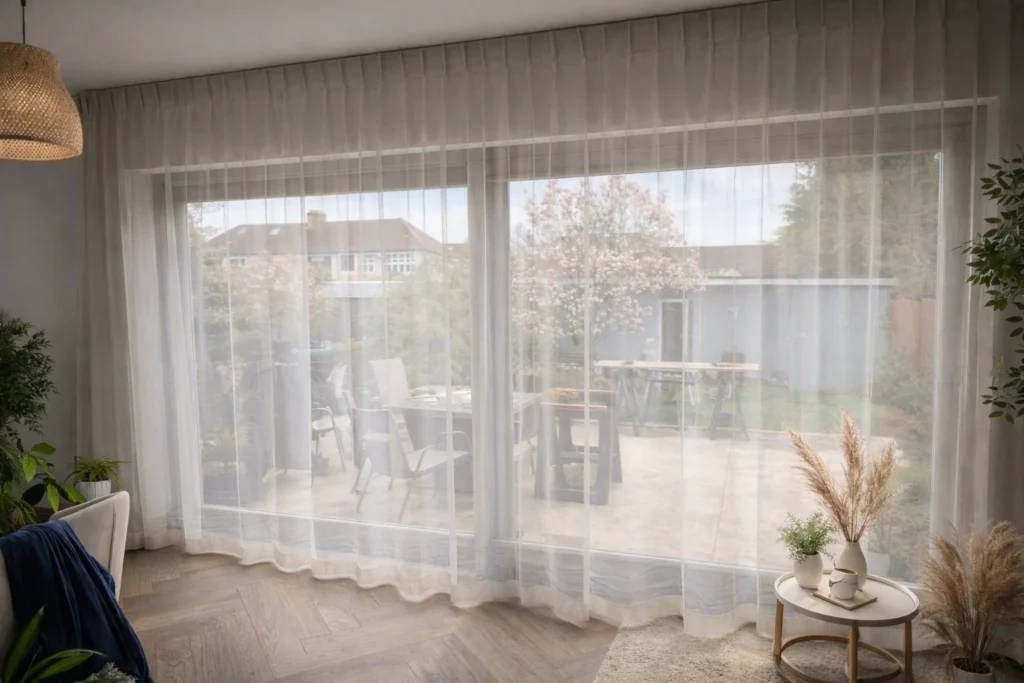
A pair of voiles behind the main curtains, or a Roman blind in the same fabric for a smaller window in the same room, is priced separately and added as its own line.
Poles and tracks
A standard track or a standard pole is included in our curtain price, and a decorative pole, a bay track or an electric track is shown as an extra. Tracks are plain, sit close to the wall or ceiling, bend round bays and suit pencil pleat, pinch pleat and wave headings. Poles are visible, come in wood and metal with a choice of finials, and suit eyelet and pinch pleat curtains.
Bay windows need a track or a pole bent to the shape of the bay with enough brackets to carry the weight, and that costs more than a straight run. A corded track lets you draw heavy curtains without touching the fabric. An electric track with a quiet motor and remote, app or voice control is the dearest option, and our electric curtains page explains what it involves. Ceiling fixing instead of wall fixing is the same price unless the ceiling needs special fixings.
Fitting: what is included
Fitting is included in our curtain prices, and it covers the home visit to measure, making the curtains in Rainham, fixing the track or pole, hanging the curtains and dressing them so the pleats fall evenly. Dressing matters more than people expect. A new pair of curtains is tied loosely into its folds for a few days so the fabric learns to hang, and we set that up before we leave.
How long it takes
From the measuring visit to the curtains hanging is usually a few weeks, most of it waiting for the fabric to arrive from the mill and then the making in our workshop. Fitting itself takes an hour or two for a standard window and longer for a bay, where the track has to be bent and set out with care so the curtains run smoothly round the corners. We fit the track, hang the curtains, check the overlap in the middle and the clearance at the floor or sill, and adjust the hooks until the drop is even on both sides.
If you already have a track or pole in good condition and want to keep it, we hang the new curtains on it and the quote reflects that. If you are asking how much are curtains fitted on their own, for curtains bought elsewhere, that depends on the fixings and the wall, and it is best discussed at a visit rather than priced blind.
Why made to measure curtains cost more than ready made
Made to measure curtains cost more than ready made because they are cut to your exact width and drop, use the fullness the heading needs rather than the minimum, are lined and finished by hand, come in the fabric you chose rather than the handful on the shelf, and are fitted. A ready made pair is made to the nearest stock size, usually with less fullness, a lighter lining and machine hems, which is why it looks thinner on the window and often puddles on the floor or stops short of the sill.
There are rooms where ready made is sensible, such as a spare room or a short tenancy. For a living room, a bedroom that needs darkness or a bay, bespoke curtains tend to last many years longer and hang in a way a stock pair cannot. If you are still deciding between the two routes, or between curtains and a blind, our blinds or curtains guide sets out the trade offs.
Curtain prices in Romford and East London homes
Around Romford, Hornchurch, Upminster and Rainham the window that decides the curtain budget is the front bay on a 1930s semi. A three or five pane bay needs a bent track, a wide pair or sometimes two pairs, and floor length drops, so it is usually the largest line on a quote and the place where fabric choice matters most. The back living room window and the bedrooms are straightforward and sit lower in the range.
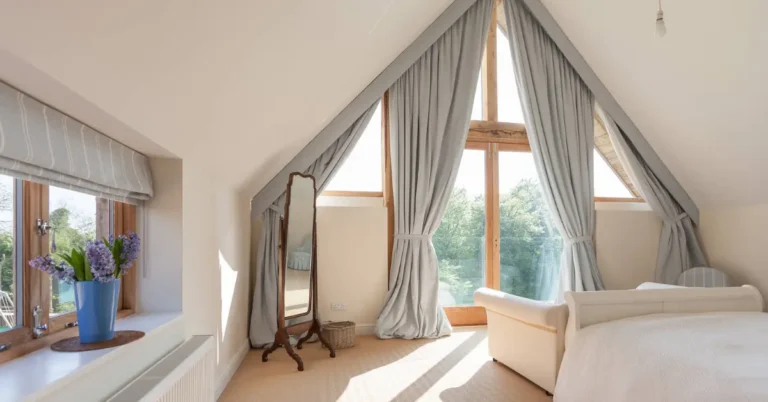
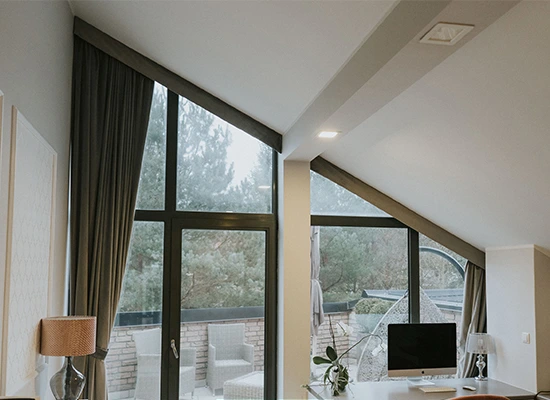
Victorian terraces in Ilford, East Ham and Barking have tall sash windows with high ceilings, so the drops are long and the fabric quantity is higher than the width suggests, and a pole above the architrave is the usual fixing. New build flats in Stratford, Canary Wharf and Beam Park have floor to ceiling glazing where a ceiling fixed track with a wave heading is the neatest answer, and leaseholders sometimes need to check that fixings into the ceiling are allowed. Loft conversions and dormers across Elm Park and Dagenham bring sloping windows, which we cover separately in our guide to curtains for sloping windows. For the Romford area specifically, our page on blinds and curtains in Romford has the local detail.
Blinds, awnings and external screens are all covered by the British Blind and Shutter Association, the UK trade body for the industry, which is a useful place to check what good practice looks like.[1]
Frequently asked questions
Why are made to measure curtains dearer?
Because they are cut to your exact window, use full fabric width for the heading, are lined and finished by hand and are fitted. A ready made pair is a stock size with less fullness and a lighter lining.
Do you supply the fabric?
Yes. We bring sample books to the home visit and supply the fabric, lining and heading tape. If you already have fabric you love, we can usually make it up and the quote drops the fabric line.
How much fabric do curtains need?
Roughly twice the track width for pencil pleat and up to two and a half times for pinch pleat, multiplied by the drop plus hems and any pattern repeat. A 2 metre window at floor length often uses five to six metres.
Is the pole or track included in the price?
A standard track or pole is included. Decorative poles, bay tracks and electric tracks are shown as separate lines on the written quote.
How much are curtains fitted?
Fitting is included in our curtain prices, so there is nothing to add. Hanging curtains bought elsewhere depends on the fixings and is best priced at a visit.
Can I have blackout lining in any fabric?
Yes. Blackout lining goes behind any curtain fabric, including light ones, and it adds a small amount per metre to the price. It also helps with warmth and noise.
Get a free home visit in Rainham and East London
If you are still deciding on made to measure curtains cost, for an exact price for made to measure curtains on your windows, book a free home visit or call 01708 505379. We measure at your home across Romford, Rainham, Hornchurch, Ilford, Stratford and the rest of East London and Essex, bring the sample books, make the curtains in our Rainham workshop and send a written quote after the visit.
References
- ^ British Blind and Shutter Association. BBSA. Retrieved 25 October 2026.