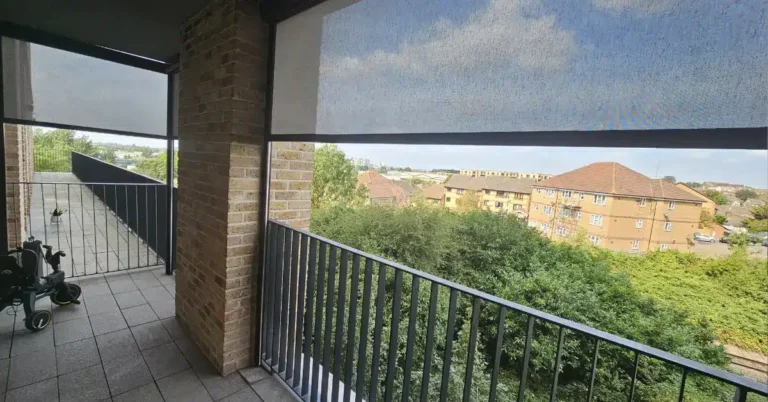
A motorised zip screen for a balcony is an outdoor fabric screen that runs down side tracks and is raised and lowered by a small electric motor instead of a hand crank. It is worth the extra cost on wide, exposed or hard-to-reach balconies, but on many East London flats the first question is not the motor at all. It is whether your lease lets you fix a screen to the balcony in the first place.
On the newer riverside blocks around Rainham, Beam Park and Barking Riverside, balconies often face open water with nothing to break the wind, and it picks up sharply in the evening. A zip screen deals with that. The harder decisions are whether a motor is worth paying for over a crank, and whether you are allowed to fix one to a rail or soffit that your lease may say is not fully yours.
Both questions come up all the time across East London’s riverside developments, and most content written about motorised zip screens for balconies skips straight past them into fabric colours and motor specs.
This article works through the whole decision properly: what motorised actually means, how it differs from automatic, what it costs, and the leasehold and fire safety questions that decide whether you can fit one at all, before you get anywhere near choosing a fabric.
What a motorised zip screen actually is
A zip screen is a retractable outdoor fabric screen that runs inside a zip guide track fixed to either side of the opening. The track holds the fabric edges, which keeps it taut and stops it flapping loose in wind the way an unguided awning would. We have covered the mechanism in full on our zip screens page, so this article will not repeat it. What matters here is the part that changes when you motorise one.
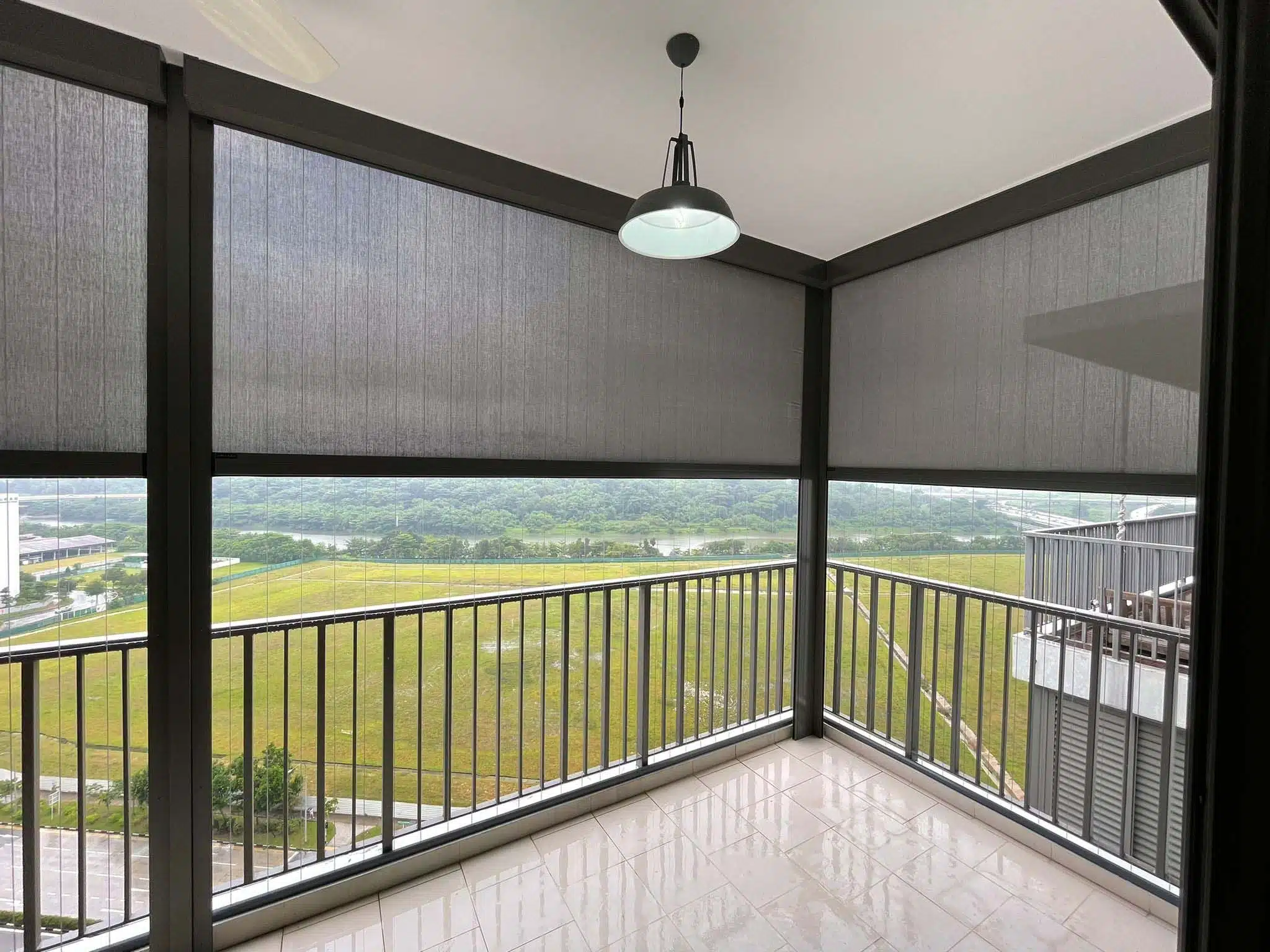
A manual zip screen uses a crank handle at the base. A motorised zip screen replaces that crank with an electric motor built into the roller tube at the top, so there is nothing extra bolted on to look at. The motor does the winding, and you just tell it when.
How the motor and controls actually work
The motor sits hidden inside the tube the fabric winds onto, the same principle used on the motorised roller blinds and electric curtains we fit indoors. Two power options cover most balcony installations. A mains motor is wired in permanently by an electrician. A battery or solar motor runs on a rechargeable battery, and some outdoor screen motors are made with a small solar panel to keep it topped up, so no new wiring is needed. Solar powered motors are also available for outdoor screens.
Control is where motorised screens have moved on fastest. A remote handset still comes as standard, but many people also want a wall switch next to the balcony door, the way a light switch would be. With the motor maker’s hub, an app lets you operate the screen from inside the flat or while you are out. Voice control through Alexa or Google Home is increasingly requested too, and it is worth knowing this is not a balcony-specific gimmick. We wrote about the same shift indoors, where motorised blinds have become a standard request across East London homes, and a balcony zip screen can often join the same app or hub rather than needing a separate system.
Motorised versus manual: when each earns its cost
A hand crank is fine for a single balcony door you open once a day. A motor earns its keep once you are operating the screen several times a day, or it is mounted somewhere a stepladder should not be going, or the opening is wide enough that winding a crank back and forth every time the wind shifts starts to feel like a chore rather than a five-second job.
We will tell you plainly if manual is the better call for your opening. Motorising a screen you will use once a day is money that could go on a better fabric instead. Small balconies with a single opening and no real wind exposure rarely need anything beyond a manual crank, and there is no reason to talk anyone out of that if it suits the space.
| Option | How it works | Best for |
|---|---|---|
| Manual crank | Wind the screen up and down by hand | Small, sheltered balconies used once or twice a day |
| Motorised | Remote, wall switch, app or voice | Wide openings, high fixings and daily use |
| Automatic | Motorised plus a wind or sun sensor | Exposed riverside balconies and homes left empty during the day |
Motorised with sensors: the automatic upgrade
“Automatic” gets used loosely, so it is worth being precise. A motorised screen still needs someone to press a button, a switch or open an app. An automatic screen adds a sensor, usually for wind, that retracts the screen on its own once conditions cross a set threshold, with no one needing to be home or to check the forecast first.
That distinction matters most on exposed elevations. A balcony facing open river frontage with nothing breaking the wind is a very different case to a sheltered balcony tucked between two buildings. On the first, a wind sensor protects the fabric and the mechanism from a gust nobody was there to see coming. On the second, the same sensor is solving a problem the balcony probably does not have, and the extra cost is harder to justify.
Before you choose a motor, check who owns the wall
If your balcony sits on one of the newer developments around Rainham, Beam Park or Barking Riverside, there is a question that matters more than manual versus motorised, and almost nothing else written about balcony zip screens raises it. Your lease decides whether you can fix anything to that rail or soffit.
Most flats in managed developments are leasehold. Balconies are usually included for the leaseholder’s use, but the external fabric of the building, including the rail, the soffit above it and often the balcony floor itself, usually remains outside what you are free to alter without asking first. GOV.UK’s guide for leaseholders explains that leases often require the freeholder’s permission before alterations, and that a consent fee may be charged.[1] That is not a technicality. A managing agent can ask for an alteration fitted without consent to be removed, even something as low-impact as a bracket-mounted screen.
For taller blocks there is a second layer. A GOV.UK research report on balcony fire safety, published in December 2025, notes that the balcony provisions in the building regulations fire guidance (Approved Document B) focus on residential buildings with a storey 11 metres or more in height, and that combustible materials and items on balconies can help fire spread.[2] A retractable fabric screen is not part of the wall build-up in the way cladding or fixed decking is, but the building owner may still have rules about what goes on balconies. If your building is above about four storeys, or already has fire safety remediation underway, send a short email to the managing agent before you book anything. We always ask which floor you are on and flag this early rather than assume it is fine.
None of this should put you off. A retractable, removable screen that does not touch structural elements and can come down cleanly is a much easier request than a fixed structure. It just needs asking first, not after.
Power without a socket
A common snag on balconies, particularly in flats, is that there is no easy way to get mains power to an external motor without new wiring, and running new wiring across a balcony brings you straight back to the consent question above.
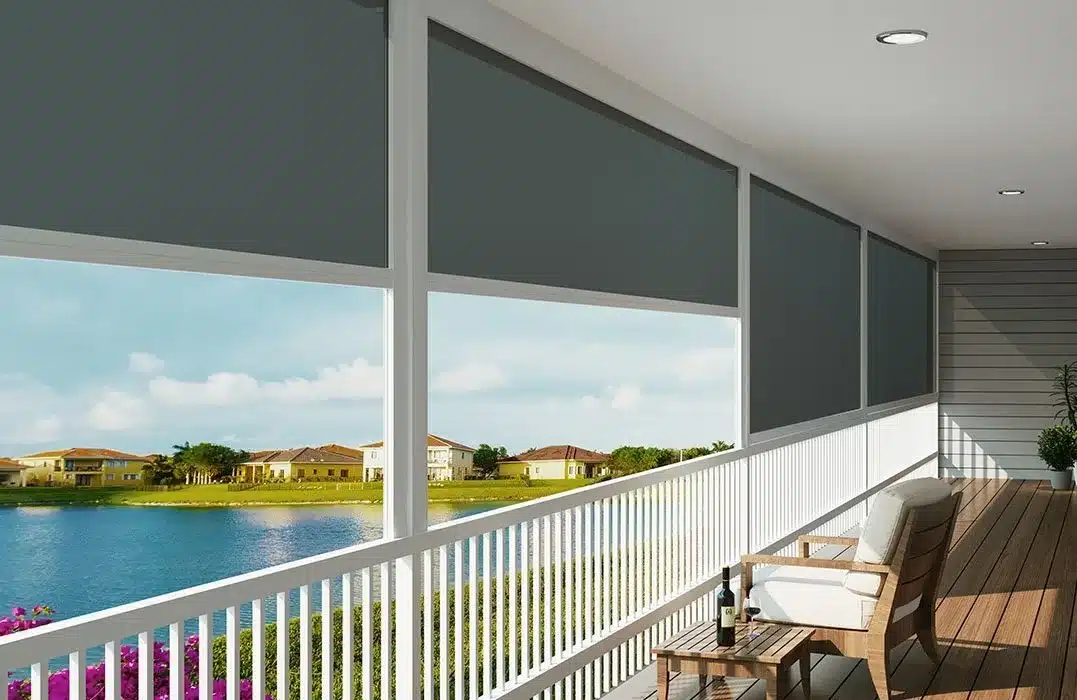
Battery and solar motors solve this for many installations. A small solar panel keeps the battery topped up, which works on a balcony that gets reasonable daylight. It is a practical option for riverside flats where an electrician is not going to run a new spur out to a balcony rail, and it sidesteps the mains-power question rather than trying to argue around it. On a north-facing or heavily shaded balcony, we check that a solar panel will get enough light before recommending one.
Wind, rain and riverside exposure
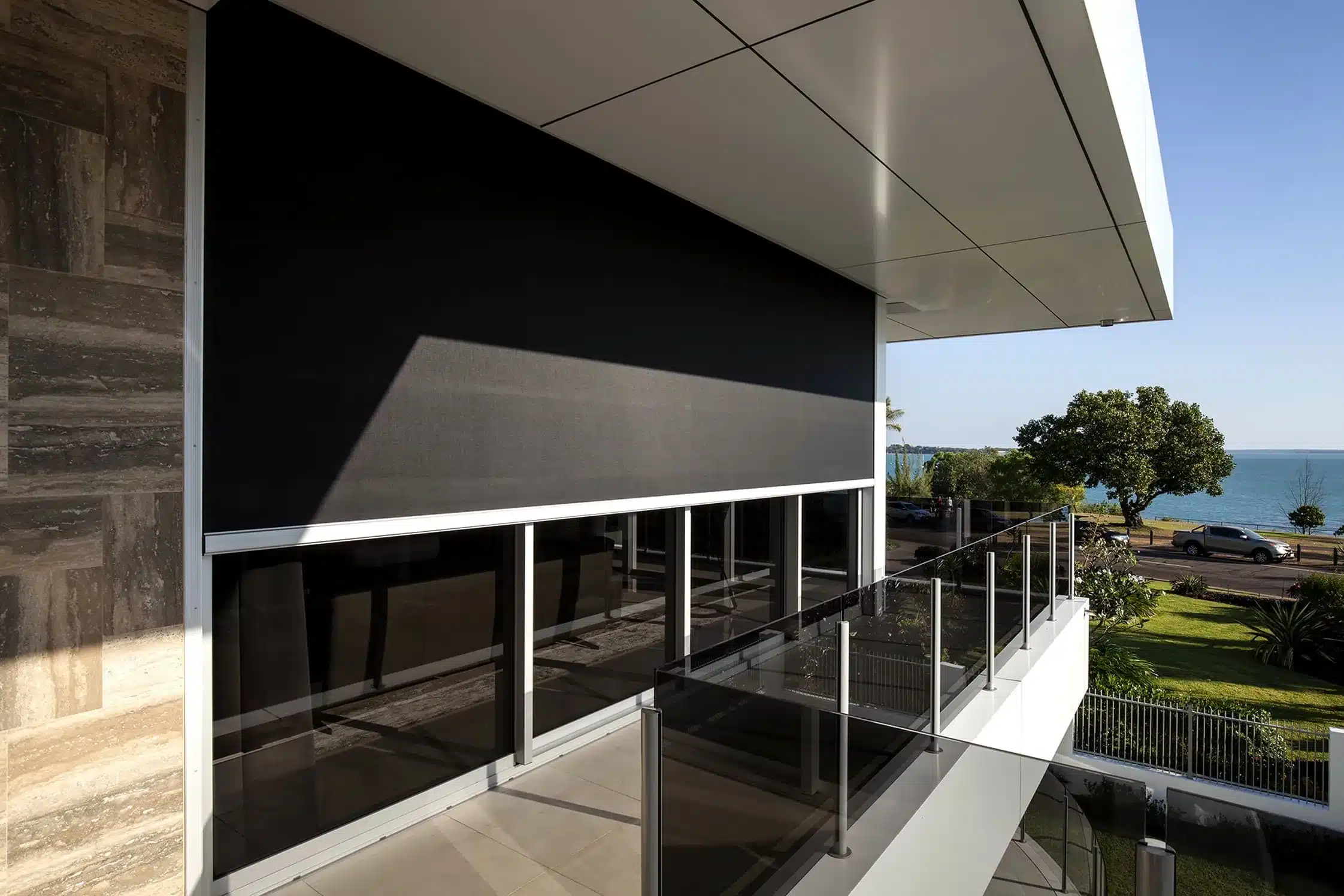
This is where automation earns its place over simple motorised control. A screen left down during an unexpected gust can strain against the guide tracks and, in the worst case, tear. A motorised screen still needs someone to press the button. An automatic screen with a wind sensor retracts itself once conditions cross the threshold it is set to, which matters on a balcony that catches wind off open water more than it would on a garden patio with a fence and a hedge doing some of the work already.
No sensor replaces good fabric choice or proper tensioning at fitting, but a sensor adds a layer of protection that manual control cannot offer when nobody is around to react to a change in the weather.
What this costs to add
Motorising a zip screen adds to the cost of a manual crank system, and adding sensors or smart-home control adds further again. Our zip screens fall between £280 to £950 per screen, and the exact figure depends on the size of the opening, the motor type and whether it is battery, solar or mains powered. Our zip screen for balcony cost guide breaks down what drives the price for East London balconies, and a free home visit gives you a written quote for your actual balcony rather than a generic range.
If you are already considering motorised control elsewhere in the home, look at our electric blinds page too. The same app or wall switch can often control zip screens alongside indoor blinds and curtains, which is worth planning at the same time rather than adding piecemeal later.
Where we fit these
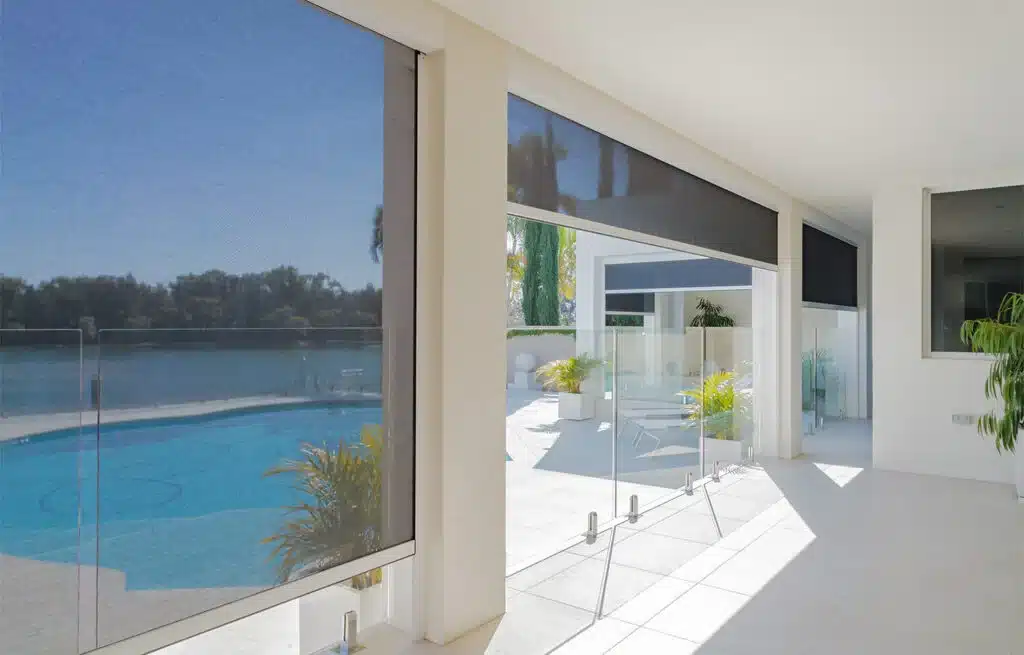
We are HomeDecisions, based at C3, Star Business Centre, Fair View Industrial Estate, Marsh Wy, Rainham RM13 8UP, and we fit motorised zip screens for balconies across the riverside apartment blocks close to home, from the newer streets around Beam Park and the wider Rainham area through to the floor-to-ceiling glazing common across Barking Riverside and the rest of East London and Essex.
Frequently asked questions
What is an automatic zip screen for a balcony?
An automatic zip screen is a motorised outdoor screen with a sensor, usually for wind, that retracts it on its own in poor weather. That is what separates “automatic” from simply “motorised”, which still needs a remote, switch or app.
Do I need my freeholder’s permission to fit a zip screen on a leasehold balcony?
In most managed developments, yes. The rail, soffit and external wall usually remain outside your control under the lease, so fixing a screen to them counts as an alteration. Check your lease and contact the managing agent before ordering.
Is a motorised zip screen worth it over a manual one for a balcony?
It depends on how often you will use it and how easy the crank is to reach. A motor is generally worth it on wide openings, screens fixed above head height or ones you use several times a day.
Can motorised zip screens run without mains power?
Yes. Battery motors, some with a small solar panel to recharge them, suit balconies without a socket. They are common on riverside flats where running new wiring to the balcony is not practical or not allowed by the building.
Are there fire safety rules affecting screens on high-rise balconies?
The balcony provisions in Approved Document B apply to residential buildings with a storey 11 metres or more in height, according to a GOV.UK research report. A retractable screen is treated differently from fixed cladding, but on taller blocks you should confirm with your managing agent first.
Book a free zip screen visit in Rainham and East London
If you are on a riverside development around Rainham, Beam Park or Barking, start with your lease and a quick message to the managing agent before you get as far as choosing a fabric or a motor. Once that is clear, we will measure the opening, talk through manual, motorised and automatic options for your balcony, and then email or phone through a written quote. Book a free home visit or call 01708 505379.
References
- ^ Buying or owning a leasehold home. GOV.UK. Retrieved 25 October 2026.
- ^ Fire safety: Balconies, spandrels and laminated glass report (excluding appendices). GOV.UK. Retrieved 25 October 2026.