Perfect Fit conservatory blinds keep a conservatory more comfortable and cut glare by putting a framed, made-to-measure blind on every uPVC side pane and door, with no drilling into the frames. For the heat that builds up on sunny days, the roof matters more than the sides, so the best results come from Perfect Fit blinds on the side panes combined with pleated blinds on the roof.
We make conservatory blinds in our workshop in Rainham and measure and fit them across East London and Essex, from Victorian-style and lean-to conservatories on semis in Hornchurch and Upminster to small garden rooms on terraces in Dagenham. This guide explains what Perfect Fit blinds do well in a conservatory, where the roof needs something different, which fabrics to choose, how to measure, and what it costs.
Why conservatories need the right blinds
Conservatories need well-chosen blinds because they are mostly glass, so they gain heat quickly on sunny days, lose it quickly on cold ones, and suffer from glare on screens and seating. A blind cannot turn a conservatory into a brick room, but the right blinds in the right places make it usable for much more of the year.
The Energy Saving Trust notes that heat is lost through windows and doors, and lists options from double glazing to thermal curtains and sealed blinds to reduce it.[1] It does not give a figure for how much a blind saves, and neither will we. What we can say is that fabric chosen for the direction the room faces, with the roof covered as well as the sides, does far more than any single blind on its own.
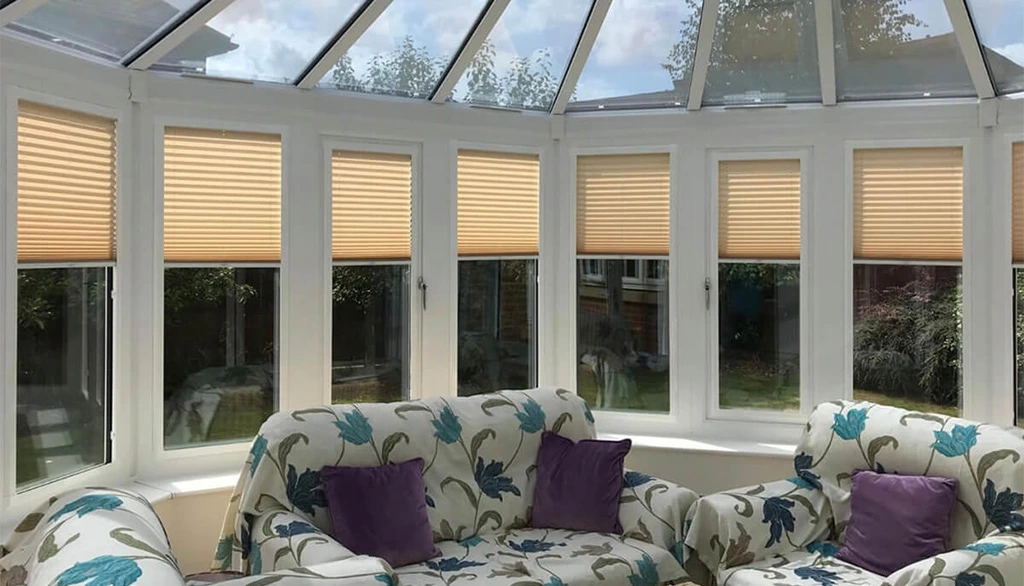
What are Perfect Fit conservatory blinds
Perfect Fit conservatory blinds are made-to-measure blinds held in a slim aluminium frame that clips into the glazing bead of each uPVC side window and door. Small brackets push into the gap between the bead and the frame, and the blind frame clips onto them, so nothing is screwed into the conservatory frame.
That matters in a conservatory for three reasons. There is often very little wall to fix to. Conservatory frames are expensive to repair if a drill slips. And many conservatories have opening top lights and doors, where a Perfect Fit blind travels with the sash instead of hanging loose. Each pane gets its own blind, which gives an even line round the room and lets you shade the sunny side while leaving the other side open.
What they do well
- No drilling into uPVC conservatory frames.
- Small light gaps at the edges, so glare control and privacy are better than with a blind hung in front of the glass.
- Blinds on doors and opening windows move with them.
- No long loose cords, which suits family homes. GOV.UK product safety guidance warns that looped blind cords can be dangerous for young children.[2]
- Frames unclip for cleaning the glass behind.
Where they do not fit
Perfect Fit needs a suitable uPVC bead. Timber conservatories, many aluminium frames and very shallow or rounded beads will not take the brackets. The low brick or panel wall at the base of most conservatories is not glass, so it needs no blind. And the roof is a different job altogether.
Conservatory roof blinds and why the roof matters most
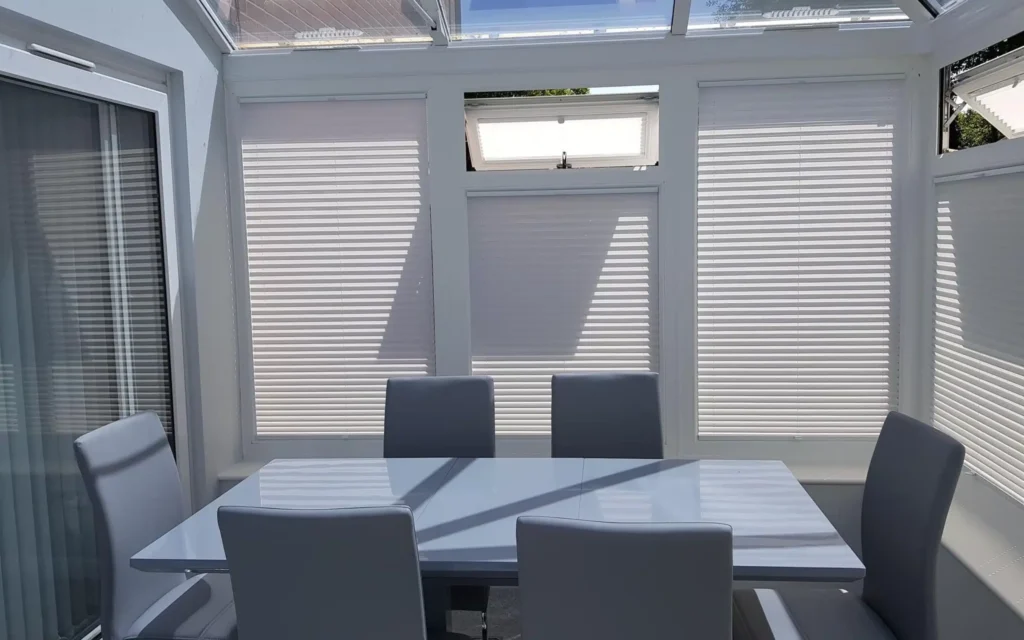
The roof is where most of the sun comes in, so shading it makes the biggest difference to how hot a conservatory feels in summer. Perfect Fit blinds are designed for vertical panes, so the roof needs made-to-measure pleated roof blinds instead.
Conservatory roof blinds are pleated blinds held taut across each roof panel on side guides, so they do not sag on the slope. They are made to the shape of each panel, including the triangular and fan-shaped panels at the end of Victorian and Edwardian style roofs, and fixed to the roof frame. Our pleated blinds page covers the range. For roof lanterns on flat-roof extensions, see our lantern blinds page.
A few points we check at the visit:
- Roof material. Glass and polycarbonate roofs both take roof blinds, but polycarbonate lets more heat through, so fabric choice matters more.
- Roof vents. Blinds have to leave opening vents free to work.
- Reach. Roof blinds on a high ridge can be hard to work by hand, which is where motorising becomes worthwhile. Our electric blinds page explains the options.
Best fabrics for Perfect Fit conservatory blinds
The best fabric for a conservatory depends on which way it faces and what you use it for: reflective or light-coloured fabrics for sunny rooms, honeycomb for cold ones, and blackout only where you really need darkness.
Pleated and honeycomb fabrics
Perfect Fit pleated blinds are the most popular choice for conservatory side panes. Many can open from the top down or the bottom up, so you can keep the lower half private from the garden next door and let light in over the top. Honeycomb pleats have a double layer that traps air in each cell, which makes them the usual pick for north-facing conservatories that feel cold.
Reflective and light-coloured fabrics
For south and west-facing conservatories, a fabric with a reflective backing, or simply a light colour such as white or pale grey, bounces more sunlight back through the glass. The room stays bright with less glare.
Roller and blackout fabrics
Perfect Fit roller blinds work well on conservatory doors and on side panes used as a snug or TV room. Blackout is rarely needed in a conservatory, but it suits a conservatory used as a playroom or for watching films.
| Conservatory faces | What it needs | Fabric we usually suggest |
|---|---|---|
| South or west | Heat and glare control | Light-coloured or reflective pleated, roof blinds as a priority |
| East | Morning glare | Light-filtering pleated or roller on the east panes |
| North | Warmth in winter | Honeycomb pleated on sides and roof |
| Overlooked garden | Privacy | Top-down pleated on the side facing the neighbours |
Ventilation and condensation in conservatories
Blinds do not cause condensation, but a conservatory with poor ventilation will show it on the glass, especially in winter mornings. Because Perfect Fit blinds sit close to the glass, they meet that moisture first.
The Energy Saving Trust advises keeping trickle vents open and clear and opening windows for at least five minutes several times a day.[3] In a conservatory that means using the roof vents and top lights, which Perfect Fit blinds do not block because they move with the sash. Drying washing in the conservatory is a common cause of heavy condensation. A wipe of the glass on cold mornings keeps the blinds dry and fresh.
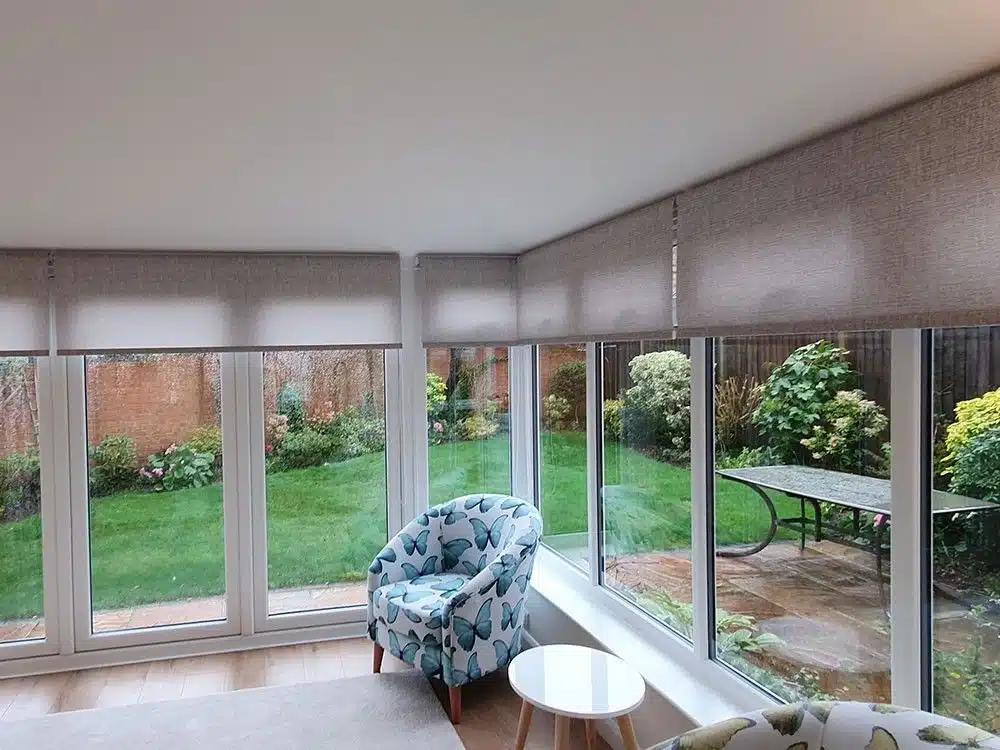
Conservatories in Rainham, Hornchurch and East London homes
Most conservatories around Rainham, Hornchurch, Upminster, Elm Park and Romford are uPVC, added to 1930s semis or post-war houses, and most of them take Perfect Fit on the side panes.
- Victorian and Edwardian style conservatories on semis have a faceted end with several narrow panes, each with its own Perfect Fit blind, and a roof with shaped end panels that need made-to-measure pleated roof blinds.
- Lean-to conservatories on terraces in Dagenham, Barking and Ilford are simpler, with a sloping roof and two or three side frames.
- Older conservatories with polycarbonate roofs can get very warm, and roof blinds in a reflective fabric are the first thing we suggest.
- Newer garden rooms with solid roofs and roof lanterns need Perfect Fit on the side glazing and a lantern blind overhead.
How to measure conservatory windows for Perfect Fit blinds
Measure each side pane bead to bead in millimetres, at the top, middle and bottom for width and at left, centre and right for height, and use the smallest figures. Every pane is measured separately, because conservatory panes that look identical are often a few millimetres different.
- Check the frame. Confirm the frames are uPVC with a square or gently angled bead the brackets can grip.
- Number the panes. Go round the room in order so nothing is missed or mixed up.
- Measure bead to bead. Width in three places, height in three places, smallest figure each time.
- Check obstacles. Note handles, restrictors and trickle vents near the bead.
- Leave the roof to us. Roof panels are measured differently, with angles and shapes, and are best measured at a visit.
Our free home visit covers all of this, including the roof. More detail on the order of measuring and the most common mistakes is in our Perfect Fit blinds buying guide.
How much do Perfect Fit conservatory blinds cost
Perfect Fit blinds for conservatory side panes start at £60, and most fall between £60 to £75 per blind, with one blind per pane. Pleated blinds, including conservatory roof blinds, start at £120 and most fall between £120 to £490 per blind.
The total for a conservatory depends on:
- The number of panes. A Victorian-style conservatory can have many more side panes than a lean-to of the same floor area.
- Whether the roof is included. Roof blinds add the most to the total, and do the most for summer comfort.
- Fabric. Honeycomb and reflective fabrics generally cost more than plain pleats.
- Motorising. Adding a motor to a blind costs from £80 per blind, and is usually only worth it on high roof panels.
After the free measuring visit we email or phone through a written quote showing every blind. For more on how Perfect Fit pricing works, see our Perfect Fit blinds price guide.
Frequently asked questions
Do Perfect Fit blinds make a conservatory cooler?
They help, especially in light or reflective fabrics, by cutting glare and the sun coming through the side panes. Most summer heat comes through the roof, though, so roof blinds make the bigger difference.
Can Perfect Fit blinds go on a conservatory roof?
No. Perfect Fit is made for vertical panes. Roof panels need made-to-measure pleated roof blinds held taut on side guides, which we also supply.
Do conservatory blinds need drilling?
Perfect Fit blinds on the side panes and doors need no drilling. Roof blinds are fixed to the roof frame, and we explain how for your roof at the measuring visit.
What colour blinds are best for a conservatory?
Light colours such as white, cream and pale grey reflect more sunlight and keep the room bright. Darker colours give stronger shade but absorb more heat at the glass.
Are motorised conservatory blinds worth it?
They are worth it for roof blinds you cannot easily reach. On side panes at hand height, manual Perfect Fit blinds are simpler and cost less.
Will Perfect Fit blinds fit an aluminium conservatory?
Sometimes, but many aluminium frames have beads that are too shallow or the wrong shape for the brackets. We check the profile before recommending them.
Book a free conservatory blind visit in Rainham and East London
To have every side pane and roof panel measured, book a free home visit or call us on 01708 505379, Monday to Friday, 9am to 5pm. We measure at your home, make the blinds in our workshop at C3, Star Business Centre, Fair View Industrial Estate, Marsh Wy, Rainham RM13 8UP, and email or phone through a written quote after the visit. We fit across East London and Essex.
References
- ^ Energy efficient windows and doors. Energy Saving Trust. Retrieved 25 October 2026.
- ^ Child safety: blind cords. Office for Product Safety and Standards (GOV.UK). Retrieved 25 October 2026.
- ^ How to get rid of damp. Energy Saving Trust. Retrieved 25 October 2026.