Perfect Fit zebra blinds are popular because they put two useful ideas into one blind: a striped day and night fabric that lets you switch between soft daylight and privacy without raising the blind, and a Perfect Fit frame that clips onto uPVC windows with no drilling and moves with the sash when you open it. There are no reliable public sales figures for blinds, so we will not quote any. What we can do is explain how they work, where they suit and where they do not.
We make zebra blinds, also called day and night or vision blinds, in our Rainham workshop and fit them across East London and Essex, from new build flats in Stratford and Beam Park to 1930s semis in Hornchurch and Romford. This guide covers how the fabric works, what the Perfect Fit frame adds, which rooms they suit, the honest drawbacks, how to measure, and what they cost.
What are Perfect Fit zebra blinds
A Perfect Fit zebra blind is a day and night roller blind held in a slim aluminium frame that clips onto the glazing bead of a uPVC window, so the blind sits on the glass rather than in the recess.
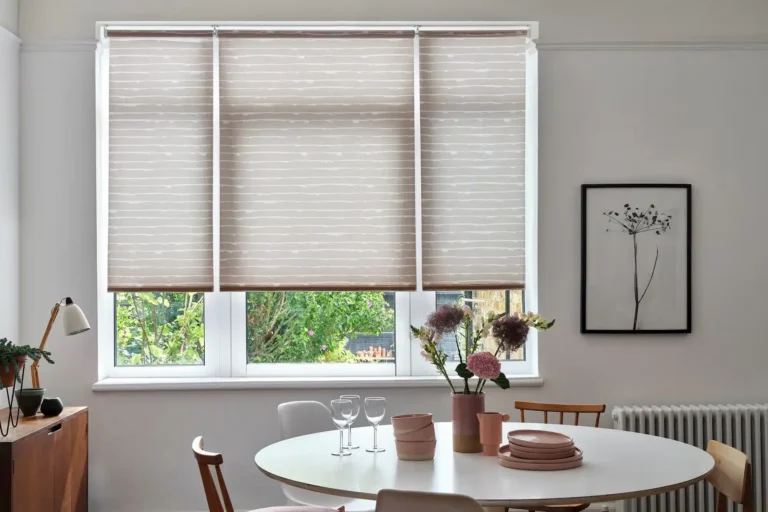
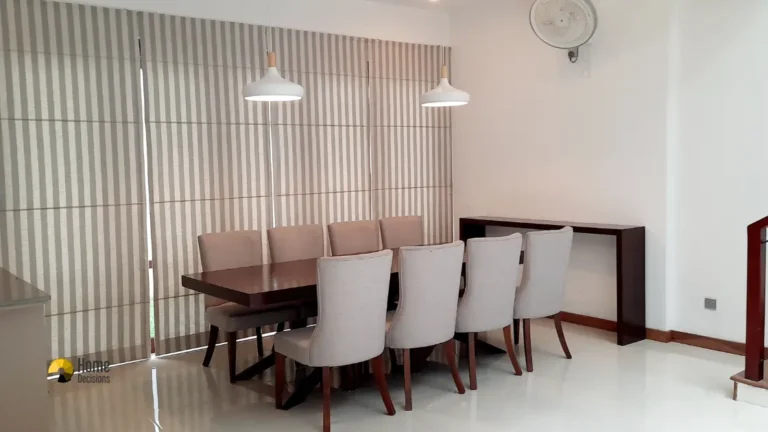
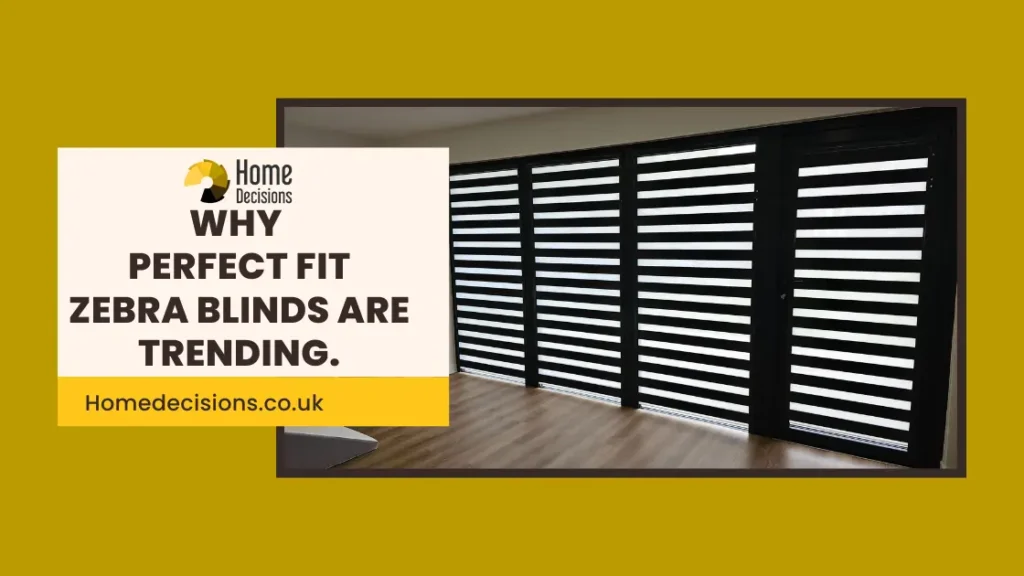
The zebra part is the fabric. It is one long loop of fabric with horizontal bands, alternating translucent and opaque, that runs down the front of the roller and back up behind it. Because there are two layers of stripes, one in front of the other, moving the blind slightly slides the bands past each other. When the sheer bands line up with the sheer bands, light comes through softly. When the solid bands cover the sheer ones, the blind closes for privacy. In short, a zebra blind is two layers of translucent and opaque striped fabric moved by a single control, such as a chain, cord or motor.
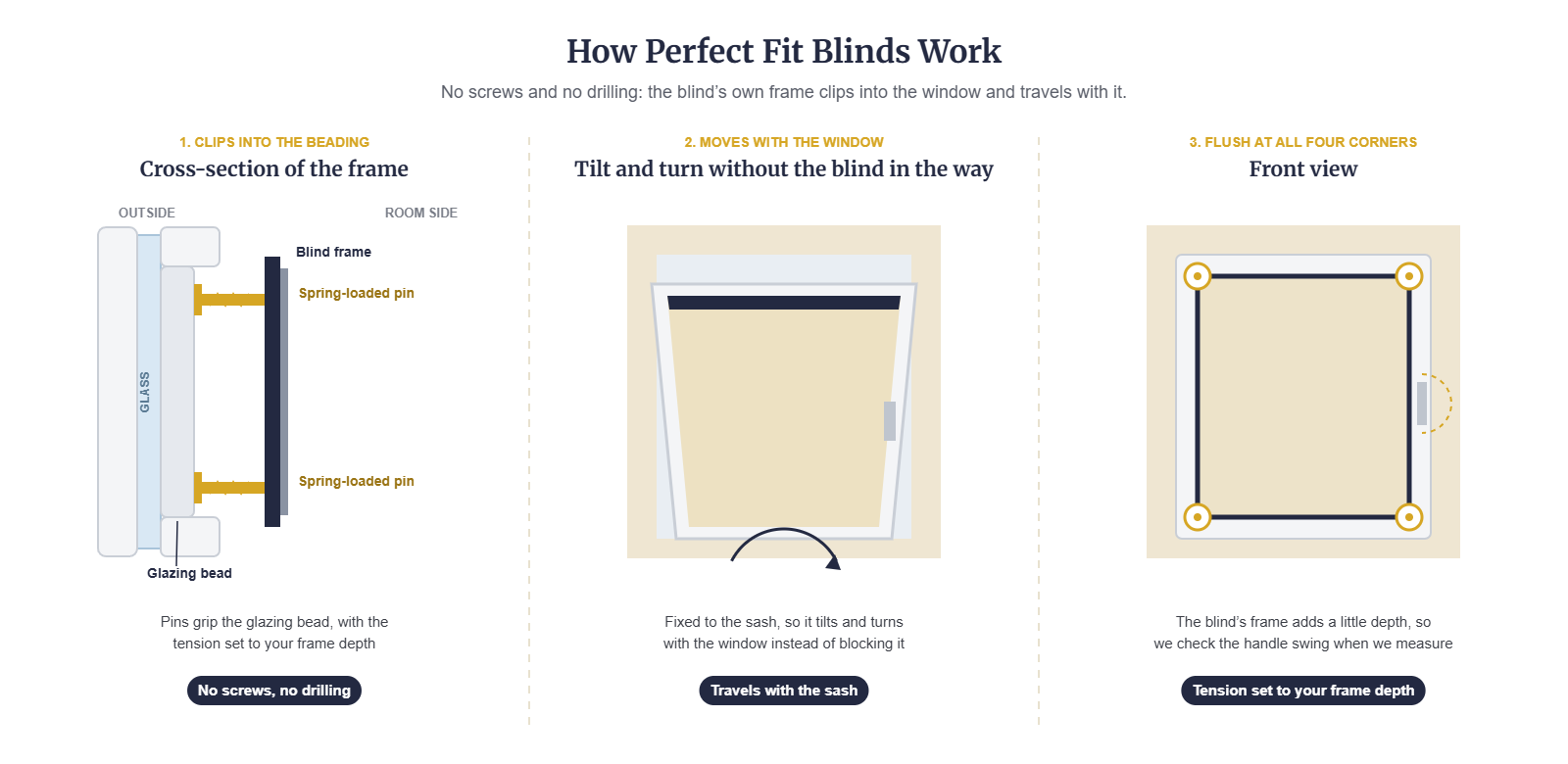
The Perfect Fit part is the fixing. Small brackets push in between the glass and the rubber seal, the frame clips onto them, and nothing is screwed into the window. Our day and night blinds page shows the fabrics, and the Perfect Fit blinds page explains the frame system across all blind types.
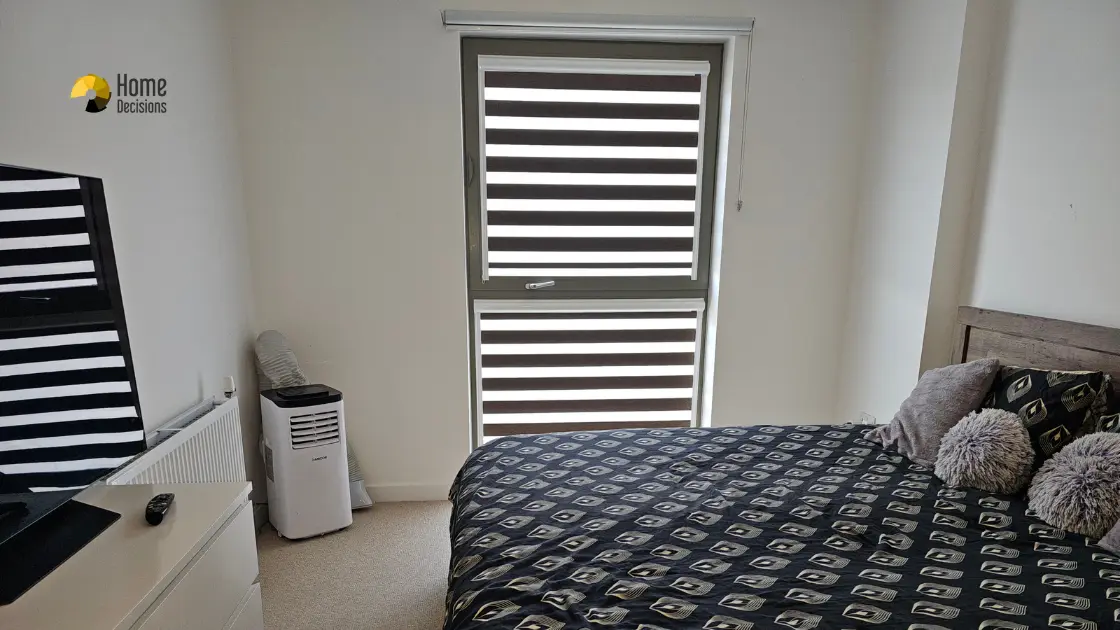
Why people choose zebra blinds in a Perfect Fit frame
The reason people choose this pairing is simple: each half fixes a weakness in the other.
A zebra blind hung in the recess in the usual way gets in the way of opening windows. On a tilt and turn or top-hung casement, you have to raise it every time you want air. In a Perfect Fit frame the blind travels with the sash, so you can set the bands to let light in and still open the window.
A plain Perfect Fit roller, on the other hand, has only two states: down or up. Down gives privacy and shade, up gives light and a view. A zebra fabric adds a middle position, so you can keep daylight coming in while the solid bands stop people seeing straight in. That suits ground floor rooms facing the street, which is common in East London terraces and semis.
- Light and privacy are adjusted without lifting the blind off the glass.
- There is no drilling into uPVC frames, which matters in rented homes and new builds.
- The frame keeps the fabric close to the glass, so side light gaps are smaller than with a recess blind.
- The blind moves with tilt and turn and casement sashes.
- The chain is held taut on the frame, which keeps it neat and safer around children.
How the bands control light and privacy
The bands give you three useful positions: open bands for filtered light, closed bands for privacy, and the whole blind raised for a clear view.
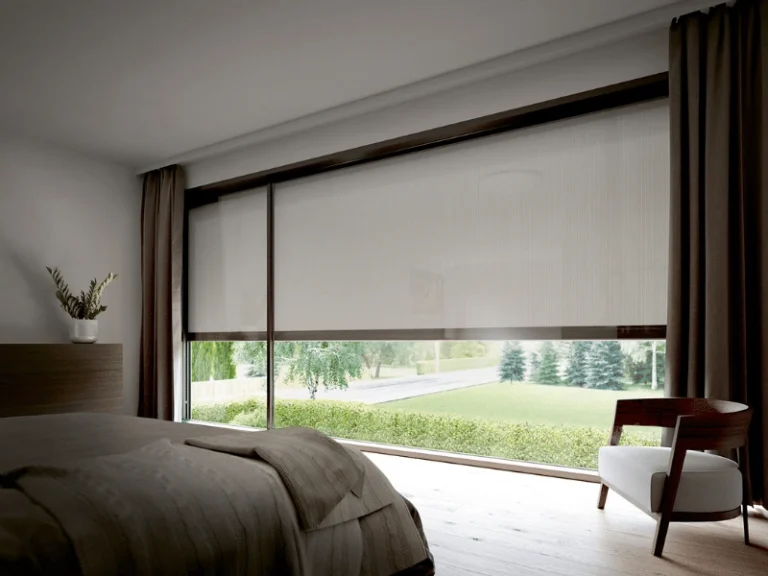
In the open position you see a soft striped view of the outside, and the room stays bright with less glare on a television or laptop. In the closed position the room is private and darker, but not dark. Most zebra fabrics are light filtering rather than blackout, so a closed zebra blind in a bedroom on a summer morning will still let light through. Some ranges have dimout or blackout solid bands, which help, but the sheer bands always pass some light.
Raised fully, the blind rolls up inside the head of the frame. Because zebra fabric is a double layer, the roll is thicker than a plain roller, which is one reason the frame depth and the window bead matter more than they do with a single fabric.
Which rooms suit Perfect Fit zebra blinds
Perfect Fit zebra blinds suit rooms where you want daylight and privacy at the same time, such as living rooms, kitchens, home offices and ground floor rooms facing a street.
Living rooms and front rooms
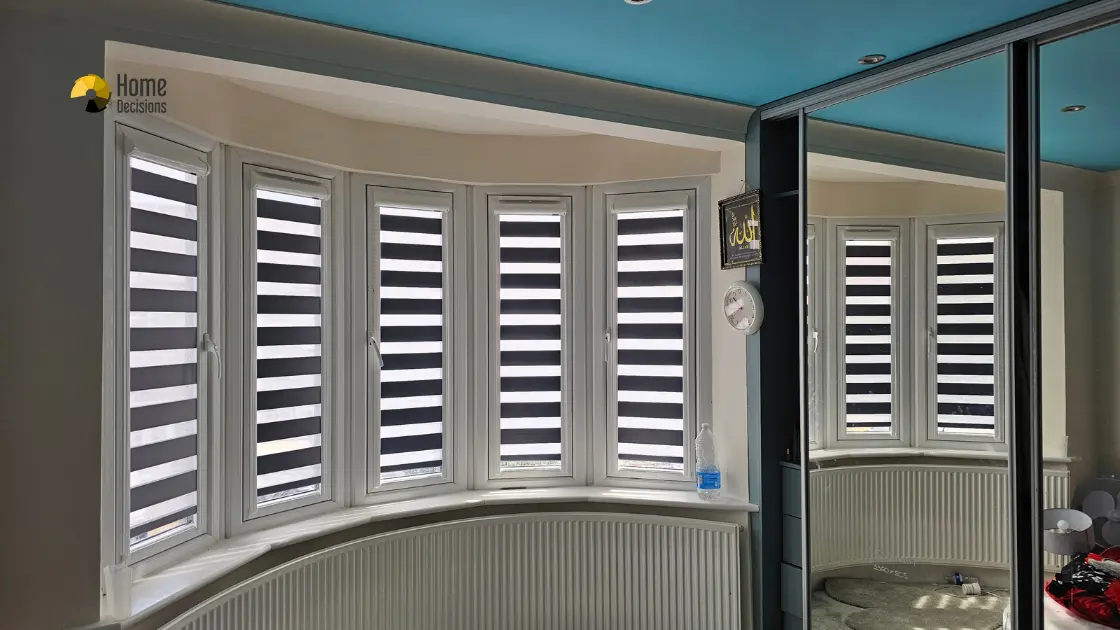
A front bay in a 1930s semi in Hornchurch or Upminster is a good example. Each pane of a uPVC bay can take its own Perfect Fit frame, so the bands line up across the bay and you can keep the front private during the day while the room stays light.
Kitchens and home offices
In a kitchen, the open bands cut glare on worktops while you cook, and a Perfect Fit frame keeps the fabric away from the sink and the tap. For a home office, filtering the light reduces glare on the screen without making the room gloomy.
Bedrooms
Zebra blinds work in bedrooms if you are happy with a dim room rather than a dark one. If you want the room dark for sleep, a blackout roller is the better choice, and our guide to blackout blinds explains what to expect. Some people use a zebra blind on the front window and a blackout blind behind curtains in the bedroom.
Bathrooms
Zebra fabrics are woven, so in a steamy bathroom we usually suggest a wipe-clean PVC roller instead. A well ventilated bathroom with an opening window can take a zebra blind, but it needs the window opened after showers.
Honest drawbacks of Perfect Fit zebra blinds
Zebra blinds are not right for every window, and the main drawbacks are light in the closed position, cleaning, and the depth of the roll.
- They are not blackout. Even with the bands closed, the sheer stripes let some light through. For a nursery or a shift worker’s bedroom, choose blackout instead.
- Dust shows on the stripes. Dust settles between the two layers. A soft brush or a vacuum on a low setting with a brush head every few weeks keeps them clean. Do not soak the fabric.
- The roll is thicker. The double fabric makes a fatter roll at the top, so the bead and handle clearance on the window need checking before you order.
- Fewer fabric choices than plain rollers. Zebra ranges are growing, but plain roller fabrics still come in more colours and textures.
- Perfect Fit needs a uPVC bead. Timber windows and many aluminium frames will not take the brackets. In that case a zebra blind can still be fitted in the recess or on the wall.
Chain, spring or motorised zebra blinds
Most Perfect Fit zebra blinds are worked by a chain on the side of the frame, which gives the fine control you need to line the bands up exactly.
The chain is held taut by a tidy fixed to the frame, so it moves with the sash and does not hang in a loose loop. That matters for families. The British Blind and Shutter Association advises that blinds with a cord or chain that could form a loop must be kept out of reach of babies and young children, and describes blinds that are cordless or have concealed or tensioned cords as safe by design.[1]
Motorised zebra blinds suit windows that are hard to reach, or rooms where you want the blinds to open and close on a timer. Our page on electric day and night blinds covers the motor options. A motor needs a frame and window large enough to house it, so not every Perfect Fit window can take one.
How to measure for Perfect Fit zebra blinds
You measure for a Perfect Fit zebra blind the same way as any Perfect Fit blind: the visible glass between the rubber seals, three times for width and three times for drop, using the smallest figure each time.
- Measure the width of the visible glass at the top, middle and bottom, seal to seal, in millimetres. Write down the smallest.
- Measure the drop at the left, centre and right. Write down the smallest.
- Check the bead depth by laying a card across the corner of the frame and measuring from the glass to the card.
- Measure from the glass edge to the handle, because the thicker zebra roll needs clearance at the top of the frame.
- Measure every pane separately and label it, even panes that look identical.
Do not make any deductions, because the blind is made to the glass size. Our step-by-step guide on how to measure for Perfect Fit blinds goes into more detail, and on a free home visit we measure every pane for you.
Tilt and turn windows
Perfect Fit zebra blinds work well on tilt and turn windows, because the frame sits on the sash and the blind tilts and swings with it.
Tilt and turn windows are common in newer flats across Stratford, Canary Wharf and Beam Park. With a zebra blind in a Perfect Fit frame you can leave the window on tilt for air and keep the bands set for privacy at the same time. The one thing to check is handle clearance, since the handle sits on the sash close to the glass. Our guide to Perfect Fit roller blinds for tilt and turn windows covers this in detail.
Zebra blinds in Rainham and East London homes
Zebra blinds suit a lot of the housing around Rainham and East London, because so many homes have uPVC windows and rooms that face the street.
- 1930s semis and bay windows in Hornchurch, Upminster, Elm Park and Romford, where each bay pane can take its own frame.
- Terraced houses in Dagenham, Barking and Ilford, where the front room is close to the pavement and daytime privacy matters.
- New build flats in Stratford, Beam Park and around the Rainham area, where tilt and turn windows are common and leases often restrict drilling.
- Rented homes, where a no-drill fixing can be removed at the end of a tenancy.
If you are in the Rainham area, our Rainham page covers the nearby streets and estates we fit in.
How much do Perfect Fit zebra blinds cost
Day and night blinds from HomeDecisions start at £175 and most fall between £175 to £390 per blind. Perfect Fit blinds start at £60, and a Perfect Fit zebra blind is priced on the glass size, the fabric and the frame colour.
The things that change the price are:
- Size. Larger panes need more fabric and a bigger frame.
- Fabric. Dimout and textured zebra fabrics can cost more than standard ones.
- Number of panes. A bay with five panes needs five frames.
- Motorising. Adding a motor costs from per blind where the window can take one.
After the free measuring visit we email or phone through a written quote that shows each blind. For more on how Perfect Fit pricing works, see our Perfect Fit blinds price guide.
Frequently asked questions
Are zebra blinds still in style?
Style is personal, but zebra blinds suit the plain, modern look of many uPVC windows, and the striped fabric comes in neutral colours that sit well in most rooms. Choose them for the light and privacy control rather than for fashion.
Do zebra blinds give full privacy?
With the bands closed, people cannot see clearly into the room in daylight. At night with the lights on inside, some shapes can show through the sheer bands, so for evening privacy some people pair them with curtains.
Are zebra blinds blackout?
No. Most zebra fabrics are light filtering, and even dimout ranges let some light through the sheer stripes. For a dark bedroom, choose a blackout roller blind.
Can zebra blinds go on tilt and turn windows?
Yes, in a Perfect Fit frame. The frame clips onto the sash, so the blind moves with the window in both the tilt and the turn position, as long as the handle has enough clearance.
How do you clean zebra blinds?
Dust them with a soft brush or a vacuum with a brush head on a low setting, and spot clean marks with a damp cloth. Do not soak the fabric or put it in a washing machine.
Book a free home visit for zebra blinds in Rainham and East London
To see zebra fabrics against your own windows and have every pane measured, book a free home visit or call us on 01708 505379, Monday to Friday, 9am to 5pm. We make the blinds in our workshop at C3, Star Business Centre, Fair View Industrial Estate, Marsh Wy, Rainham RM13 8UP, fit them across East London and Essex, and email or phone through a written quote after the visit.
References
- ^ BBSA supports Child Safety Week to raise awareness of window blind safety. British Blind and Shutter Association. Retrieved 25 October 2026.