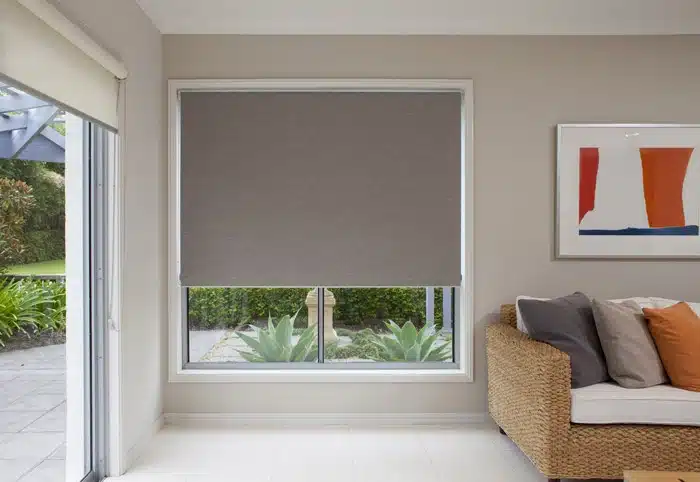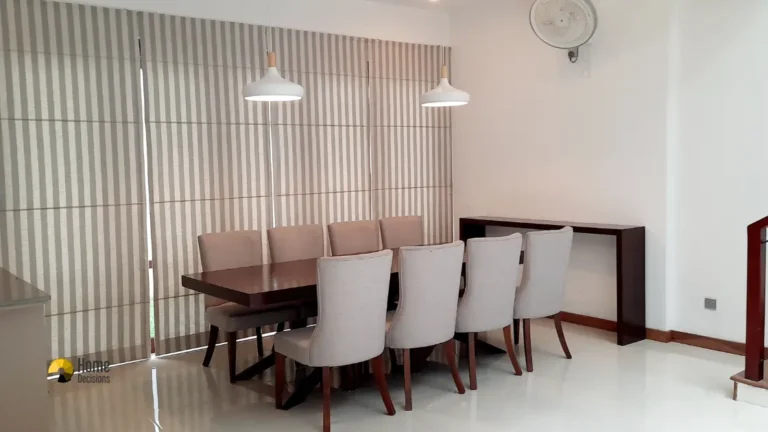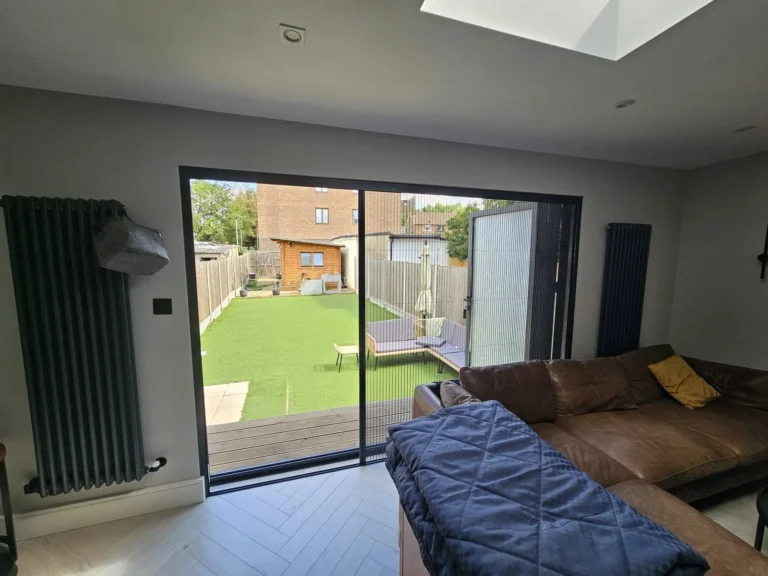
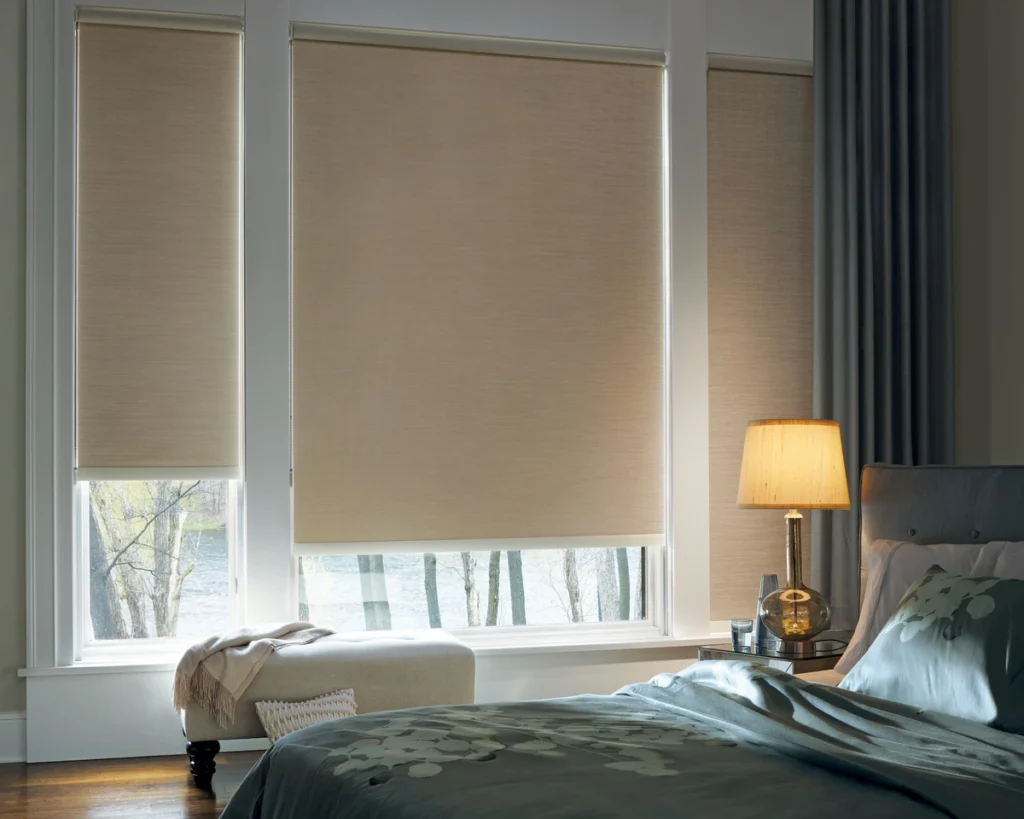
Perfect Fit blinds blackout a bedroom better than any other blind you can fit to a uPVC window without shutters, because the frame sits on the glass inside the bead and leaves only a thin line of light at the edges instead of the wide gaps a roller in the reveal leaves down each side. They have no cords or chains, which is why they are the usual choice for a nursery or a child’s bedroom. Blackout Perfect Fit blinds are the answer for bedrooms and nurseries where light leaking round the edges is the problem.
We make blackout Perfect Fit blinds in Rainham and fit them in bedrooms and nurseries across East London and Essex, from the box rooms of semis in Hornchurch and Romford to the tilt and turn windows of flats in Stratford and Barking. This guide explains where light gets past an ordinary blackout blind and how a Perfect Fit frame closes that gap, whether to put a blackout roller or a blackout pleated inside the frame, what the child safety position is, how dark the room really gets, and what they cost. Our general blackout blinds guide covers fabrics across every blind type; this post is specifically about the Perfect Fit version.
Where light gets past a blackout blind and how Perfect Fit closes the gap
Light gets past an ordinary blackout blind at the sides, where a roller or Roman fitted inside the reveal has to be made narrower than the opening so it can turn, and at the top, where the fabric leaves the roller a short distance in front of the wall. The fabric itself is black on the back and blocks the light completely; the gaps around it are the problem. A Perfect Fit blind moves the blind off the reveal and onto the glass, so the frame edges sit against the glazing bead on all four sides and the gaps shrink to a thin line.
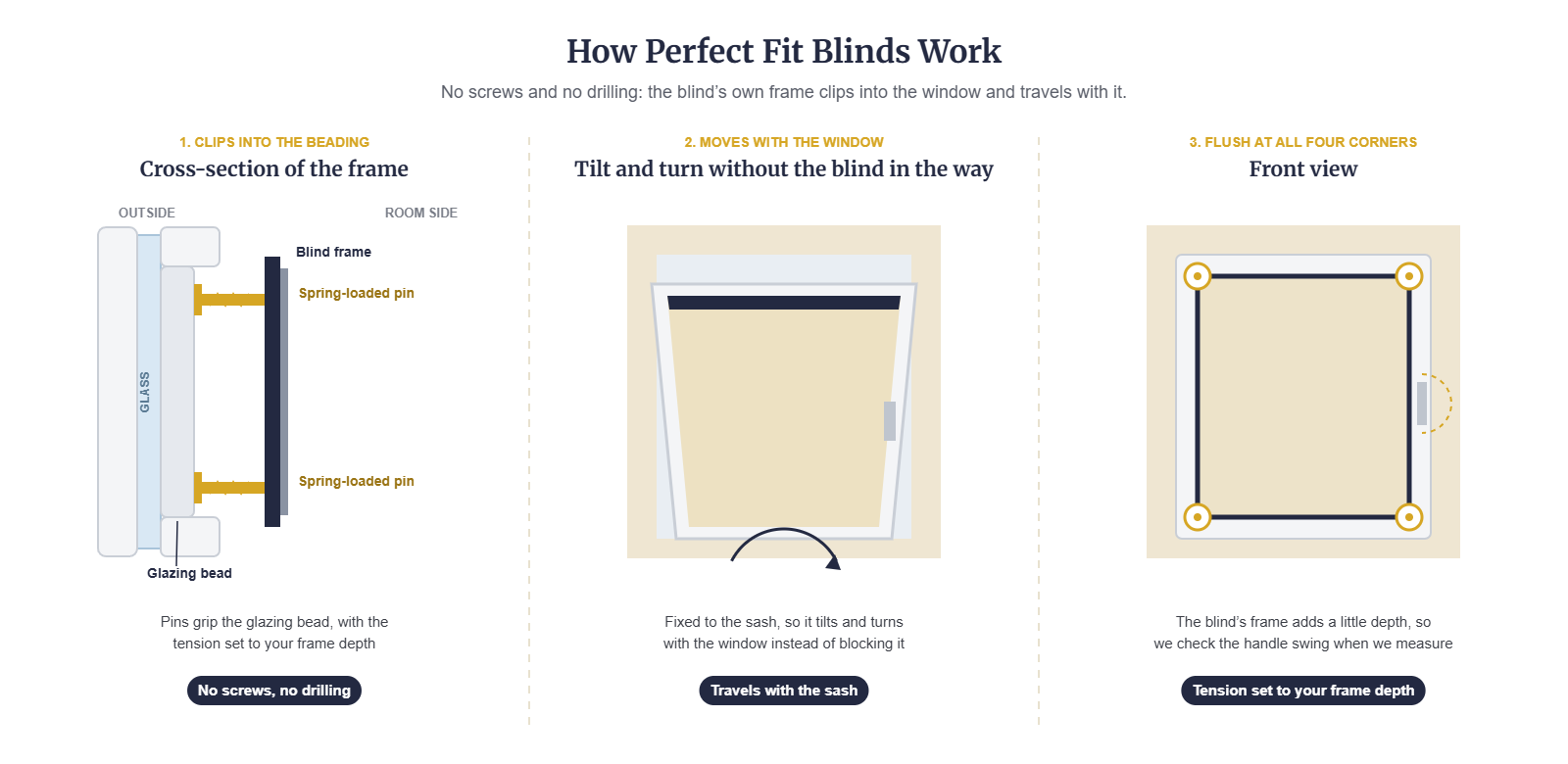
The frame is held by spring loaded pins pushed into the rubber bead of the window, so it fits each pane of glass individually. On a window with an opener and a fixed pane you get two blinds, one on each pane, and both sit flush. The fabric runs inside the frame in side channels, which is what stops the light creeping around the edge of the fabric the way it does on a free hanging roller.
A sidewinder or a roller in the reveal can be made darker with side channels bolted to the wall, but that is a bigger and uglier job than a frame that clips in with no drilling.
Blackout roller or blackout pleated inside the frame
A blackout roller inside a Perfect Fit frame gives the darkest result and the flattest look, while a blackout honeycomb pleated gives almost the same darkness with more insulation and a softer finish, so the roller is the usual choice for a bedroom that must be dark and the pleated for a room that is also cold or that faces the afternoon sun. Both fabrics are fully opaque; the difference is in the edges and the depth of the frame.
| Blackout roller Perfect Fit | Blackout pleated Perfect Fit | |
|---|---|---|
| Fabric | Coated blackout roller fabric, flat | Honeycomb or single pleat with an opaque backing |
| Darkness | Darkest, fabric runs in side channels | Very dark, honeycomb cells sit tight in the channels |
| Insulation | Some | Better, trapped air in the cells |
| Frame depth | Medium | Slimmest, best for tight handle clearance |
| Look | Clean, flat, modern | Softer, textured |
| Handling | Pull the bottom bar, sprung | Slide the bottom bar, stays where left |
Our Perfect Fit roller blinds in blackout fabric come in plain whites, greys and darker colours, and the fabric has a white backing to the street so a grey bedroom blind does not look black from outside. Our Perfect Fit pleated blinds in blackout honeycomb fabric have the same white backing and a cell structure that holds a layer of still air between the glass and the room. On a north facing nursery or a loft room with a lot of glass, that insulation is worth having. On a south facing bedroom in summer the honeycomb also slows the heat coming through the glass.
Child safety and nursery blinds with no cords
Perfect Fit blinds have no operating cords, no chains and no loops of any kind, so they meet the spirit of current UK child safety rules without needing cleats, tensioners or breakaway connectors, and there is nothing within reach of a cot or a bed for a child to pull on. The roller version is moved by a small handle on the bottom bar, and the pleated version slides with a tab. Both are worked from the bottom of the blind.
That matters in a nursery for two reasons. The first is the obvious one: a cot is often against the wall under the window, and a corded blind in that position is a hazard that the rules were written to remove. The second is practical: a blind that moves with the window and has nothing dangling cannot be pulled down by a toddler standing in the cot, and cannot be rattled by a draught from a tilted window. Where a room already has corded blinds, we take them away when we fit the new ones.
- No cords, chains or loops on any Perfect Fit blind
- Operated from the bottom bar, no reach above the window
- Frame clips to the bead, so no screws into a freshly decorated nursery
- Blind moves with a tilt and turn window, so it cannot swing or bang
- Fabric held in side channels, so a child cannot push it out of the frame by leaning on it
How dark Perfect Fit blinds blackout a bedroom
With a blackout Perfect Fit blind down, a bedroom is dark enough at midsummer sunrise to keep a sleeping child asleep, with only a faint outline of light around the frame and none through the fabric; it is not the total darkness of a room with no window, and nobody selling a blind should tell you otherwise. The remaining light comes from the fine gap between the frame and the glass at the bead, and from the window frame itself if it is a pale colour that catches the light.
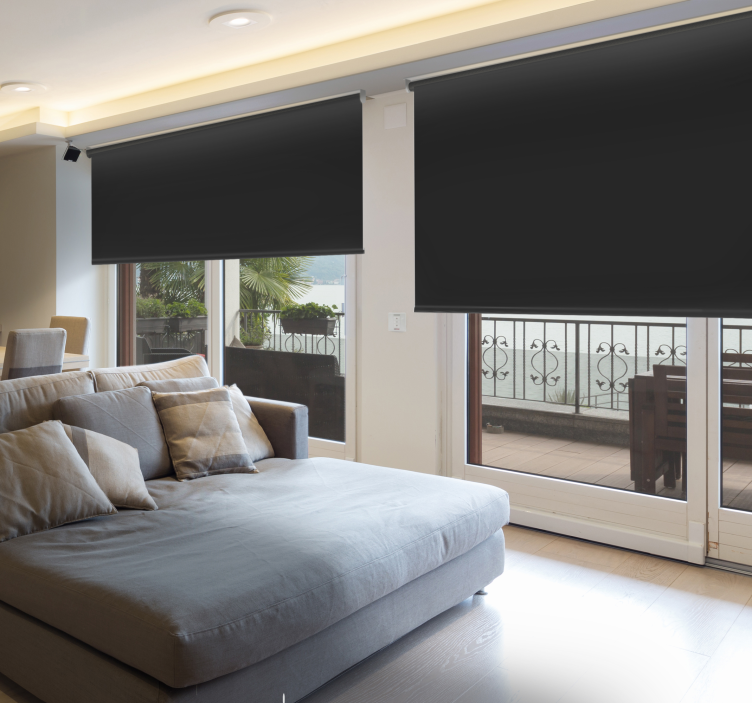
For a baby or a young child this level is normally plenty. For an adult shift worker sleeping through a bright afternoon, or anyone sensitive to the thin edge of light, we suggest pairing the blind with lined made to measure curtains on a pole that overlaps the wall each side. The blind does the main work and the curtains catch the outline. That combination, blind on the glass and curtains to the wall, is the darkest a bedroom can be made without shutters. A dark frame colour helps too, because a white frame reflects the little light that reaches it while an anthracite or black frame absorbs it.
Rooms that suit blackout Perfect Fit blinds
Blackout Perfect Fit blinds suit any uPVC window in a room where someone sleeps: a nursery, a child’s bedroom, a main bedroom, a loft conversion with Velux and dormer windows, a spare room used by a shift worker, and the bedroom of a flat with a tilt and turn window that opens inwards. They are less often the right choice in a living room, where full blackout makes the room feel shut and a dimout or day and night blind suits better.
Nurseries and children’s rooms
A nursery wants a dark room for daytime naps, no cords, and a blind that a parent can lower with one hand while holding a baby in the other. The bottom bar handle on a Perfect Fit roller does that. A pale blackout fabric keeps the room feeling light when the blind is up, and the white street side keeps the house looking tidy from outside.
Main bedrooms
In a main bedroom the question is usually whether to have blackout rollers on each pane of a wide window or a single roller across the whole reveal. The Perfect Fit answer is one per pane, which gives a flat, built in look and lets you drop the blind on the sunny side only. With curtains over the top the room is as dark as it will get.
Tilt and turn windows
Tilt and turn windows open inwards, so a blind hung in the reveal is in the way every time the window opens, and a blind on the glass is the only tidy answer. Our post on Perfect Fit roller blinds for tilt and turn windows covers the detail; for a bedroom, add a blackout fabric and the problem of light and the problem of the inward opening window are solved together.
How much do blackout Perfect Fit blinds cost
Perfect Fit blinds from HomeDecisions start at £60 and most fall between £60 to £75 per blind, with blackout fabrics sitting a step above the plain dimout fabrics in the same frame and a blackout honeycomb pleated at the upper end. The written quote after the home visit lists each pane separately, so a window with three panes shows three blinds.
Fabric is the main cost driver. A blackout roller in a plain colour sits in the middle of the range, a blackout pleated above it, and a blackout honeycomb pleated at the top because the cellular fabric costs more to make. Frame colour is included for white, and coloured frames to match anthracite or woodgrain uPVC may add a little. Fitting is included. If you are weighing it against a standard blackout roller in the reveal, the Perfect Fit costs more per window and gives a darker room with no drilling; whether that is worth it depends on how dark the room has to be and who sleeps in it.
| Blind | Where in the Perfect Fit range | Darkness |
|---|---|---|
| Dimout roller, for comparison | Lower | Softens light, does not black out |
| Blackout roller | Middle | Dark, thin edge line only |
| Blackout single pleat | Middle to upper | Dark |
| Blackout honeycomb pleated | Upper | Dark, plus insulation |
Measuring and fitting blackout Perfect Fit blinds
We measure blackout Perfect Fit blinds at the free home visit by taking the bead to bead width at three heights on each pane, the drop at both sides, and the bead depth with a gauge, because a blackout blind shows up any error in the frame as a line of light that a dimout blind would hide. The guide on how to measure for Perfect Fit blinds explains the checks if you want to look at your window first, but for a blackout blind we would rather measure it ourselves.
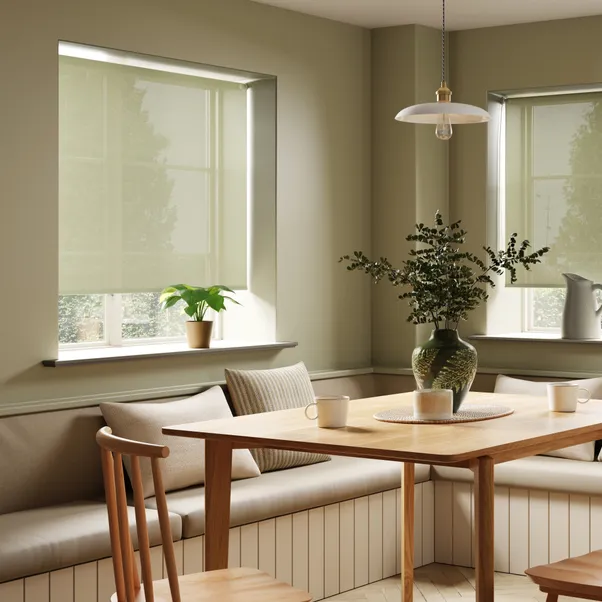
Fitting takes minutes per pane. The pins go into the bead, the frame is squared and tensioned, and we drop the blind and close the curtains to check the light line before we leave. Nothing is drilled, so a newly decorated nursery stays as it was, and a rented room goes back to the landlord with no holes to fill. A whole nursery or bedroom is normally finished in one short visit.
Bedrooms in Rainham and East London homes
The bedrooms we fit blackout Perfect Fit blinds in across Rainham, Hornchurch, Romford, Upminster and the rest of East London fall into a few types: the small front box room of a 1930s semi that becomes the nursery, the rear bedroom of a terrace in Dagenham or Ilford with a single uPVC casement, the loft conversion with a dormer and a roof window, and the bedroom of a new build flat in Stratford or Canary Wharf with a tall tilt and turn window and a lease that forbids drilling.
The box room usually has one window of two panes, an opener and a fixed light, and takes two blackout rollers in a white frame. The terrace bedroom often has a bay or a wide casement that takes three. The loft room is where the honeycomb pleated earns its place, because the room is hot in summer and cold in winter, and the dormer window often has a tight handle.
The flat is the tilt and turn case, where a blackout roller in a grey frame matched to the window is the common choice, and the no drill fixing keeps the lease happy. Across Grays, South Ockendon and the newer estates around Beam Park the houses are mostly uPVC throughout, so the same blinds suit every bedroom in the house.
Every blind we make is fitted to current UK child safety rules. The Make it Safe campaign from the British Blind and Shutter Association explains what to check on blinds you already own.[1]
Frequently asked questions
Are Perfect Fit blinds fully blackout?
In a blackout fabric they block all light through the fabric and leave only a thin line around the frame edge, which is darker than any blind hung in the reveal. Total darkness needs shutters or a blind paired with lined curtains over the wall.
Are Perfect Fit blinds safe for a cot room?
Yes, they have no cords, chains or loops, are operated from the bottom bar and clip to the window bead, so there is nothing hanging within reach of a cot and nothing to swing or rattle.
Which is darker, blackout roller or blackout pleated Perfect Fit?
The blackout roller is slightly darker because the flat fabric sits tight in the side channels. The blackout honeycomb pleated is very close behind it and adds insulation, which is why it suits loft rooms.
Do blackout Perfect Fit blinds work on tilt and turn windows?
Yes, the blind is fixed to the glass pane and tilts and turns with the window, so the room stays dark with the window tilted for air and nothing swings when the window opens inwards.
Can I fit blackout Perfect Fit blinds in a rented flat?
Yes, the frame clips into the rubber bead with spring pins and nothing is drilled, so the blinds can be removed without a mark when you move out. Check the tenancy agreement for any clause about window coverings, but a blind that leaves no holes is an easy thing to agree with a landlord.
Do blackout Perfect Fit blinds keep a room cooler in summer?
They help, because the white backing reflects sun before it warms the room and the frame holds the fabric close to the glass. The honeycomb pleated version does more, as the cells trap a layer of air between the glass and the room.
Get a free home visit in Rainham and East London
If you are still deciding on blackout perfect fit blinds, we measure bedrooms and nurseries at your home for free, check the bead on each pane, make the blinds in Rainham and fit them ourselves across East London and Essex, with a written quote after the visit. To arrange it, book a free home visit online or call 01708 505379, Monday to Friday, 9am to 5pm.
References
- ^ Make it Safe from the BBSA. Make it Safe (British Blind and Shutter Association). Retrieved 25 October 2026.