The blinds for arched windows that actually work are shaped pleated blinds made to the curve, fan pleated blinds that open out from a central point, and Perfect Fit blinds with a shaped top frame, while roller, vertical and Venetian blinds cannot follow a curve and leave the arch uncovered. Which of the three you choose depends on whether the curved part needs to open, whether you need blackout, and whether the window has a uPVC bead for a Perfect Fit frame.
We make shaped blinds in our Rainham workshop and fit them across East London and Essex, and arched windows are the shape we are asked about most after triangles. This guide sets out what follows a curve and what does not, how each option is made and operated, what goes wrong when the wrong product is forced onto an arch, how we measure one, and what the price depends on.
Which blinds follow a curve
Only blinds whose fabric can be cut and held to a shape follow a curve, which in practice means pleated and cellular fabrics in a shaped frame or on shaped rails, and nothing that rolls on a tube or hangs from a straight headrail. A roller needs a straight tube. A vertical needs a straight or gently sloping track. A Venetian needs a rectangular stack of slats. All three can cover the rectangle below the arch and leave the curve bare, which is sometimes acceptable in a hallway and rarely acceptable in a bedroom.
Fixed, rising or fan
An arched blind is one of three things. A fixed shaped blind fills the curve permanently and is paired with an ordinary blind on the rectangle below. A rising shaped blind covers the whole window, arch included, and draws up from the bottom so the rectangular part opens while the top of the arch stays filled. A fan blind pivots from the centre of the base line and opens like a hand fan. Each suits a different window and a different need for light.
Shaped pleated blinds for arched windows
Shaped pleated blinds are the most common answer for an arched window because the pleated fabric can be cut to any curve and held in a shaped top rail, with the pleats running horizontally and gathering towards the base. On a full height arched window the blind has a curved top rail, straight side guides and a bottom rail that rises, so the lower part opens like a normal pleated blind while the arch stays covered. On a semicircular fanlight above a door the blind is usually fixed.
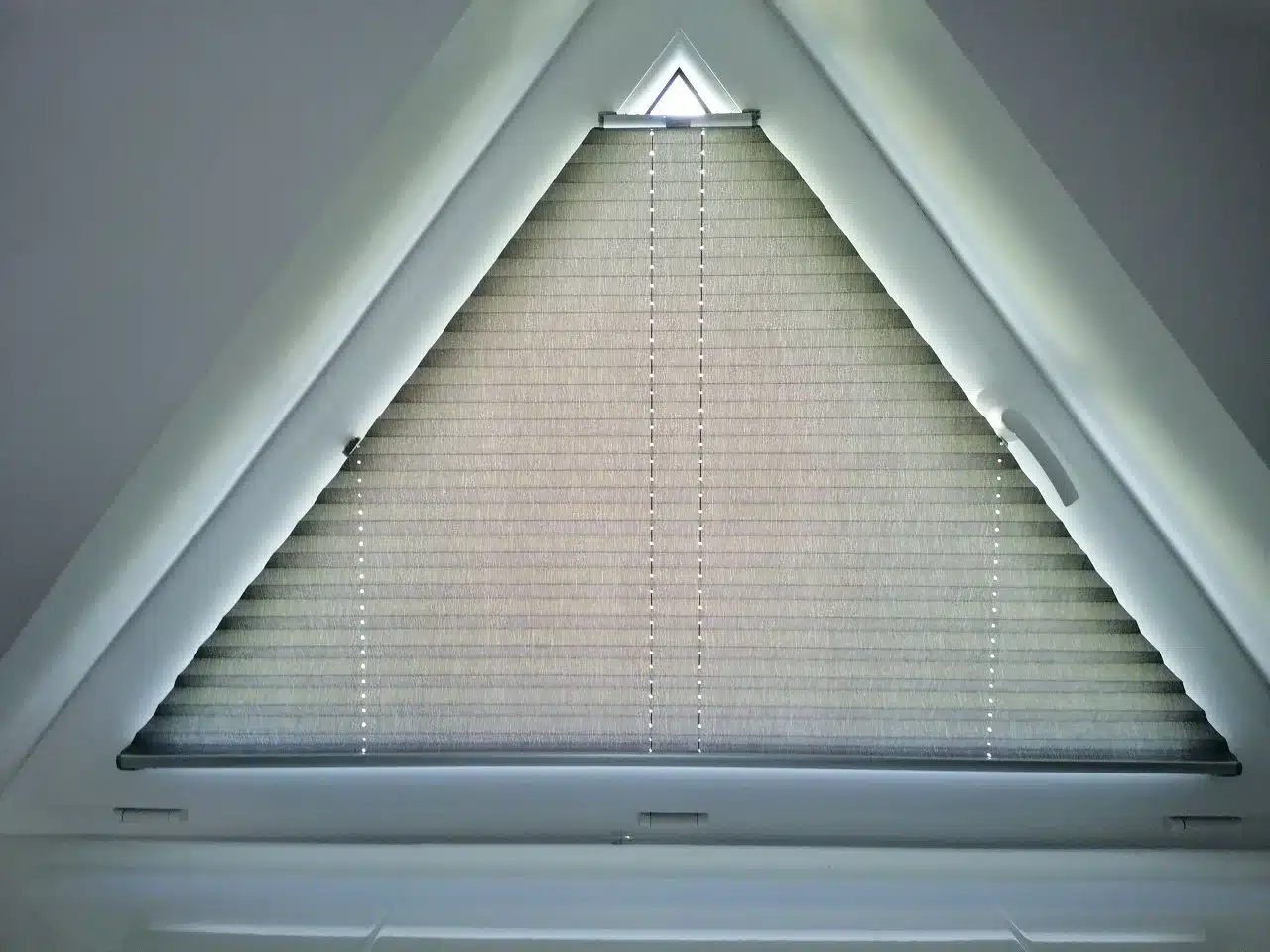
The fabric range is the same as our standard pleated blinds, so you can have a light filtering voile, a dimout, or a blackout cellular fabric where the honeycomb cells block the light and add insulation. Operation is by a cord or a small handle on the bottom rail, and cordless tensioned versions are available where the window is reachable. Our guide to pleated blinds for odd shaped windows covers the wider family of shapes and the costs.
Where the pleats sit
On an arch the pleats are horizontal, so the fabric at the top of the curve is a series of shorter and shorter pleats held by the rail. That gives a neat look from inside and a slightly stepped look from outside, which bothers nobody at ground level. Where the curve is very tight the top few pleats are hand finished, which is part of why a shaped blind takes longer to make.
Fan pleated blinds for the arch
A fan pleated blind is a pleated fabric fixed at a central pivot on the base line of the arch, with the pleats radiating outwards like the spokes of a wheel, so it fills a semicircle or a segment of one. It is the traditional answer for a half moon window or a fanlight, and it looks right on a period house because it follows the lines of the glazing bars. Most fan blinds are fixed in place. Opening versions fold to one side on the pivot, which clears part of the glass but never all of it.
Fan blinds are made for the arch alone, so the rectangular window below gets its own blind, and the two are matched in fabric. They suit light filtering fabrics best. A blackout fan blind is possible but the pleats meet at the pivot and let a little light through at the centre, so if darkness matters a shaped cellular blind is the better choice.
Perfect Fit blinds with a shaped top
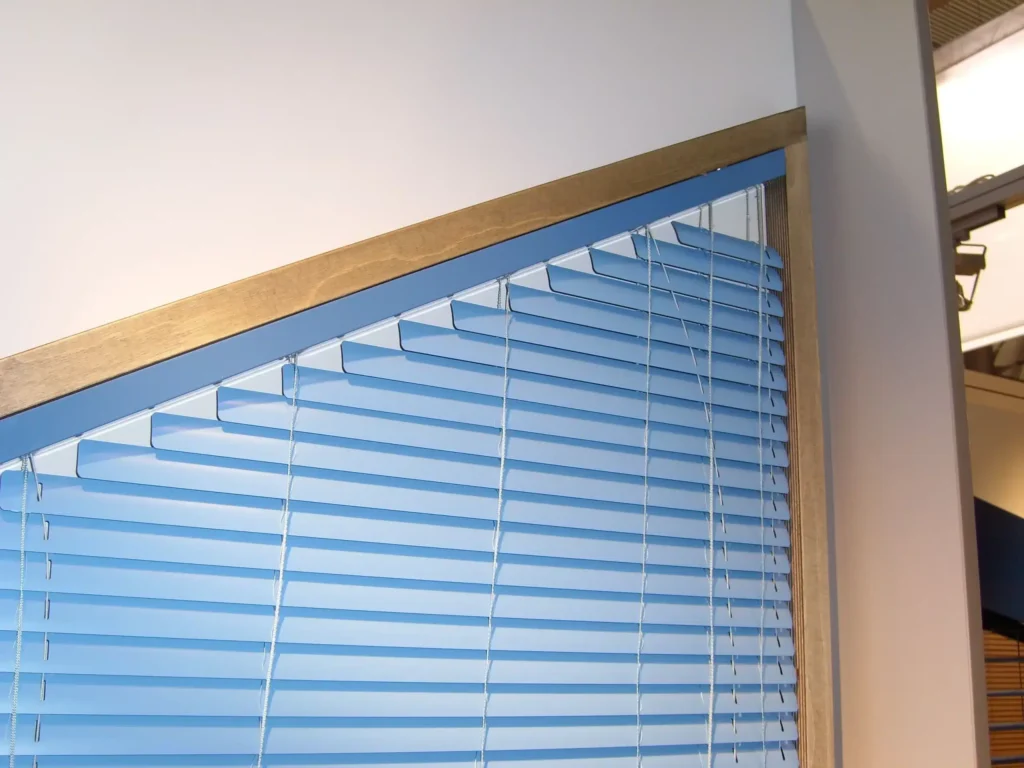
Perfect Fit blinds with a shaped top put a pleated blind inside a slim frame that follows the curve of the window and clips to the uPVC glazing bead, with no screws and no drilling, so the blind sits flat on the glass and moves with the sash if the window opens. The frame is bent or mitred to the arch and the pleated fabric inside rises from the bottom in the normal way. It is the tidiest arched option on a modern uPVC window.
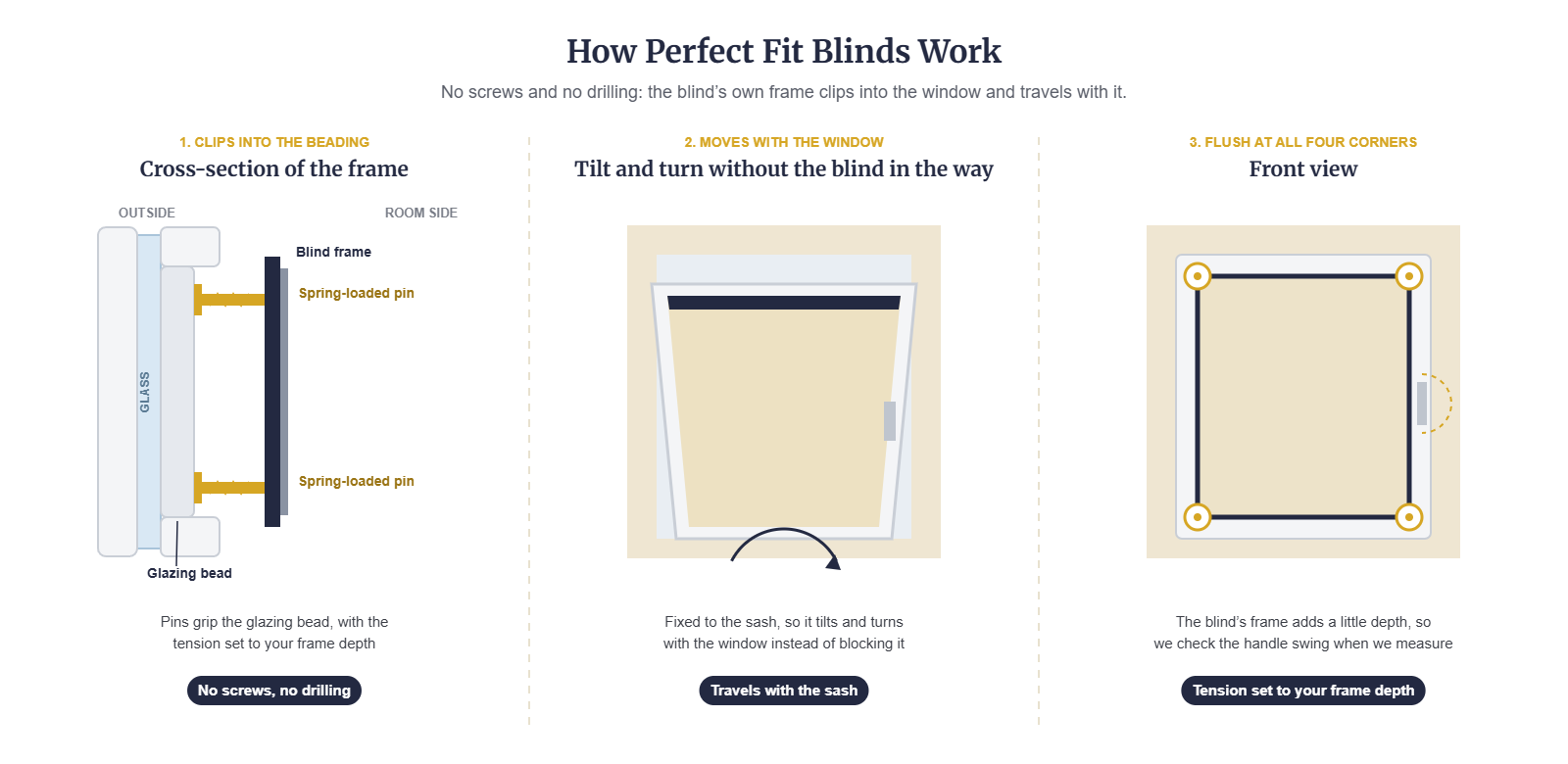
The condition is the bead. The window needs a uPVC or aluminium bead deep enough for the clips, all the way round the curve, and timber windows do not have one. Where the bead is present, Perfect Fit pleated blinds in a shaped frame are our usual recommendation for an arched bedroom window, because the frame closes the light gap at the edges that a face fixed blind leaves. Our general Perfect Fit blinds page explains the frame colours, and the Perfect Fit blinds for angled windows guide shows the same idea on straight angles.
What fails on an arched window
What fails on an arched window is anything that assumes a straight top: a roller fixed across the springing line leaves the arch bare, a vertical blind on a straight track does the same, a Venetian stacks as a rectangle, and a ready made stick on fan shade sags and yellows within a year. Curtains on a straight pole above the arch cover it when closed but hide the shape, which is usually the reason the window was chosen in the first place.
- Roller blinds: the tube is straight, so the curve above it stays uncovered and lets in early light.
- Vertical blinds: louvres hang from a track, and a track cannot curve in the vertical plane.
- Venetian and wooden blinds: slats are straight and the stack is rectangular.
- Ready made fan shades: tension fitted, thin fabric, no way to adjust them to the exact radius.
- Curtains on a straight pole: cover the glass but hide the arch, and the pole has to sit above the curve.
A roller or Venetian on the rectangle with a fixed shaped pleated blind in the arch above is a fair compromise and often cheaper than one full height shaped blind. We suggest it where the arch is small and the main window needs a wipe clean or a slatted blind.
How we measure an arch
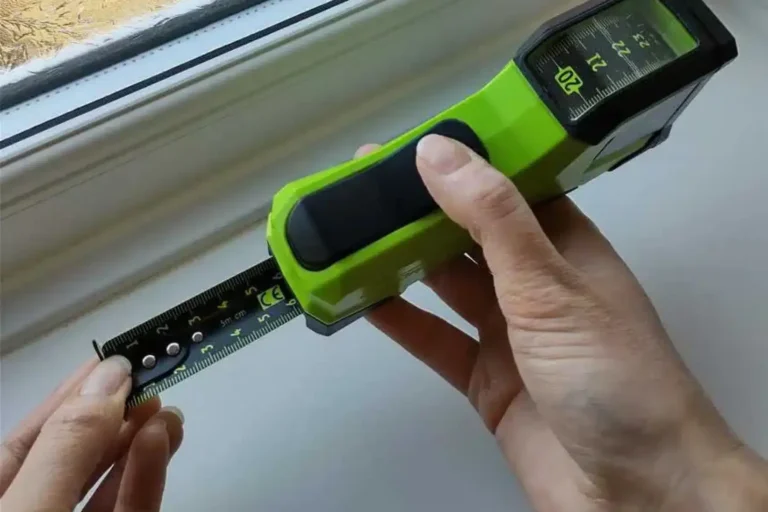
We measure an arched window by taking a full size template of the curve rather than relying on a radius, because very few arches in real houses are a true semicircle. The template is drawn on card or thin board held against the glass or the recess, then checked in three or four places with the tape. We also record the springing line, which is where the curve starts, the width at that line, the height to the top of the arch and the recess depth.
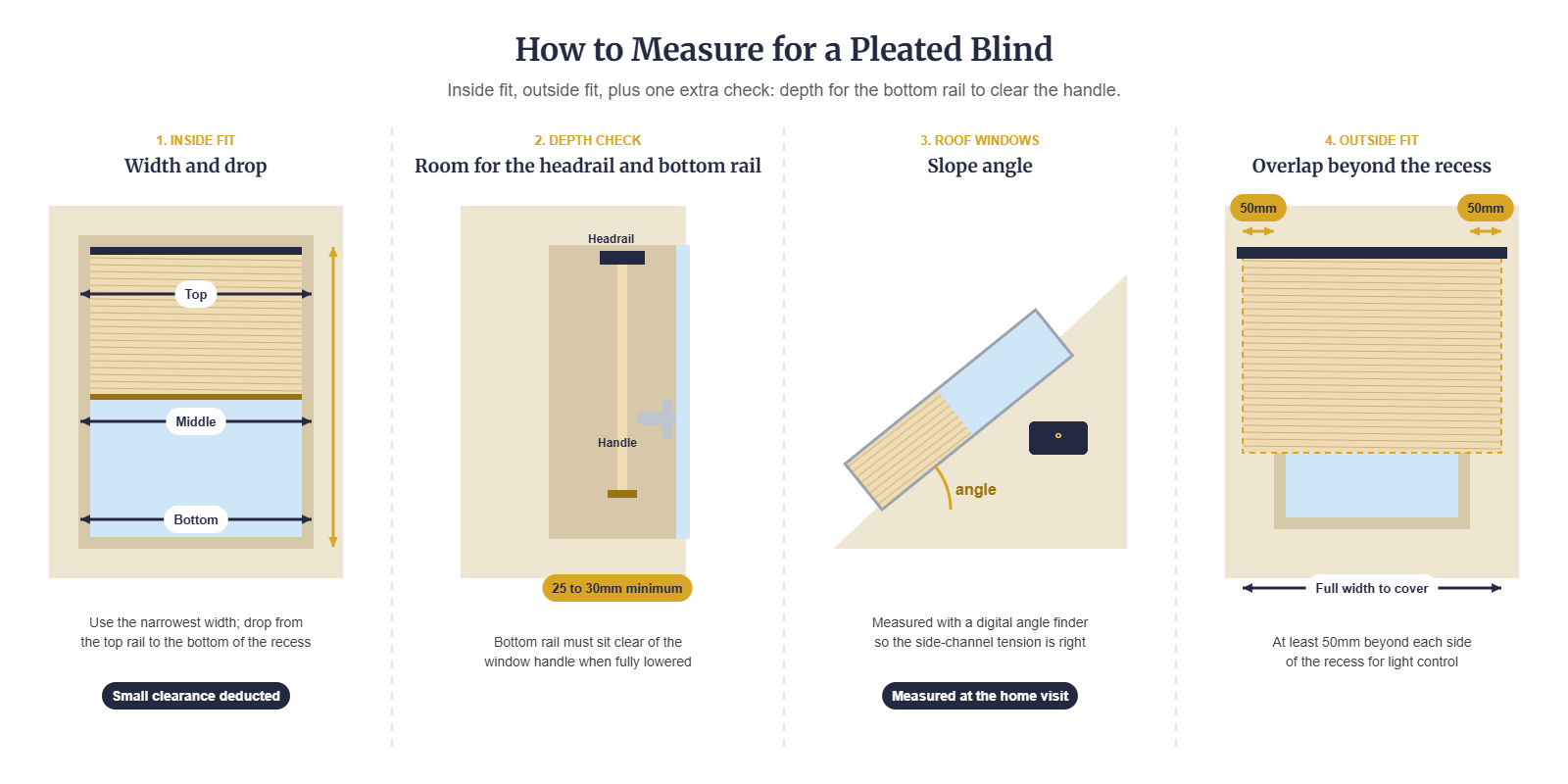
For a Perfect Fit frame the bead is measured round the curve, and for a recess fitted shaped pleated blind the recess depth has to clear the window handle. A segmental arch, which is a shallow curve on a wide window, is measured the same way but needs more care at the ends where the curve meets the straight sides. We do all of this at the home visit, and we do not ask customers to template their own arches, because a template that is a few millimetres out shows as a light gap on the finished blind.
How much do arched window blinds cost
Arched window blinds cost more than a rectangular blind of the same size because the fabric is hand cut to the template, the rail or frame is shaped, and the making takes longer. Our pleated blinds start at £120 and most fall between £120 to £490 per blind, and a shaped version sits in the upper part of that range or above it. Perfect Fit blinds start at £60 and most fall between £60 to £75 per blind, with the shaped frame adding to the figure.
| Option | Price basis | What moves it |
|---|---|---|
| Fixed shaped pleated blind in the arch only | Pleated blind price, shaped | Size of the arch, fabric, blackout cellular or not |
| Rising shaped pleated blind, full height | Pleated blind price, shaped | Height, width at springing line, cord or cordless |
| Fan pleated blind | Pleated blind price, shaped | Radius, fixed or opening, fabric |
| Perfect Fit with shaped top | Perfect Fit price plus shaped frame | Frame length round the curve, fabric |
| Standard blind below plus fixed arch above | Two blinds priced separately | Type of the lower blind |
The written quote after a home visit gives the exact figure. Because every arch is templated, we do not quote shaped blinds over the phone.
Arched windows in East London and Essex homes
Arched windows around here turn up in three places: the fanlight over the front door of Victorian and Edwardian terraces in Ilford, East Ham and Barking, the round top landing or bathroom window on 1930s semis in Hornchurch, Upminster and Rainham, and the full height feature arch in newer detached houses and barn style conversions out towards Grays, South Ockendon and the Essex villages. Each wants a different answer.
The terrace fanlight is nearly always a fixed fan pleated or shaped pleated blind in a light fabric, there to soften the glare rather than black out a hallway. The 1930s round top window is usually uPVC now, and a Perfect Fit pleated blind with a shaped top is the neatest fit, with blackout cellular fabric if it is a bedroom. The modern feature arch, often two storeys tall, is a rising shaped pleated blind with a motor, because nobody wants to reach a cord four metres up. Where an arched window is also set in a sloping gable, our guide to blinds for sloping and angled windows covers the combination. For rooms where the arch is purely decorative and warmth matters more, made to measure curtains on a pole above the arch remain a reasonable choice.
Every blind we make is fitted to current UK child safety rules. The Make it Safe campaign from the British Blind and Shutter Association explains what to check on blinds you already own.[1]
Frequently asked questions
Can arched blinds open?
Yes. A rising shaped pleated blind opens from the bottom so the rectangular part of the window clears while the arch stays covered, and some fan blinds fold to one side. A fixed arch blind does not open and is paired with an opening blind below.
Are arched window blinds expensive?
They cost more than a rectangular blind of the same size because the fabric is cut to a template and the frame or rail is shaped. They sit in the upper part of our pleated and Perfect Fit ranges, and the written quote gives the exact figure.
Can you get blackout blinds for an arched window?
Yes, as a shaped cellular pleated blind in blackout fabric, ideally in a Perfect Fit frame that closes the edge gap. A fan blind lets a little light through at the central pivot, so it is less suited to blackout.
Can you put a roller blind on an arched window?
Only on the rectangular part below the curve. The arch itself stays uncovered unless you add a fixed shaped blind above the roller.
Do arched blinds have cords?
Rising shaped pleated blinds use a cord or a handle, and cordless tensioned and motorised versions are available. Fixed and fan blinds have no cord.
How do you measure an arched window for a blind?
We take a full size template of the curve at the home visit and record the width at the springing line, the height to the top of the arch and the recess or bead depth. We do not rely on a radius because most arches are not true semicircles.
Get a free home visit in Rainham and East London
If you are still deciding on blinds for arched windows, if you have an arched, round top or fanlight window and want to see what will fit it properly, book a free home visit or call 01708 505379. We template the arch at your home across Rainham, Hornchurch, Upminster, Ilford, Barking, Grays and the rest of East London and Essex, make the blind in our Rainham workshop and send a written quote after the visit.
References
- ^ Make it Safe from the BBSA. Make it Safe (British Blind and Shutter Association). Retrieved 25 October 2026.