This Perfect Fit blinds buying guide comes down to five checks: your windows need uPVC frames with a suitable glazing bead, you need exact bead-to-bead measurements for every pane, you choose the blind type and fabric room by room, you match the frame colour to your windows, and you budget per pane of glass rather than per window. Get those five right and a Perfect Fit blind will sit flat in the frame, move with the window and leave no holes behind.
We are HomeDecisions, and we make Perfect Fit blinds in our own workshop in Rainham, then measure and fit them in homes across East London and Essex. This guide pulls together what we tell people at the measuring visit: how the system works, which windows it suits and which it does not, what each type of blind is good at, what changes the price, and the mistakes we see most often when people order on their own. If you already know you want them, our Perfect Fit blinds page is where to start an order.
What are Perfect Fit blinds and how do they work
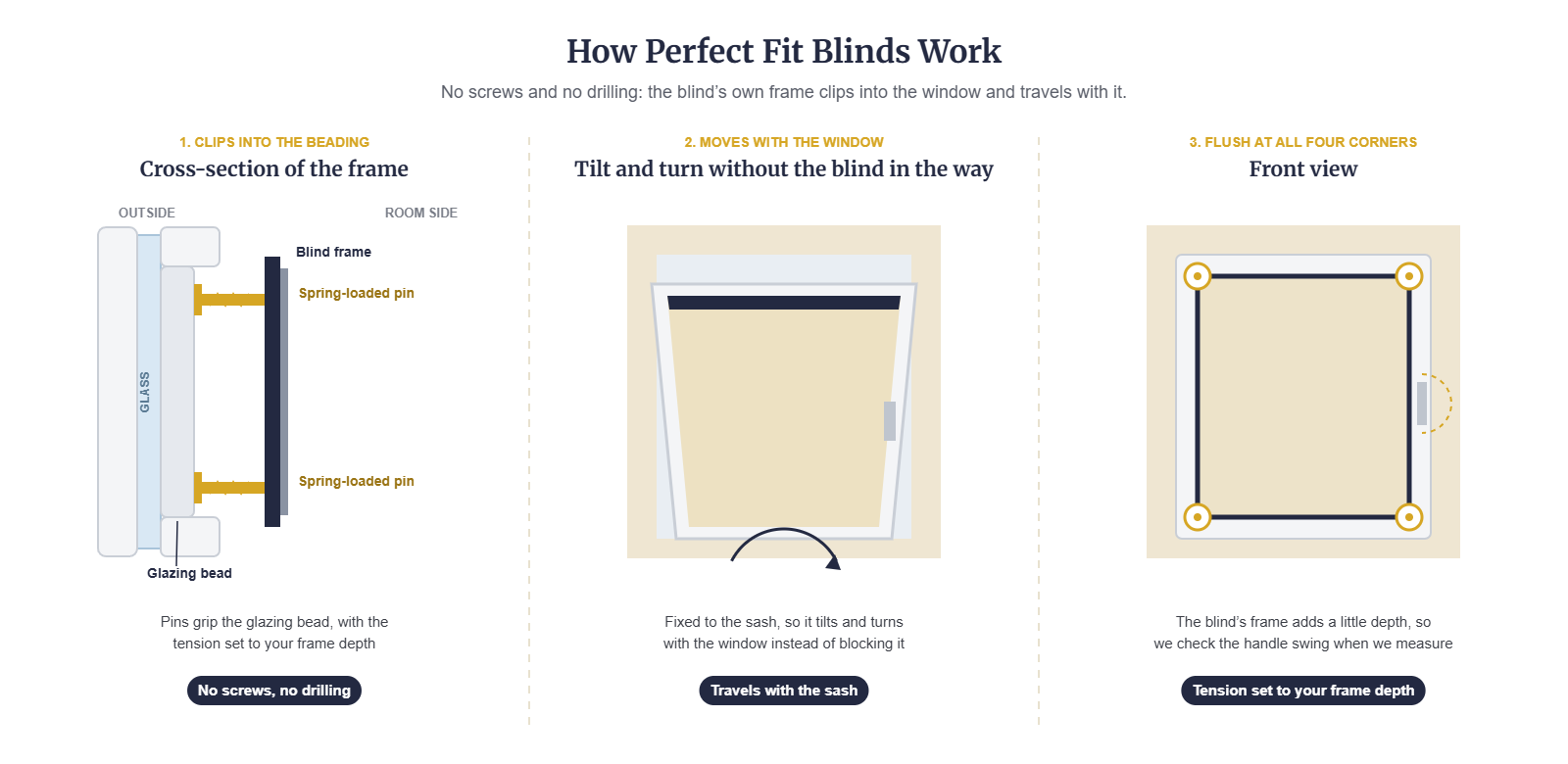
Perfect Fit blinds are made-to-measure blinds built into a slim aluminium frame that clips onto the glazing bead of a uPVC window or door, so nothing is screwed into the frame, the wall or the plaster. The blind sits close to the glass inside its own frame, and the whole unit becomes part of the opening sash.
The glazing bead is the strip of uPVC that holds the double glazed unit in place, with a rubber gasket between the bead and the glass. Small metal brackets push into the gap between the bead and the frame. The blind frame then clips onto those brackets at the corners. Take the frame off and the brackets slide out again, leaving the window as it was.
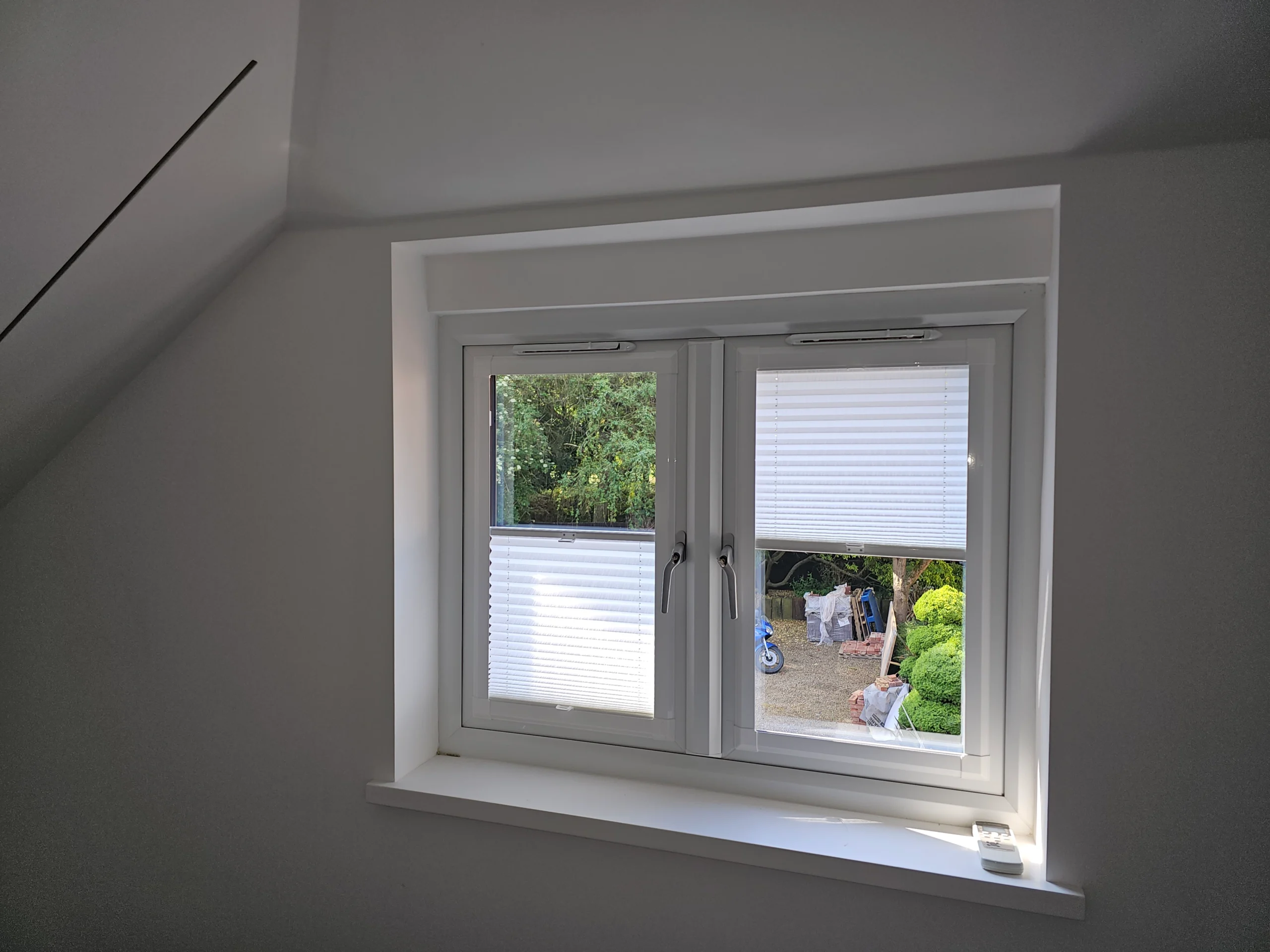
Because the blind is fixed to the sash rather than to the wall above, it moves when the window moves. Open a casement, tilt a tilt and turn window or swing a French door and the blind goes with it, held flat against the glass. That single detail is the reason most people choose the system: no blind swinging into the room, no fabric caught in the handle and no need to raise the blind before you open the window.
Do Perfect Fit blinds damage your windows?
No. Perfect Fit blinds do not damage uPVC windows, because nothing is drilled, screwed or glued. The small brackets sit in the gap between the glazing bead and the frame, held by the rubber gasket, and they slide out again if the blind is ever taken off, leaving no holes and no marks. The frame does not affect the double glazed unit or the seal around it.
The one way a bead can be marked is by forcing a bracket into a gap that is too tight or too shallow, which is why we measure the bead on every window before we recommend the system, and say so if a window is not suitable. If you rent, that also makes Perfect Fit one of the few blinds you can fit and take with you without a word from the landlord.
Which windows suit Perfect Fit blinds
Perfect Fit blinds suit most uPVC windows and doors that have a square-edged or gently angled glazing bead with enough depth for the brackets to grip. The frame material and the shape of the bead matter more than the style of the window, which is why we look at the bead first on every visit.
Windows and doors that usually work well
- uPVC casement windows. The standard side-hung and top-hung windows found in most East London homes. Each opening sash and each fixed pane gets its own blind.
- Tilt and turn windows. Common in new build flats and replacement windows. The blind stays put whether the window is tilted for air or swung fully open. The blind needs to clear the handle in both positions, which we check at the visit.
- French doors and uPVC back doors. No blind flapping when the door opens, and the handle stays clear because the frame sits inside the bead line.
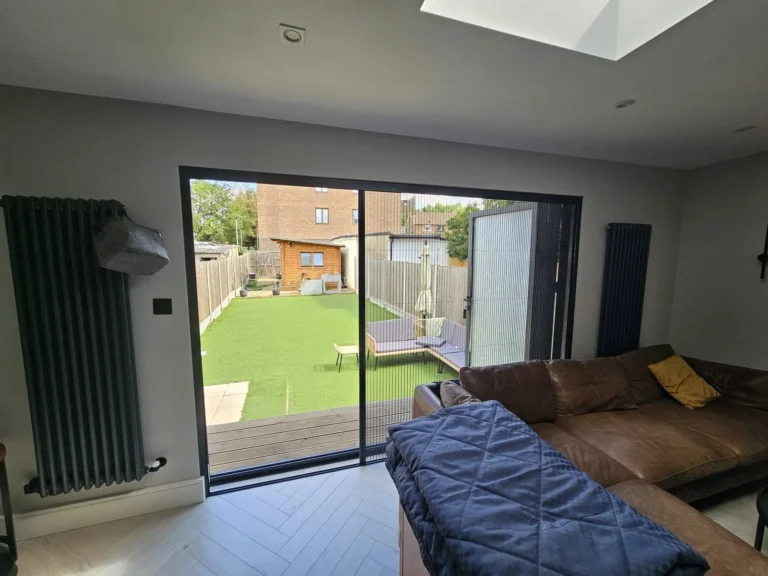
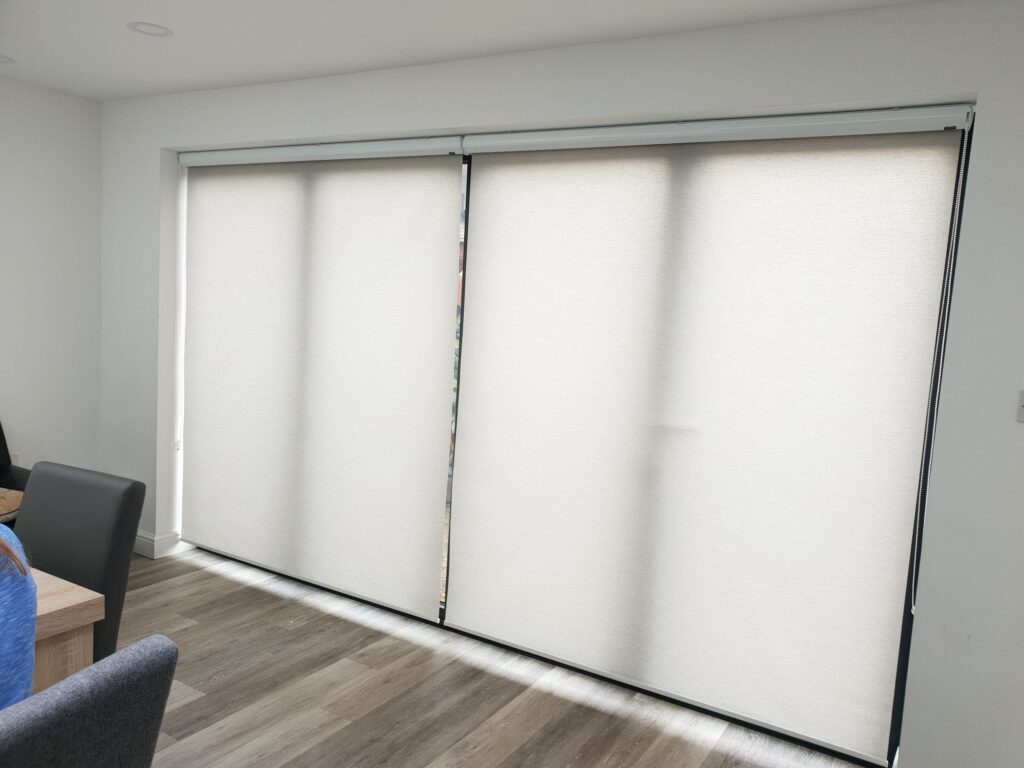
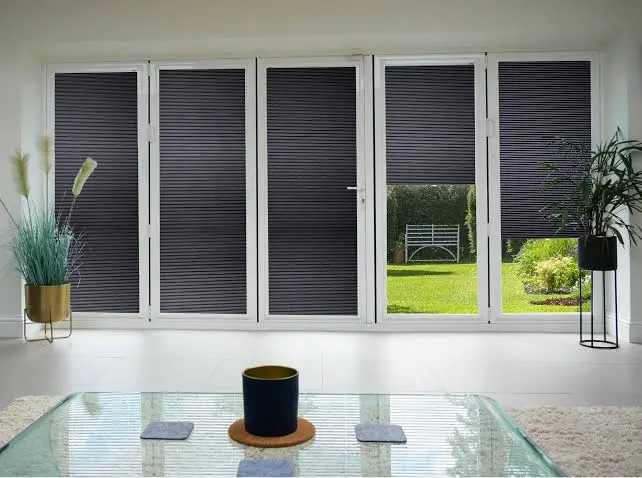
- Patio doors and bifolds with uPVC frames. Each glass panel gets its own blind, so a bifold can fold back with the blinds still attached to each leaf.
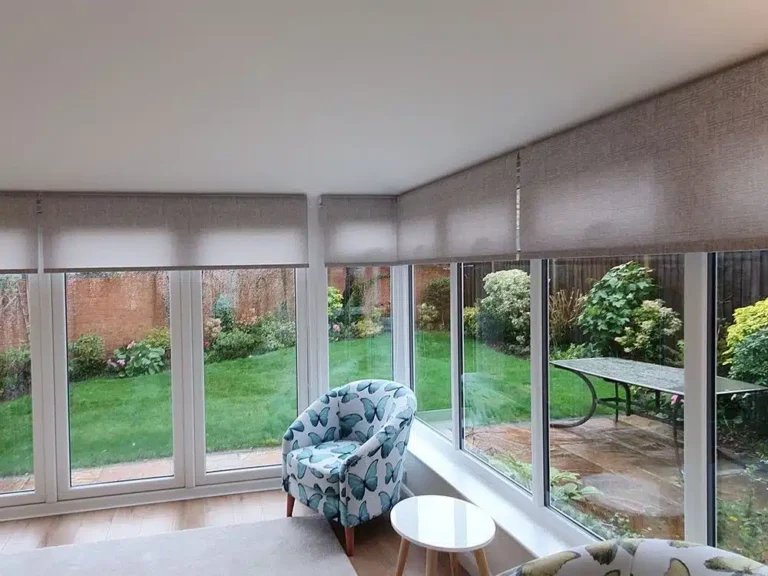
- Conservatory side windows. uPVC conservatory frames usually take Perfect Fit well, and a blind on every pane gives a tidy, even look.
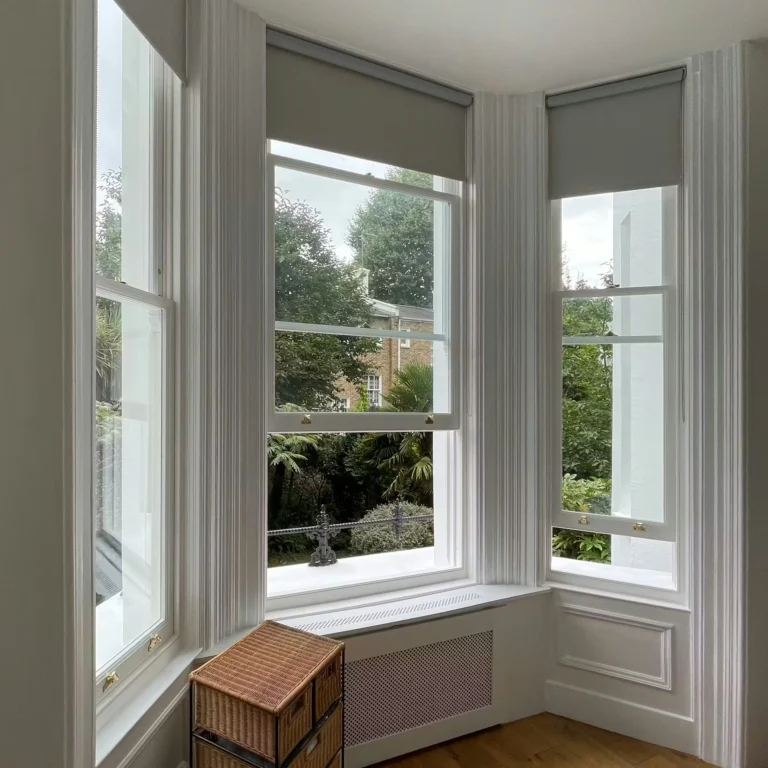
- Bay windows with uPVC frames. Each facet of the bay gets its own blind, so there is no need for an angled headrail across the bay.
Where Perfect Fit is not the right choice
Perfect Fit is not right for timber windows, most steel windows, and many aluminium frames, because they rarely have a bead the brackets can grip. Some aluminium systems do take them, so it is worth checking rather than assuming. The system also struggles with:
- Beads that are very shallow, heavily rounded or sculpted, where the bracket has nothing square to hold.
- Glass that is not rectangular, such as arched tops and steep triangles. For shaped windows a pleated or vertical blind made to the shape is usually the better route.
- Windows where a handle, restrictor or vent sits so close to the bead that the frame would foul it.
- Very small panes, where the frame and mechanism take up a large share of the visible glass.
If your windows fall into one of these groups, a standard recess or face-fitted blind is usually the better buy, and we will say so at the visit rather than sell a system that will not sit right.
Benefits of Perfect Fit blinds
The main benefits of Perfect Fit blinds are no drilling, a blind that moves with the window, smaller light gaps at the edges, a clear windowsill and no long loose cord. Each of these is practical rather than cosmetic, and each one matters more in some rooms than others.
No drilling into the frame or wall
Nothing is screwed into the uPVC, the plaster or the tiles. That suits tenants whose tenancy says no drilling, owners of new windows who do not want holes in the frames, and kitchens and bathrooms where the wall around the window is tiled. It also means the blind can be lifted off when you move house or redecorate.
The blind moves with the window
This is the reason the system exists. On tilt and turn windows, French doors and inward-opening sashes, a normal blind either has to be raised every time you open the window or it ends up hanging loose in the room. A Perfect Fit blind travels with the sash, so you can ventilate a bedroom at night with the blind still down.
Smaller light gaps at the edges
Because the fabric runs inside a frame tight to the glass, there is far less light spill at the sides than with a blind hung in front of the window. It will not make a room perfectly dark, since there is still a small margin at the frame edge, but with a blackout fabric it gets close enough for most bedrooms.
A clear windowsill
The blind sits within the window itself, so the sill stays free for plants, photos or a cat. In small rooms, and in kitchens where the sill sits behind the taps, that makes a real difference to how the window gets used.
No long loose cords
Perfect Fit blinds keep their workings inside the frame, so there is no long looped cord hanging down beside the window. GOV.UK product safety guidance warns that looped blind cords and chains can be dangerous for young children, and advises keeping cots, beds and high chairs away from blinds.[1] A framed blind removes most of that risk, though we still give the same advice about furniture placement in children’s rooms.
Easy to remove and clean
The frame unclips without tools, which makes cleaning the glass behind it, or wiping the blind itself, much easier than with a blind fixed to the wall. A soft brush or dry cloth keeps most fabrics clean, with a damp cloth for wipeable ones.
What to weigh up before you buy
The trade-offs with Perfect Fit blinds are cost per pane, a slightly reduced glass area and the need for a compatible bead. None of them rules the system out, but you should know them before you order.
- You pay per pane, not per window. A three-pane window with two opening sashes and a fixed centre needs three blinds. That can make a Perfect Fit room cost more than a single blind across the recess.
- The frame takes a little light. The aluminium frame sits over the edge of the glass, so a small strip of view is lost on each side. On large panes you will not notice it. On small panes you will.
- Raised blinds still sit on the glass. When a roller is fully up, its cassette stays at the top of the pane. You do not get a fully clear window the way you do with a blind above the recess.
- Measurements have to be exact. The blind is made to the bead, not the recess, so a few millimetres out is enough to stop it clipping in properly.
Types of Perfect Fit blind
The four common types of Perfect Fit blind are roller, pleated, Venetian and day and night, all using the same clip-in frame. Choose the type by how you want to control light in that room.
Perfect Fit roller blinds
A single flat sheet of fabric that rolls up into a cassette at the top of the frame. Rollers are the simplest and most popular choice, with the widest range of blackout and light-filtering fabrics. Our Perfect Fit roller blinds page shows the range. If an older roller has started to rise slowly or droop, our guide on how to retension a Perfect Fit roller blind walks through the fix.
Perfect Fit pleated blinds
Folded fabric that stacks neatly at the top or bottom of the frame and can usually be set to open from the top down or the bottom up. That makes pleated blinds good for privacy at street level while still letting light in over the top. Honeycomb versions have a double layer that traps air between the folds.[2] They are a common choice for conservatory panes and front rooms.
Perfect Fit Venetian blinds
Aluminium slats that tilt to angle light up or down. Venetians are hard wearing and wipe clean, so they work in kitchens, bathrooms and utility rooms, and they give fine control over glare without fully closing the blind.
Perfect Fit day and night blinds
Two layers of alternating sheer and solid bands. Line up the solid bands for privacy, or the sheer bands for soft daylight. They suit living rooms and front bedrooms that face the street, where you want privacy without losing all the light.
Choosing fabric and frame colour room by room
Choose the fabric for the job the room does first, then the colour. A beautiful fabric in the wrong weight is the most common reason people are unhappy with a new blind.
Bedrooms and nurseries
Blackout rollers or blackout pleats are the usual pick. The frame keeps side light low, which helps on summer mornings and with streetlights outside. For a child’s room, the absence of a loose loop is a real plus.
Kitchens, bathrooms and utility rooms
Use a wipeable PVC-coated roller fabric or aluminium Venetian slats. These rooms get steam and condensation on the glass, and because a Perfect Fit blind sits close to the pane it will meet that moisture first. The Energy Saving Trust advises keeping trickle vents open, opening windows for a few minutes several times a day and running extractor fans after cooking or a shower.[3] Do that and a moisture-resistant blind will last well.
Conservatories
Pleated and honeycomb fabrics are popular on conservatory side panes, often in a lighter colour to cut glare. The roof is a separate job. Our guide to Perfect Fit conservatory blinds covers sides, doors and roofs together.
Living rooms and home offices
Light-filtering rollers, day and night blinds or Venetians give you control over screen glare without making the room dark. In a front room that faces a busy road, a top-down pleat keeps the lower half private and leaves the top open to the sky.
Matching the frame colour
Frames come in a range of colours, with white the most common, and anthracite grey and woodgrain effects to match coloured uPVC. Match the frame to the window rather than to the fabric, so the blind reads as part of the window. If your windows are white inside and grey outside, it is the inside face that matters.
How much do Perfect Fit blinds cost
Perfect Fit blinds from HomeDecisions start at £60, and most fall between £60 to £75 per blind. Remember that the price is per blind and each pane needs its own, so count the panes before you budget.
What moves a blind up or down that range:
- Pane size. A tall patio door panel uses more fabric and a longer frame than a small top-hung window.
- Blind type. Rollers usually sit at the lower end, with pleated, honeycomb, Venetian and day and night blinds higher.
- Fabric. Blackout, thermal and wipeable fabrics generally cost more than a plain light-filtering fabric.
- Frame colour. White is the standard. Coloured and woodgrain frames can add to the cost.
- Number of blinds. A whole house is quoted as one job, which keeps the per-blind cost sensible.
After the free measuring visit we email or phone through a written quote that shows the exact figure for each blind. For a fuller breakdown, our Perfect Fit blinds price guide explains the cost in more depth.
Measuring and fitting Perfect Fit blinds
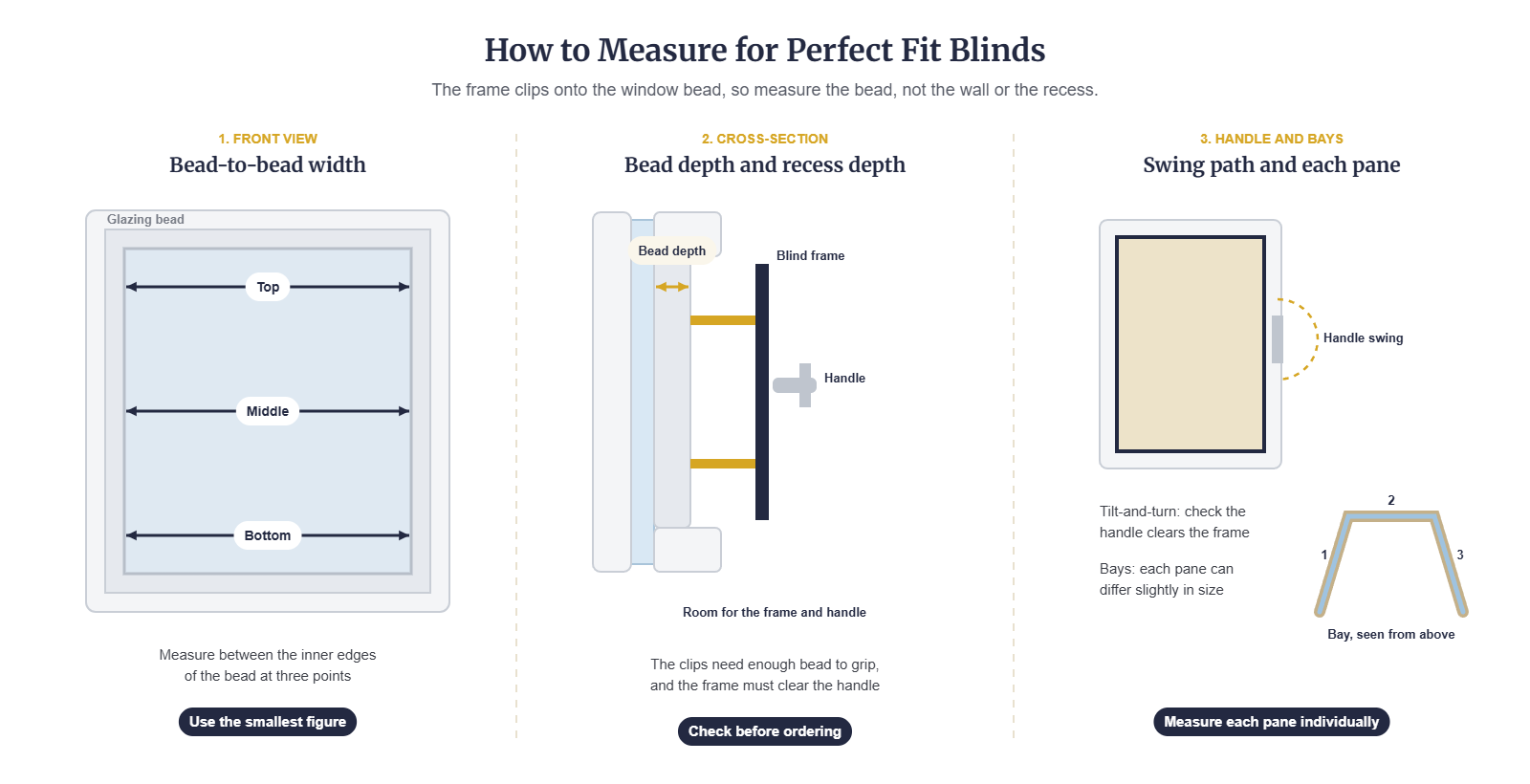
Perfect Fit blinds are measured bead to bead on the glass, not across the recess, and every pane is measured separately even when the windows look identical. That is the single most important rule when you buy them.
The basics are simple. Measure the width of the glass between the inside edges of the bead at the top, middle and bottom, and use the smallest figure. Do the same for the height, left, centre and right. Work in millimetres with a metal tape. Then check the depth and angle of the bead to make sure the brackets will grip. Our step-by-step guide on how to measure for Perfect Fit blinds goes through each step with photos.
Fitting is a matter of pushing the brackets into the bead in the right positions and clipping the frame on. Our guide on how to install Perfect Fit roller blinds shows the process. It is quick when the measurements are right, and frustrating when they are not.
Measure yourself or book a visit
Measuring yourself works for a few standard uPVC casements. A measuring visit makes more sense when you have bays, bifolds, French doors, older replacement windows that are not square, or a whole house to do. At the visit we measure every pane, check each bead, look at handles and restrictors, and talk through fabrics in your own light. We then send the written quote. If you order on your own measurements, the risk of a blind that does not fit sits with you.
Perfect Fit blinds for homes in Rainham and East London
Most homes we visit around Rainham, Hornchurch, Upminster and Romford have uPVC replacement windows, and they are well suited to Perfect Fit. Housing type changes what we recommend.
- 1930s semis in Hornchurch, Elm Park and Upminster. Many have a uPVC bay at the front. A blind on each facet keeps the shape of the bay and avoids an angled rail. Top-down pleats give street privacy at the front.
- New build flats in Beam Park, Stratford and Canary Wharf. Tilt and turn windows and Juliet balcony doors are common, and many leases or tenancies restrict drilling. Perfect Fit solves both.
- Terraces and maisonettes in Dagenham, Barking and Ilford. Rear kitchens and bathrooms often have small top-hung windows with tiled surrounds, where a wipeable roller or Venetian clipped into the bead avoids drilling tile.
- Family homes in Grays and South Ockendon. uPVC French doors and patio doors onto the garden are typical, and a blind on each door panel is a clean answer.
Older homes with original timber sashes, often in conservation areas, are the exception. There a standard recess blind or curtains are usually the right answer.
Perfect Fit blinds buying checklist
Work through this list before you order and most problems never happen.
- Confirm every window and door is uPVC, or an aluminium frame you have checked, with a square or gently angled bead.
- Count the panes, including fixed ones, and note which open and which way.
- Check handles, restrictors and trickle vents for clearance near the bead.
- Measure each pane bead to bead in three places for width and height, in millimetres, and record the smallest figures.
- Decide the job of each room: blackout, privacy, glare control or moisture resistance.
- Pick the blind type for each room: roller, pleated, Venetian or day and night.
- Match the frame colour to the inside face of the window.
- See the fabric against your own window light before you commit.
- Budget per blind, not per window, using the price range above.
- Get a written quote that lists each blind, its size, fabric and frame colour.
Common mistakes we see
- Measuring the recess instead of the glass. The blind is sized to the bead, so recess measurements give a blind that is far too big.
- Measuring one window and copying it. Windows that look the same are often a few millimetres different.
- Ignoring the bead profile. A rounded or very shallow bead will not hold the brackets securely.
- Choosing fabric by colour alone. A light-filtering fabric in a bedroom, or a plain fabric in a steamy bathroom, will disappoint whatever the colour.
- Forgetting fixed panes. A blind on the opening sash but not the fixed pane beside it looks unfinished.
Frequently asked questions
Are Perfect Fit blinds worth it?
They are worth it on uPVC windows that open often, such as tilt and turn windows, French doors and bedroom casements, and in homes where drilling is not allowed. On windows that rarely open, a standard recess blind can do the same job for less.
Do Perfect Fit blinds damage uPVC windows?
No. The brackets push in between the glass and the rubber seal without screws or adhesive, and they slide out again when the blind is removed. Forcing a bracket into a bead that is too tight is the only thing that can mark it, which is why we check every bead first.
Can you fit Perfect Fit blinds to aluminium windows?
Some aluminium windows take them, but many do not, because their beads are too shallow or the wrong shape for the brackets. We check the profile at the measuring visit before recommending them.
Do Perfect Fit blinds keep heat in?
A blind held close to the glass adds a layer between the room and the window, and honeycomb pleated fabrics trap air in their cells. The Energy Saving Trust lists thermal curtains and sealed blinds among the low-cost ways to reduce heat loss through windows, though it does not put a figure on the saving, and neither do we.
Can Perfect Fit blinds be removed when I move?
Yes. The frame unclips and the brackets slide out of the bead, leaving no holes. The blinds are made to your current windows, though, so they will only fit a new home if its glass is the same size.
Are Perfect Fit blinds safe for children?
They have no long loose loop hanging beside the window, which removes the main risk with older corded blinds. GOV.UK still advises keeping cots, beds and high chairs away from any window blind, and we give the same advice.
Book a free Perfect Fit measuring visit in Rainham and East London
If you would like every pane measured and every bead checked before you spend anything, book a free home visit or call us on 01708 505379, Monday to Friday, 9am to 5pm. We measure at your home, make the blinds in our Rainham workshop, and email or phone through a written quote after the visit. You are also welcome to call in to Unit C3, Star Business Centre, Fair View Industrial Estate, Marsh Wy, Rainham RM13 8UP during opening hours.
References
- ^ Child safety: blind cords. GOV.UK (Office for Product Safety and Standards). Retrieved 25 October 2026.
- ^ Energy efficient windows and doors. Energy Saving Trust. Retrieved 25 October 2026.
- ^ How to get rid of damp. Energy Saving Trust. Retrieved 25 October 2026.