Window curtains are fabric panels hung from a pole or track that you draw across a window to control light, add privacy and keep warmth in. Choosing well comes down to five things: the heading, the fabric, the lining, the length and the way the curtain is hung, and each one changes how the finished curtain looks and works.
We measure, make and fit made-to-measure curtains from our workshop in Rainham, and fit them across East London and Essex. This guide covers the curtain styles and headings worth knowing, which fabrics and linings suit which rooms, how to measure, which length to choose, poles and tracks, how curtains compare with blinds, what affects the cost, and how to look after them.
What are window curtains and how do they work
A window curtain is a length of fabric gathered at the top by a heading, hung from a pole or a track, and drawn open and closed along it. When open, the curtain stacks back at the sides of the window. When closed, it covers the glass and usually some of the wall on either side.
Every curtain has the same basic parts, and knowing them makes it much easier to talk through options or read a quote.
- Face fabric: the fabric you see from the room, which sets the colour, pattern and texture.
- Lining: a second layer sewn behind the face fabric. It protects the face fabric from sun, improves the drape and adds warmth. Blackout and thermal linings go further.
- Interlining: an optional soft layer between face fabric and lining that adds body and insulation.
- Heading: the top of the curtain, which sets how the fabric gathers and how it attaches to the pole or track.
- Fullness: how much wider the fabric is than the pole or track. More fullness means deeper folds and a richer look.
- Pole or track: the hardware the curtain hangs from. A pole is on show, and a track is mostly hidden.
- Stack back: the space the open curtain takes up at the side of the window.
- Return: the part of the curtain that wraps back from the front of the pole or track to the wall, which closes the gap at the side.
What curtains do well
Curtains are good at four jobs. They control light, from a soft filter with a sheer to near darkness with blackout lining. They give privacy, especially in the evening when a lit room is easy to see into. They keep warmth in, because a lined curtain drawn at dusk puts a layer of fabric and still air between the room and cold glass. And they soften a room, both in how it looks and in how it sounds, since heavy fabric takes some of the echo out of a room with hard floors.
The Energy Saving Trust lists heavy thermal curtains as one of the low-cost ways to reduce heat loss through windows, and names heavy lined curtains as an option for listed buildings where the windows themselves cannot easily be changed.[1] Curtains are not a substitute for draught-proofing or better glazing, but in a home with older windows they make a noticeable difference to how warm a room feels in the evening.
Curtain heading types explained
The heading is the single biggest decision in how a curtain looks. It decides how the fabric folds, how much fabric you need, whether you need a pole or a track, and how formal or relaxed the curtain feels.
Pencil pleat curtains
Pencil pleat is the classic British heading. A tape sewn across the top is drawn up with cords to create rows of tight, narrow folds, and the curtain hangs from hooks on a pole or a track. It works in almost any room and is the most flexible heading we make. Pencil pleat usually needs around two to two and a half times the width of the pole or track in fabric. It suits traditional and cottage-style rooms, and it is the easiest heading to fit to a bay window track.
Eyelet curtains
Eyelet curtains have metal rings punched through the heading, and the pole runs straight through them. They fall in big, even, rounded folds and slide easily along the pole. They need a little less fabric than pencil pleat, usually around one and a half to two times the pole width, and they only work on a pole, not a track. Eyelets suit modern rooms, flats and new builds, and they are popular because they are simple to open and close. The trade-off is that they stand a little further from the wall, which can let light spill over the top.
Pinch pleat curtains
Pinch pleat curtains have groups of two or three folds stitched together at regular intervals along the top, so the curtain falls in neat, deep columns. Sometimes called triple pleat, it is a more tailored and formal look than pencil pleat. It takes more fabric, usually up to two and a half times the pole or track width, and suits living rooms, dining rooms and bedrooms with high ceilings or tall windows.
Double pleat and box pleat curtains
Double pleat is a lighter version of pinch pleat, with two folds per pleat instead of three. It looks crisp without being as heavy. Box pleat has flat, folded pleats sewn across the top so the fabric hangs in straight, even panels. Box pleat suits fabrics with a strong pattern, because the flat pleats show more of the design.
Wave curtains
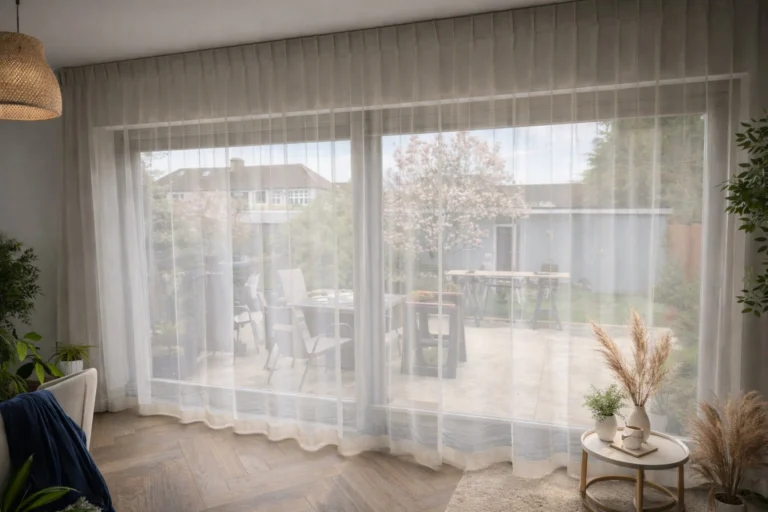
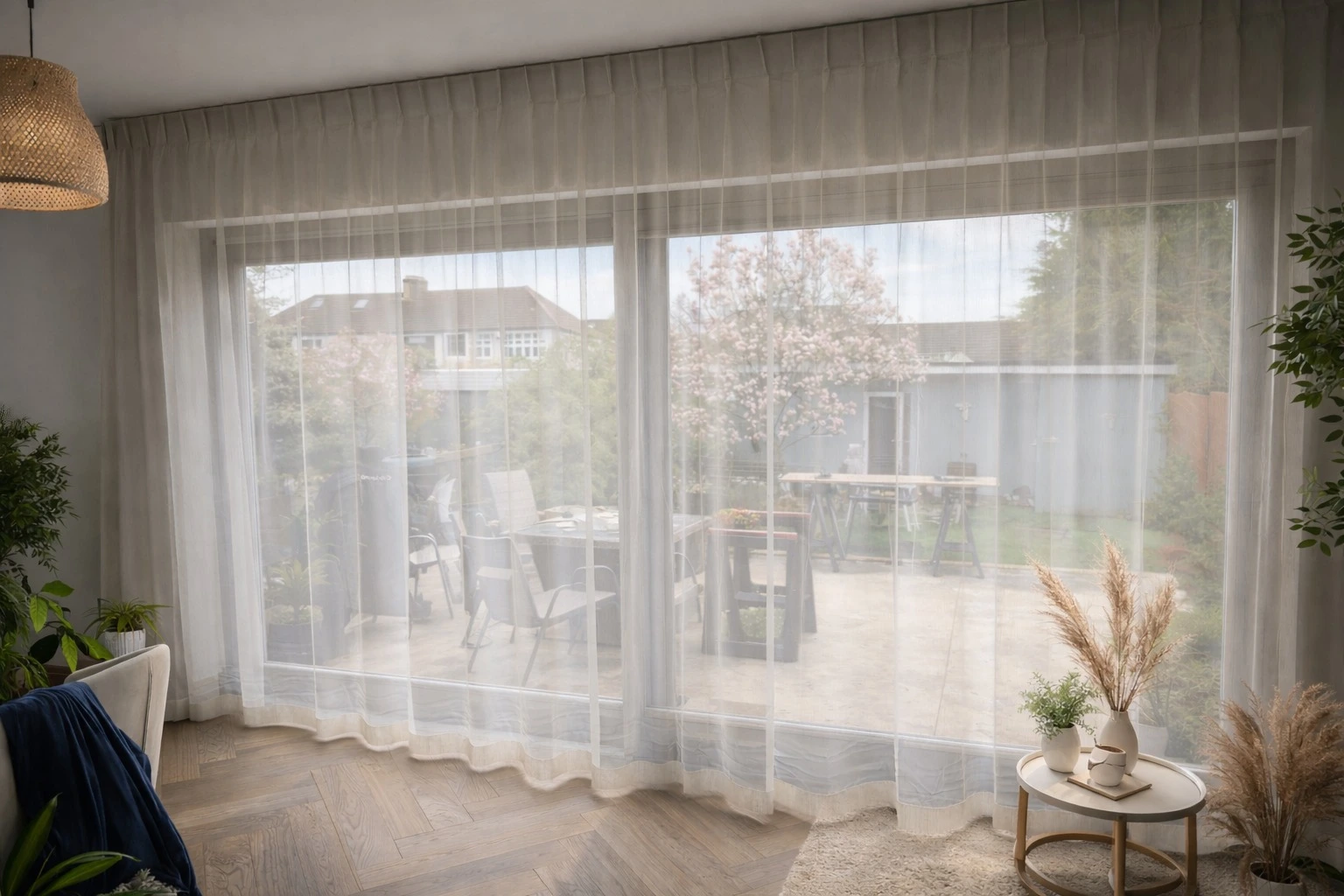
Wave curtains hang from a special track with gliders spaced at fixed intervals, so the fabric falls in a smooth, continuous S shape. It is a clean, contemporary look that suits large windows, patio doors and modern flats with floor to ceiling glass. Wave curtains also stack back neatly, which makes them a good choice where you want the glass as clear as possible when the curtains are open. Wave is also the most common heading for electric curtains, because the track and gliders move smoothly under a motor.
Tab top and rod pocket curtains
Tab top curtains hang from fabric loops over a pole, and rod pocket curtains have a sleeve sewn across the top that the pole slides through. Both have a relaxed, informal look and work best for sheers, voiles and curtains that are not drawn often, because they do not slide easily.
Which curtain heading should you choose
For most people the choice comes down to three headings. Choose pencil pleat if you want a flexible, traditional curtain that works on a pole or track, including in a bay. Choose eyelet if you want a modern look on a pole and easy everyday use. Choose wave if you want a clean contemporary finish on a track, especially on wide glass or with a motor. Pinch pleat is the step up when you want a more tailored, formal finish.
| Heading | Look | Pole or track | Typical fullness |
|---|---|---|---|
| Pencil pleat | Traditional, flexible | Both | 2 to 2.5 times |
| Eyelet | Modern, relaxed folds | Pole only | 1.5 to 2 times |
| Pinch pleat | Tailored, formal | Both | Up to 2.5 times |
| Wave | Clean, contemporary | Wave track | Set by the track |
| Tab top or rod pocket | Casual | Pole only | 1.5 to 2 times |
Curtain fabrics, colour and pattern
The best curtain fabric depends on the room, how much light you want to block and how the curtain should hang. Weight matters as much as fibre: heavier fabrics drape in deeper folds and insulate better, while lighter ones filter light and move more.
Velvet
Velvet is heavy, soft and rich in colour. It hangs in deep folds, blocks a lot of light and adds real warmth to a room, which makes it a good choice for living rooms and bedrooms in older houses. Cotton velvet has a matt, slightly crushed look, and polyester velvet is easier to care for and holds colour well. Velvet shows marks from handling, so it suits curtains you draw by the leading edge rather than grabbing in the middle.
Linen and linen-look fabrics
Linen has a natural, slightly uneven texture and a relaxed drape. It lets more light through than velvet and gives a soft, airy look in living rooms and bedrooms. True linen creases easily and can shrink if washed, so many people choose a linen-look polyester or a linen blend, which has a similar feel with less upkeep. Lined linen curtains keep their shape far better than unlined ones.
Cotton and cotton-polyester blends
Cotton and cotton blends are the everyday workhorses of curtain making. They come in the widest range of colours and prints, are easy to sew and hang well. Blends with polyester resist creasing and fading better than pure cotton. These suit almost any room, from kitchens to children’s bedrooms.
Silk and faux silk
Silk has a soft sheen and a formal look, but it fades and weakens in strong sun, so it must be lined and is best kept away from south-facing windows. Faux silk, usually polyester, gives a similar sheen and copes with sunlight far better, which is why it is the more practical choice for most homes.
Sheers and voiles
Sheer fabrics and voiles let daylight through while blurring the view in. They are often hung on their own track or pole behind or in front of a main curtain, or used alone in rooms where you want light and some privacy in the day. On their own, they give little privacy after dark.
Choosing colour and pattern
Curtains cover a large area of wall when drawn, so colour has a bigger effect than people expect. A curtain a shade or two away from the wall colour tends to look more considered than an exact match. Warm neutrals, soft greens, deep blues and earthy tones all sit well in most rooms, and darker colours make a room feel cosier in the evening.
Patterned fabrics need a little more planning. Large patterns repeat over a long distance, so more fabric is needed to match the pattern across the width of each curtain and between the pair. A strong pattern works best on a plain wall, and a plain curtain works best against a busy wallpaper. Always look at a sample in the room, in daylight and in the evening, because colours shift a lot under different light.
Lined, unlined and interlined curtains
Lining changes how a curtain hangs, how long it lasts and how warm and dark it makes the room. For most rooms, a lined curtain is the sensible default.
Unlined curtains
Unlined curtains are a single layer of fabric. They are light, let light through and give a casual look. They suit kitchens, bathrooms, sheers and voiles, but they fade faster, give less privacy at night and add very little warmth.
Lined curtains
A standard lining is a cotton or polyester fabric sewn behind the face fabric. It protects the face fabric from sunlight, gives fuller folds, blocks more light and adds some insulation. Lined curtains also look tidier from the street, because you see the plain lining rather than the back of the face fabric.
Blackout lining
Blackout lining has a coating that stops light passing through the fabric. It is the best choice for bedrooms, nurseries and rooms where you watch films. Light can still come in round the top and sides of a curtain, so for a dark room it helps to fix the pole or track well above the window, extend it past the frame, and choose a heading and return that sit close to the wall. Our guide to blackout blinds explains how a blind behind a curtain closes those gaps.
Thermal lining and interlining
Thermal lining is a heavier lining designed to hold warmth. Interlining is a soft, blanket-like layer sewn between the face fabric and the lining, which adds body, a fuller drape and the most insulation. Interlined curtains are heavier, so they need a stronger pole or track and a few more brackets. They are the best choice for draughty period windows and for rooms that feel cold in winter.
| Lining | Light | Warmth | Best for |
|---|---|---|---|
| Unlined | Lets light through | Low | Kitchens, sheers, voiles |
| Standard lining | Filters most light | Moderate | Living rooms, most rooms |
| Blackout lining | Blocks light through the fabric | Moderate to good | Bedrooms, nurseries, media rooms |
| Thermal or interlined | Blocks most light | Best | Cold rooms, period windows |
Curtains for every room and window type
Each room and window puts different demands on a curtain. These are our usual starting points before we see the room.
Curtains for the living room
In a living room, curtains are often as much about the look of the room as about light. Floor-length lined curtains in pencil pleat, pinch pleat or wave work well, in a fabric that suits the furniture and walls. If the room gets strong afternoon sun, a lined or dimout fabric protects the furniture and cuts the glare on a TV screen.
Curtains for the bedroom
In a bedroom, darkness comes first. Blackout lining, a pole or track set well above and past the window, and a curtain long enough to reach the floor give the darkest result. For a child’s room, keep cots and beds away from the window and avoid any loose cords from corded tracks.
Curtains for kitchens and bathrooms
Kitchens and bathrooms are hard on fabric because of steam, grease and splashes. Short, washable curtains in a cotton or polyester blend work over a sink or in a small bathroom, but many people find a wipeable roller blind or a faux wood blind more practical in these rooms. Keep any curtain well clear of a hob. The Energy Saving Trust advises opening windows while cooking or showering to let moisture out, so whatever you choose has to be easy to move out of the way.[2]
Curtains for bay windows
Bay windows are very common in the 1930s semis around Hornchurch, Upminster and Elm Park. A bay track is bent to follow the shape of the bay so curtains can draw all the way round. The alternative is a pole on each section joined by angled connectors, or a pair of curtains across the front of the bay. A track gives the neatest result and the best warmth, because the curtains sit close to the glass. Pencil pleat and pinch pleat headings work best on a bay track.
Curtains for patio doors and French doors
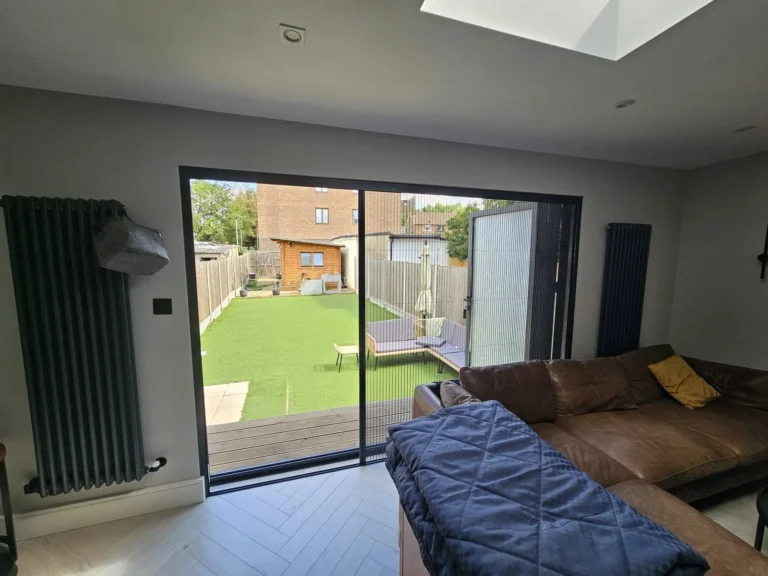
Patio doors and French doors need curtains that clear the door fully when open. That means a pole or track long enough for the curtains to stack back past the door frame, and enough height above the doors that the curtains do not catch when they open. Wave curtains are a good fit for wide patio doors because they stack back neatly. For French doors that open inwards, check the door swing before choosing a pole position.
Curtains for sloping and awkward windows
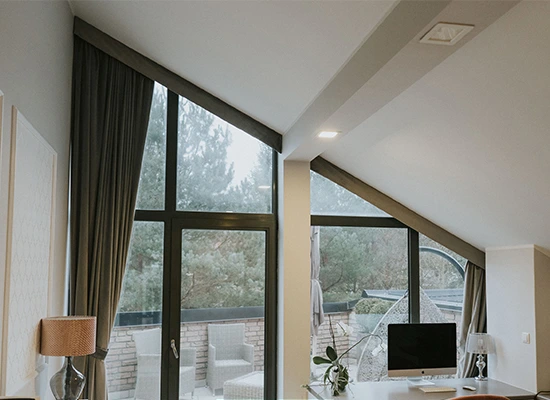
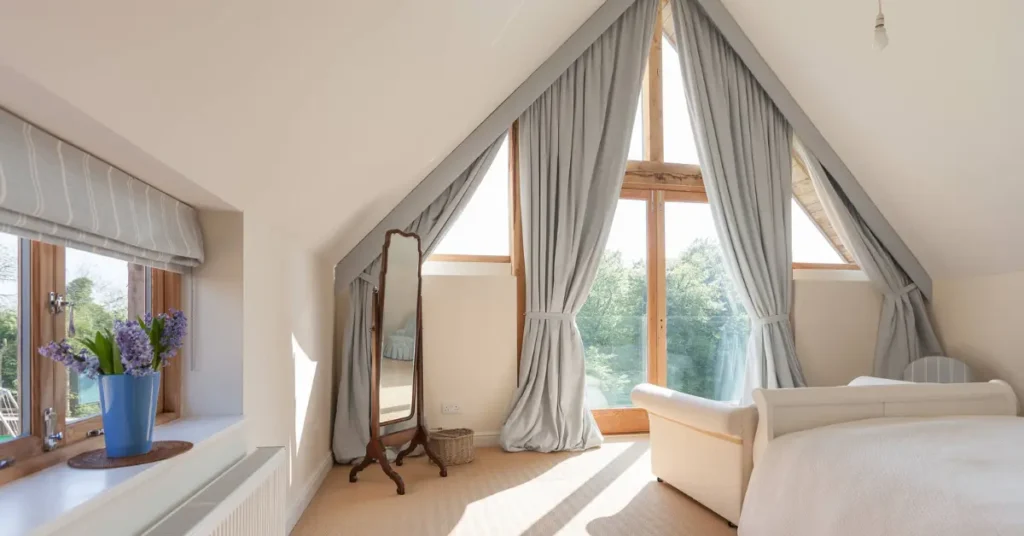
Sloping windows, dormers and windows close to a ceiling need more thought. A curtain can be held back with a second pole or a hold-back at the low side, or a blind can be used on the sloping part with a curtain on the upright part. Our guide to curtains for sloping windows covers these options in detail.
How to measure for curtains
To measure for curtains, fix the position of the pole or track first, then measure its width and the drop from it to where you want the curtain to finish. Measuring the window itself is only the starting point, because curtains almost always hang wider and higher than the frame.
- Decide where the pole or track will go. As a rule, set it around 10 to 15 cm above the top of the window frame, or higher if you want the window to look taller. Leave room for the brackets below any coving or ceiling.
- Decide how far it extends. A pole or track usually runs 15 to 20 cm past the frame on each side, so the curtains can stack back off the glass and let in more light when open. If you have a wall or a cupboard close by, measure the space you actually have.
- Measure the width. Measure the full length of the pole or track, not including decorative finials. If the pole is already up, measure it. If not, measure the planned position with a steel tape.
- Measure the drop. For a pole with rings, measure from the bottom of the ring. For eyelets, measure from the top of the pole. For a track, measure from the top of the track. Measure down to the finish point you want: the sill, below the sill or the floor.
- Measure the drop in more than one place. Floors and ceilings are rarely level, especially in older terraces, so measure the drop at the left, middle and right and work to the shortest for a floor-length curtain.
- Allow for fullness. The fabric width you need is the pole or track width multiplied by the fullness for your heading, typically around twice the width, or up to two and a half times for pinch pleat.
- Allow for pattern repeat. A patterned fabric needs extra length so the pattern lines up across the drops and between the two curtains.
- Write everything down. Note each window separately, and say whether each measurement is a pole, a track or the window frame.
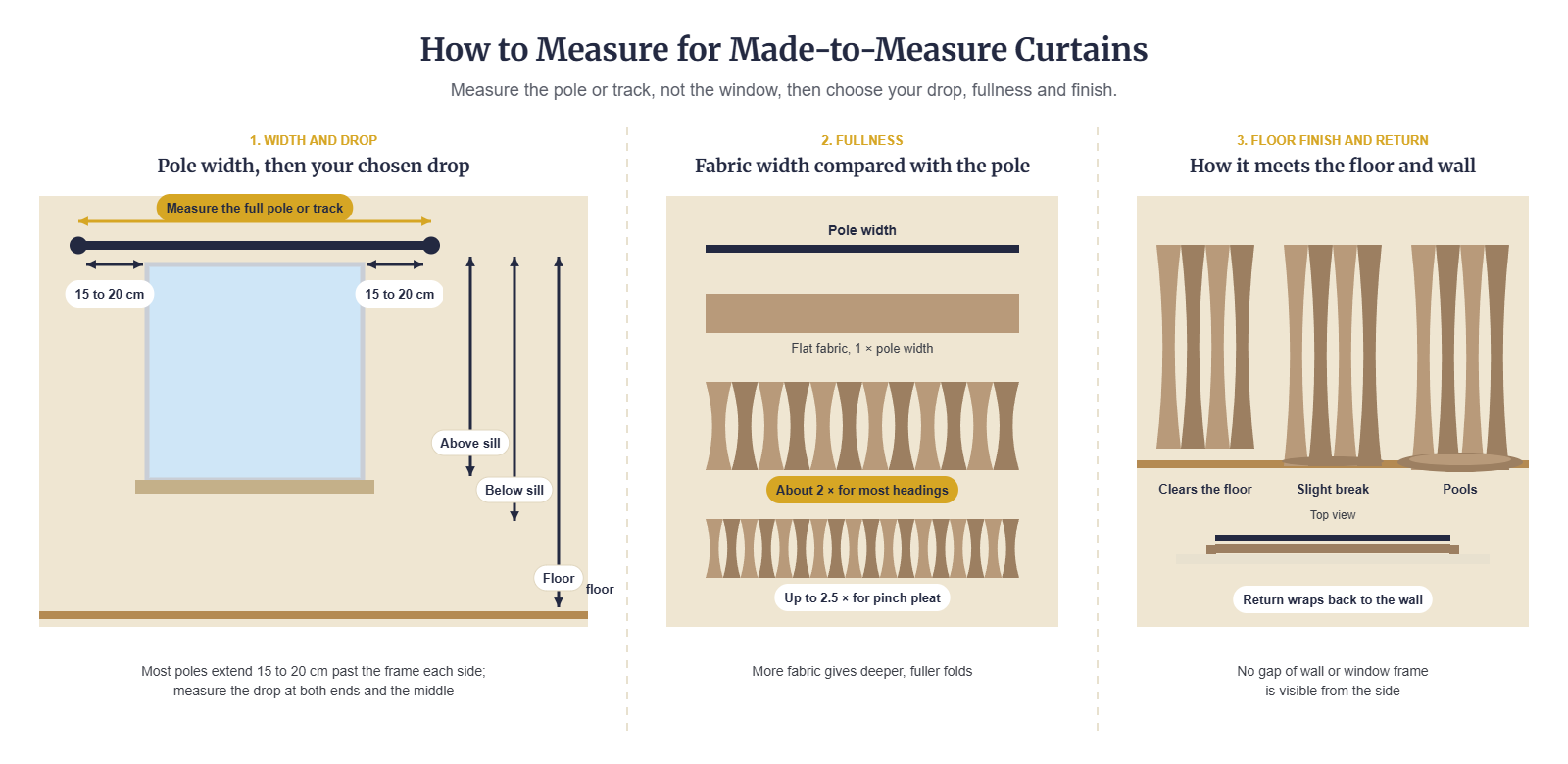
If you are ordering made-to-measure curtains from us, you do not need to get this exactly right yourself. We measure at the free home visit and make the curtains to our figures. Your own measurements are useful for planning and for a rough idea of size.
Which curtain length is right for your room
Floor length is the right choice for most living rooms and bedrooms, because it looks finished, makes the room feel taller and keeps the most warmth in. Shorter lengths have their place where there is a radiator, a window seat or furniture under the window.
Sill length
Sill length curtains finish just above the window sill, usually around 1 cm clear of it. They suit kitchens, small windows, cottage-style rooms and windows with a deep sill you want to use.
Below sill length
Below sill curtains finish around 15 cm below the sill. They are a common choice where a radiator sits under the window, because they cover the edge of the sill without hanging over the radiator and trapping its heat behind the fabric.
Floor length
Floor-length curtains finish just above the floor, usually around 1 cm clear, so they do not drag or collect dust. They are the most popular choice in living rooms and bedrooms. On an uneven floor, work to the shortest drop so the hem does not touch at the low point.
Puddle or trailing length
Puddled curtains are made longer than the drop so the fabric gathers on the floor. It is a decorative look for formal rooms with curtains that stay open most of the time. It is not practical in busy rooms or homes with pets.
Curtain poles, tracks and how to hang curtains
Poles are on show and become part of the look, while tracks sit mostly out of sight and are more practical on bays, wide windows and with heavy or motorised curtains. Both can carry most headings, apart from eyelets, which need a pole, and wave, which needs a wave track.
Curtain poles
Curtain poles come in metal and wood, in a range of diameters and finishes, with finials at each end. A pole suits eyelet, tab top and rod pocket curtains, and works with pencil and pinch pleat on rings. Thicker poles, around 28 mm or more, suit long, heavy or interlined curtains and wide windows. Slimmer poles look better on smaller windows and lighter fabrics. On a long pole, a centre bracket stops the pole bowing, and rings must be able to pass it, or you need passing brackets.
Curtain tracks
A curtain track is a slim rail, usually aluminium or plastic, fixed to the wall or ceiling. The curtain heading hides it when closed. Tracks can be bent to follow a bay, can be corded so you pull a cord rather than the fabric, and can be fitted with a motor. Ceiling-fixed tracks suit rooms where there is no wall above the window, and tall windows where you want the curtain to start right at the ceiling.
Fixing into the wall
The fixing is often the hardest part of hanging curtains. Above many uPVC windows there is a steel or concrete lintel, which needs the right drill bit and fixings. Older houses can have soft plaster, and new build flats often have plasterboard on metal studs, which needs cavity fixings or a fixing into a timber batten. Heavy interlined curtains need more brackets than light ones. If you live in a leasehold flat, check your lease before drilling into external walls or window surrounds.
Hanging and dressing the curtains
Once the curtains are up, they need training to fall in even folds. Draw them open, arrange the folds by hand from top to bottom, and tie them loosely with soft ties for a few days. Pinch pleat and pencil pleat curtains benefit most from this. Check that the curtains overlap in the middle when closed, so no line of light shows between them.
Corded tracks and child safety
Corded curtain tracks have a looped cord, which is a risk for young children in the same way as a blind cord. Keep the cord tight with a tensioner fixed to the wall, keep cots and beds away from the window, and consider an uncorded track or a motor in a child’s room.
Curtains or blinds: which should you choose
Choose curtains when you want warmth, softness and a finished look in a living room or bedroom, and choose blinds when you need precise light control, a tidy fit inside the window or something that copes with steam. In many rooms the best answer is both.
When curtains are the better choice
- Large windows and patio doors where you want the glass fully clear when open.
- Rooms that feel cold in the evening, especially with older windows.
- Bedrooms, where blackout-lined floor-length curtains give a dark, quiet room.
- Period rooms where fabric suits the style of the house.
When blinds are the better choice
- Kitchens and bathrooms, where a wipeable blind is easier to live with.
- Windows with a radiator, a sink or furniture right underneath.
- Tilt and turn windows, where a frame-fitted blind moves with the sash.
- Small rooms, where curtains stacked at the sides would take up too much space.
Layering curtains with blinds
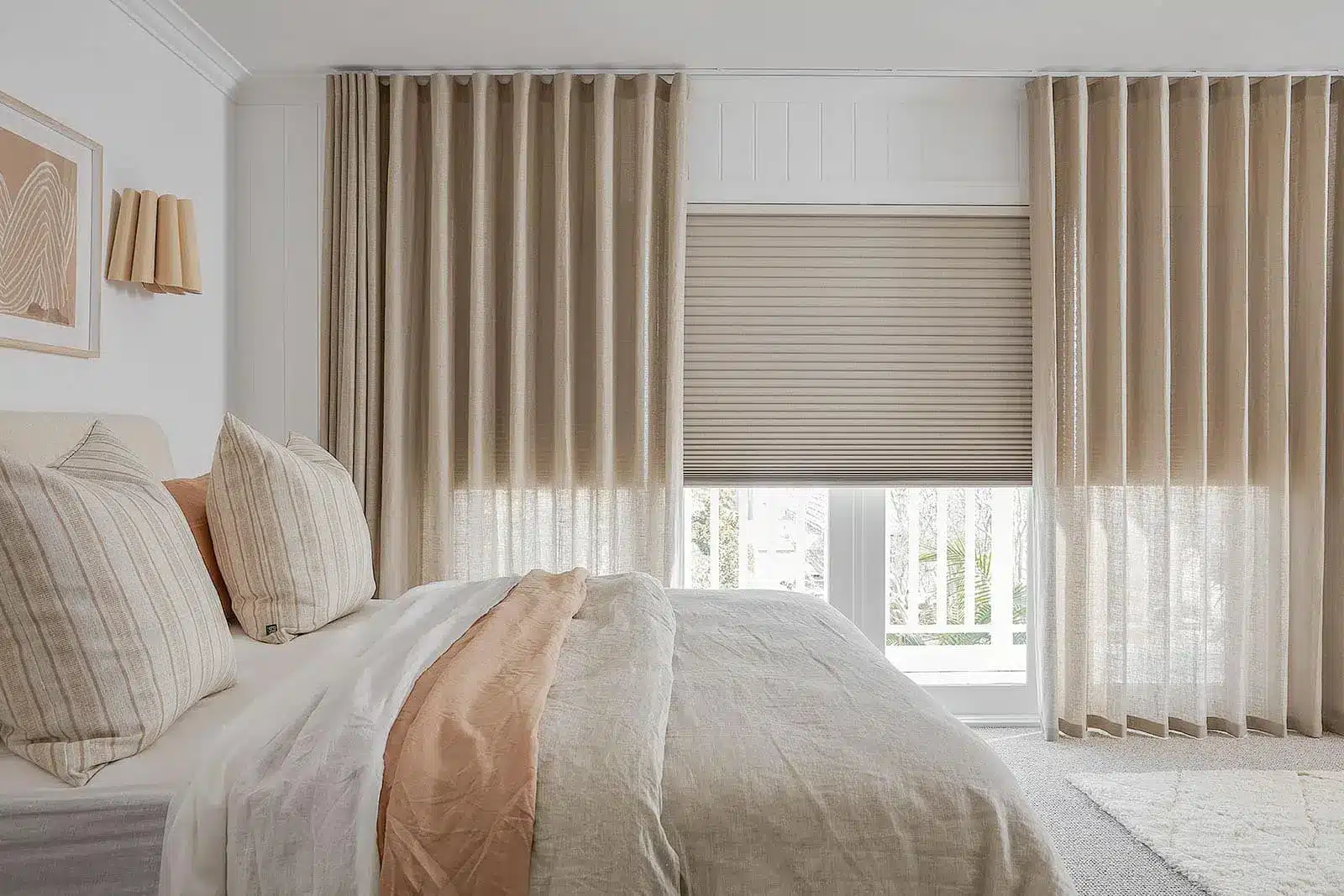
A blind inside the window and curtains on a pole above gives the most control. The blind handles daylight, glare and privacy during the day, and the curtains add darkness and warmth at night. A Roman blind under curtains suits traditional rooms, and day and night blinds under curtains work well in modern living rooms. For a full side by side comparison, read our guide to blinds vs curtains.
How much do curtains cost, and is made to measure worth it
Made-to-measure curtains from HomeDecisions start at £160 per pair including the track or pole, and most fall between £160 to £890 per pair. The exact figure depends on the size of the window and the choices you make.
What drives the price of curtains
- Size: wider and longer curtains need more fabric, and floor-length curtains on a tall window use a lot of it.
- Heading and fullness: pinch pleat and wave use more fabric and more making time than eyelet or pencil pleat.
- Fabric: velvets, linens and large patterns with a long repeat cost more than plain cottons and polyesters.
- Lining: blackout, thermal and interlining add to the price but also to how well the curtain performs and how long it lasts.
- Hardware: a bay track, a ceiling track, a heavy pole or a motorised track costs more than a simple straight pole.
- Fitting: difficult fixings, high windows and bays take longer to fit.
We put all of this in the written quote we send after the measuring visit, so you can see the price for each window and compare options before you decide.
Ready-made curtains
Ready-made curtains come in a few standard widths and drops, so they rarely fit a real window exactly. They are fine for a quick fix, a rental or a spare room, but they are often too short for a floor-length look, too narrow for full gathers, and lightly lined or unlined. Bays, tall windows and wide patio doors are hard to dress well with ready-made sizes.
Made-to-measure curtains
Made-to-measure curtains are made to the exact width and drop of your pole or track, with the right fullness for the heading and the lining you choose. They hang at the correct length, overlap properly in the middle and keep more warmth in because there are no gaps. For living rooms, bedrooms, bay windows and any large window, made to measure is usually worth the difference.
How to care for curtains
Most curtains only need regular light cleaning to stay looking good. Vacuum them every few weeks with a soft brush attachment on a low setting, working from the top down, and pay attention to the heading and the hem, where dust collects.
- Check the care label first. Many lined and interlined curtains should be dry cleaned, because the face fabric and lining can shrink at different rates.
- Washable curtains: unlined cotton and polyester curtains can often be washed on a cool, gentle cycle. Remove hooks and take out the heading tape cords if the label says so.
- Velvet: brush in the direction of the pile, and steam rather than iron.
- Linen: expect some creasing, and steam the curtains while hanging.
- Spot cleaning: blot a mark with a clean damp cloth and a little mild detergent, then let it dry. Do not rub.
- Sun and condensation: lining protects against fading, and on windows that run with condensation in winter, open the curtains during the day and wipe the glass so the fabric does not stay damp. The Energy Saving Trust notes that condensation forms where moist air meets a cold surface such as a window.[2]
Curtains for Rainham and East London homes
The housing around our Rainham workshop covers most of the window types in this guide. Older terraces in Rainham village, Dagenham and Barking often have sash or replacement uPVC windows with shallow reveals and uneven floors, so we measure the drop at several points. The 1930s semis in Hornchurch, Upminster, Elm Park and Romford usually have a bay at the front, where a bent bay track with pencil or pinch pleat curtains gives the neatest finish.
New build flats at Beam Park, Stratford, Canary Wharf and Greenwich tend to have wide, tall glazing, Juliet balconies and plasterboard walls. Wave curtains on a ceiling-fixed track suit these spaces, and the fixings need to suit the wall construction. Further out in Grays and South Ockendon, many family homes mix bays, patio doors and smaller bedroom windows, so a mix of curtains and blinds often works best. You can see more about the area we cover on our Rainham page.
Frequently asked questions
What is the difference between curtains and blinds?
Curtains are fabric panels that hang from a pole or track and draw sideways, while blinds fit in or over the window and roll, fold or tilt. Curtains are softer and warmer, and blinds are more compact and give finer light control.
Do curtains keep a room warm?
Yes, lined, thermal and interlined curtains help keep warmth in when drawn at dusk. They work best when they reach the floor and extend past the window on both sides, with no gaps at the top.
What length should curtains be?
Floor length, finishing just above the floor, suits most living rooms and bedrooms. Choose sill or below sill length where a radiator, a window seat or furniture sits under the window.
How wide should curtains be compared with the window?
The pole or track usually extends 15 to 20 cm past the frame on each side. The curtain fabric is then around two to two and a half times the pole or track width, depending on the heading.
Which curtain heading is best for a bay window?
Pencil pleat and pinch pleat curtains on a bent bay track give the neatest finish. Eyelet curtains need a pole, which is harder to fit round a bay.
What is a made-to-measure curtain?
A made-to-measure curtain is made to the exact width and drop of your pole or track, in the fabric, heading and lining you choose. It fits better and hangs better than a ready-made curtain in a standard size.
Book a free home visit for curtains in Rainham and East London
If you would like made-to-measure curtains for your home, book a free home visit or call us on 01708 505379, Monday to Friday, 9am to 5pm. We measure every window, talk through headings, fabrics, linings and poles or tracks, and send your written quote after the visit. You are also welcome to visit us at C3, Star Business Centre, Fair View Industrial Estate, Marsh Wy, Rainham RM13 8UP during opening hours.
References
- ^ Energy efficient windows and doors. Energy Saving Trust. Retrieved 25 October 2026.
- ^ a b How to get rid of damp. Energy Saving Trust. Retrieved 25 October 2026.