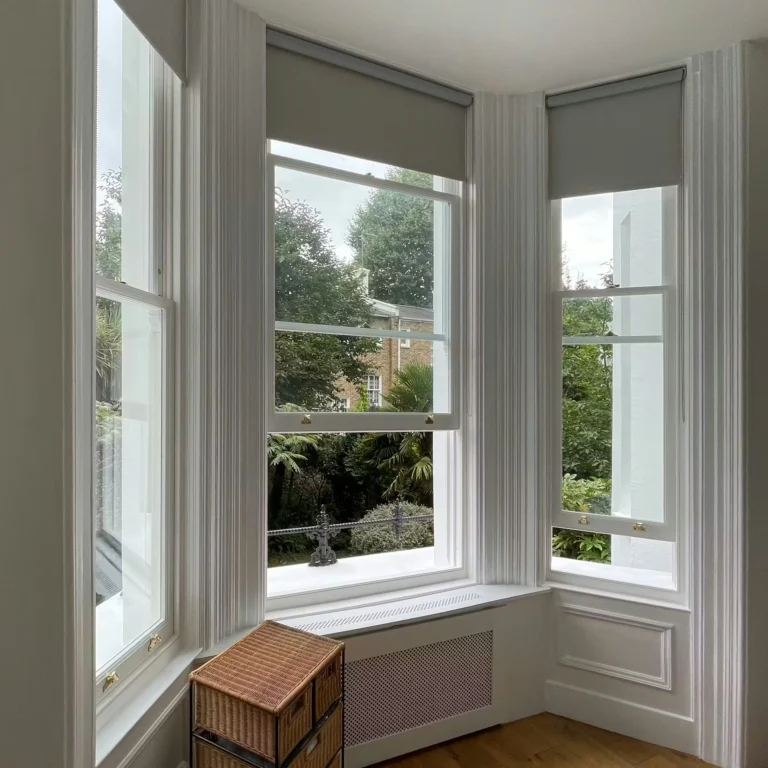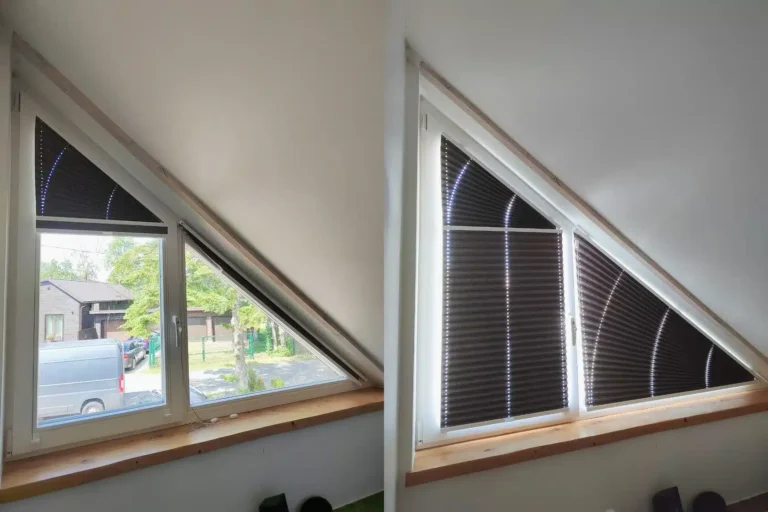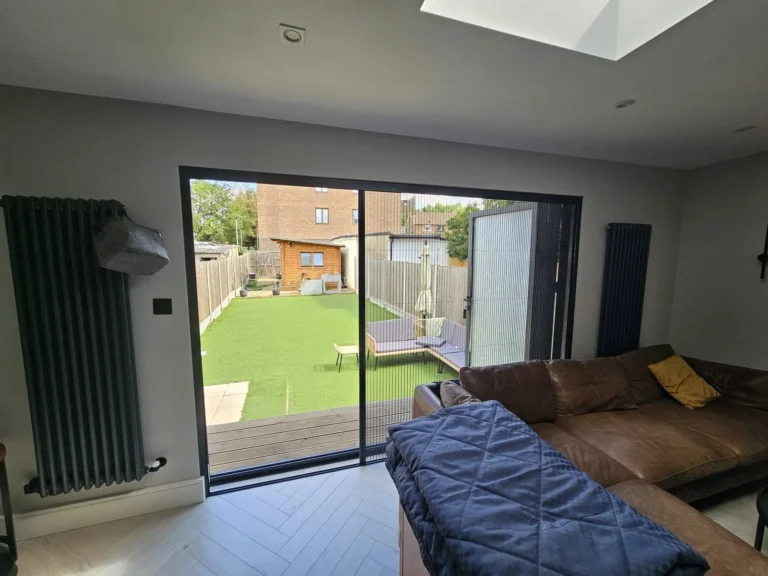
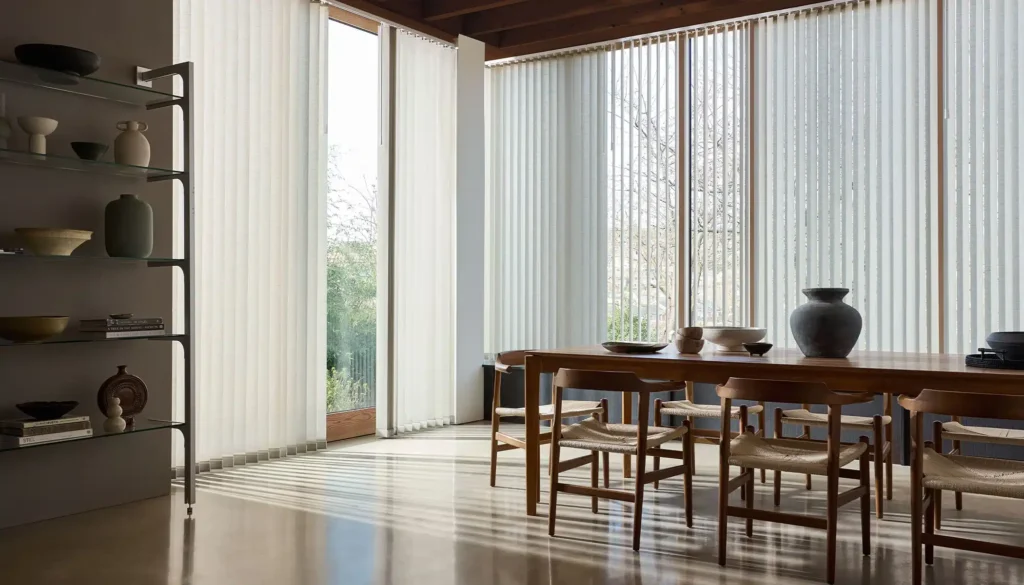
Made-to-measure vertical blinds for angled windows are one of the most reliable ways to cover upright glass with a sloping top, because the headrail is built to the same angle as the window and every louvre is cut to its own length. In Rainham and across East London that covers gable end windows in loft conversions, raked frames in single storey extensions, staircase windows and the angled side frames of many conservatories.
We measure, make and fit vertical blinds from our workshop in Rainham, and this guide sets out what a sloping vertical blind can and cannot do, how to measure for one, how it is fitted, what it costs and when another blind is the better choice. If you are still comparing every blind type for angled glass, our lead guide to the best blinds for sloping and angled windows covers the full range, and this post goes deeper on verticals.
Which angled windows suit vertical blinds
Vertical blinds suit angled windows where the glass itself stands upright and only the top edge of the frame slopes. The louvres hang straight down under gravity, so they need glass that is vertical behind them.
Windows that work well with a sloping vertical include:
- Gable end windows in loft conversions, where the top of the frame follows the roof pitch
- Raked glazing in single storey rear extensions with a mono pitch roof
- Staircase windows set into a sloping wall
- Angled side frames in lean-to and Edwardian style conservatories
- Trapezoid panels above or beside bifold and patio doors
- Large picture windows where one side is taller than the other
Vertical blinds do not suit glass that leans back with the roof, such as a Velux or other roof window. On that kind of window the louvres would hang away from the glass into the room. Roof windows need a blind held in side channels, which we cover on our Velux blinds page.
How a sloping vertical blind works
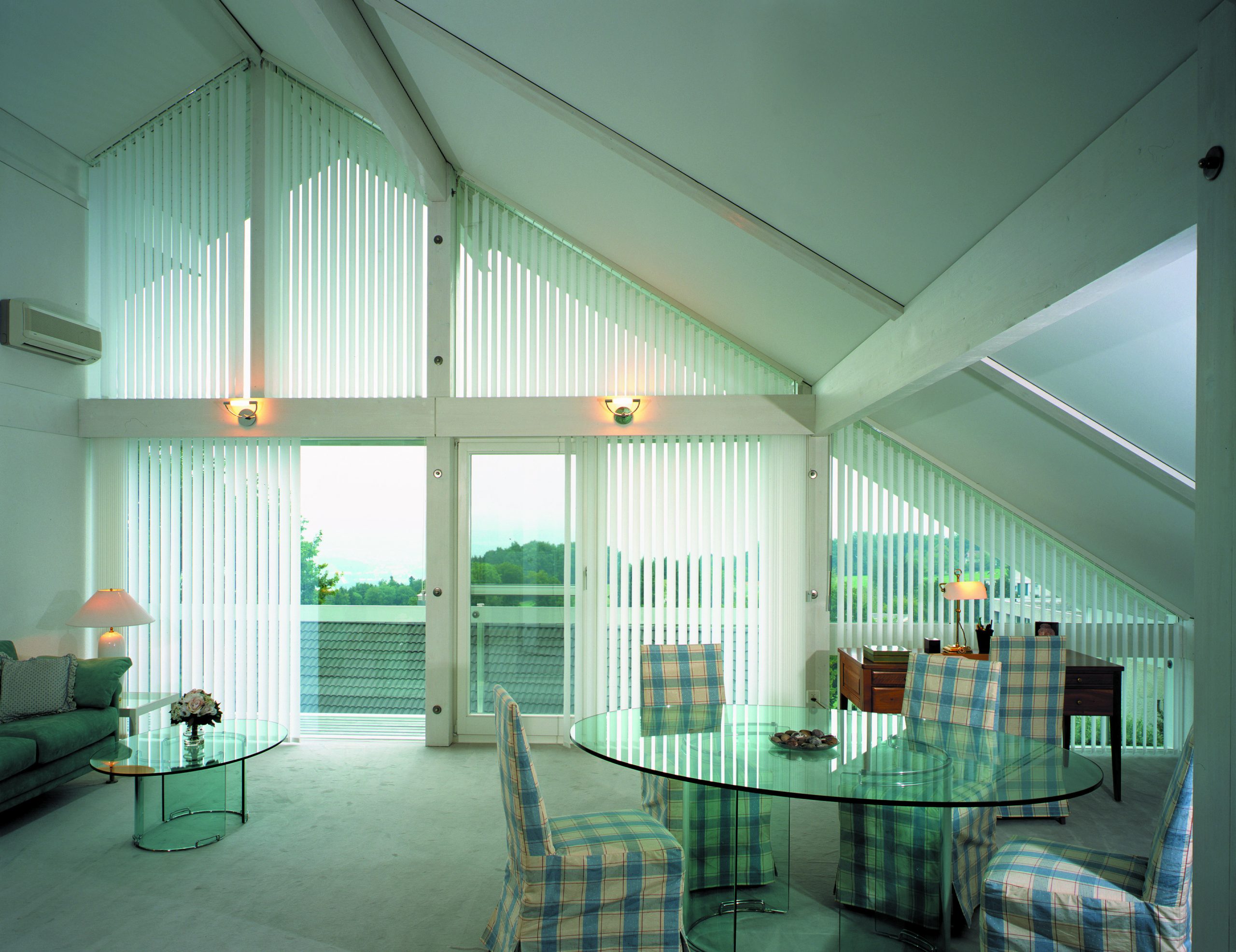
A sloping vertical blind has a headrail set at the same angle as the top of the window, with louvres that get longer towards the tall side so the bottom edge stays level. The louvres tilt open and closed with a wand or chain, and on most slopes they also draw to one side to clear the glass.
The headrail
Most sloping verticals are made with two headrail sections: a level section across the flat part of the window and an angled section that follows the slope. Where the whole top is raked, the headrail can follow the angle along its full length. The joint between the two sections is where the measuring has to be exact, because a few millimetres out at the join shows as a step in the louvres.
The louvres
Each louvre is cut to its own drop. Under the level part of the headrail they are all the same length, and under the slope each one is a little longer than the one before. The bottom weights and the linking chain keep them hanging straight and spaced evenly. On a window that sits low to the floor, or in a home with pets or small children, the bottom chain can be left off so the louvres hang free.
Tilt only or tilt and draw
On shallow and medium slopes the louvres usually tilt and draw, so you can stack them to one side when you want the full view. On steep angles some systems are tilt only on the sloping section, because the louvres cannot travel uphill along the rail. We check the angle at the visit and tell you which system your window takes before you order, so there are no surprises.
Why choose vertical blinds over other options for angled windows
Vertical blinds give full coverage of an angled window with adjustable light control, which most other blinds cannot do on a slope. That is the main reason we recommend them for large raked glazing.
- Full coverage. The louvres follow the slope right into the corner, so there is no uncovered triangle of glass at the high side.
- Light control. Tilting the louvres cuts glare from low sun while keeping the room bright, which helps in west facing extensions and loft rooms.
- Privacy with daylight. Louvres tilted part closed block a direct view in from the street or a neighbour’s window without closing the room off.
- Easy to look after. A single louvre can be replaced if it gets marked or creased, without remaking the whole blind.
The trade-off is looks. Verticals have a more practical, office style finish than a pleated or Roman blind, and they take up space at the side when drawn back. In a loft bedroom some people prefer a softer look, and we talk through those options below.
How to measure for vertical blinds on an angled window
To measure for a sloping vertical blind you need the width, the shortest drop, the longest drop and the point where the slope starts. Our free home visit takes these measurements for you, and the steps below show what we record so you know what goes into the quote.
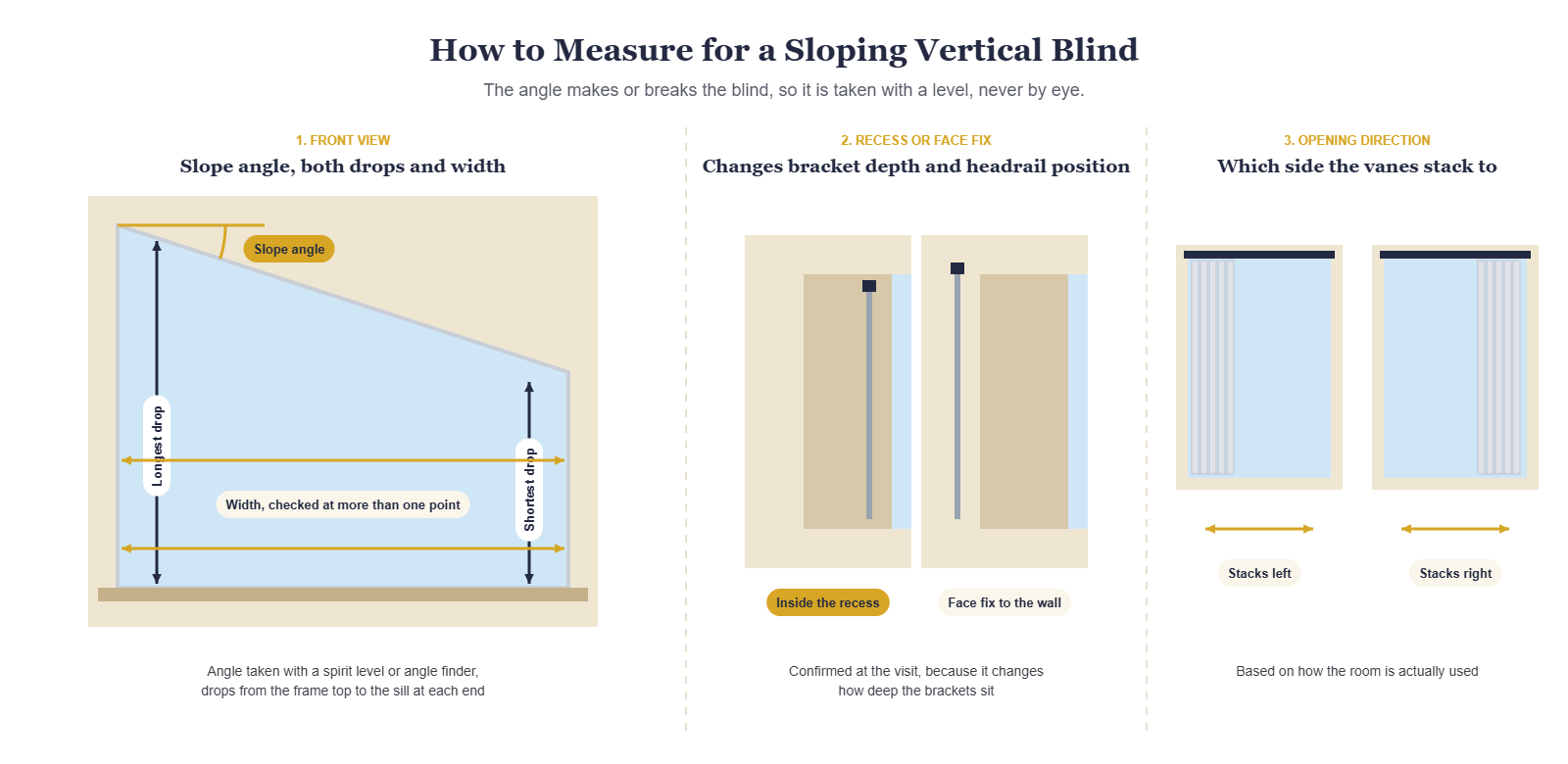
- Decide on recess or exact fit. Inside the reveal (recess fit) looks neat on deep plastered openings. Fixed to the wall or ceiling outside the frame (exact fit) gives better coverage and suits shallow reveals and uPVC frames with little depth.
- Measure the overall width at the top, middle and bottom. For a recess fit, use the narrowest figure. For an exact fit, add an overlap each side so light does not leak round the edges.
- Measure the shortest drop from the lowest point of the top edge to the sill or the finished length you want.
- Measure the longest drop from the highest point of the top edge to the same finished line.
- Mark where the slope starts. Measure the width of the level section, if there is one, and the width of the sloping section separately.
- Check the angle. We use a digital level or angle finder. The two drops and the sloping width give the angle too, but a direct reading is a useful check.
- Look for obstructions. Window handles, tilt and turn mechanisms, radiators, sockets and skirting all affect where the louvres can hang and where the stack can sit.
Older East London homes are rarely square. Plastered reveals in 1930s semis and Victorian terraces can be several millimetres out from top to bottom, and the slope in a loft conversion does not always match the roof pitch exactly. That is why we measure every window ourselves rather than working from a customer’s figures.
How sloping vertical blinds are fitted
Sloping vertical blinds are fitted with brackets fixed into the wall, ceiling or reveal above the window, with the angled headrail section set to the slope before the louvres go on. The fitting itself is not complicated, but the brackets have to sit on a true line or the louvres will not stack evenly.
What we fix into
Gable walls in loft conversions are often plasterboard on studwork, so we locate the timbers or use fixings rated for board. Masonry reveals take standard plugs and screws. Where a uPVC frame sits close to the ceiling with no wall above, we look at top fixing into the ceiling or a small face fix, and we avoid relying on the frame alone for a long, heavy blind.
Clearance for handles and opening sashes
On a tilt and turn window the louvres must clear the handle and the sash when it opens inwards. We set the projection of the brackets so the blind sits forward enough, or we suggest drawing the blind back before the window opens. On bifold and patio doors, the stack position is planned so it does not block the door you use most.
Child safety on the controls
Vertical blinds with a looped cord or chain must have that loop held taut by a tensioner fixed to the wall or frame, and it should be fitted as far from the top of the blind as practical.[1] The Make it Safe campaign run by the British Blind and Shutter Association also advises keeping cots, beds and furniture away from blind cords.[2] Wand operation removes the looped cord altogether, and a motor removes it too.
Fabrics and options for angled vertical blinds
Angled vertical blinds come in the same fabric types as standard verticals, so the choice is about the room rather than the shape of the window. The louvre width, fabric and control type all affect how the finished blind looks and works.
- Light filtering fabrics soften the light and suit living rooms, kitchens and extensions.
- Dim out and blackout fabrics suit loft bedrooms. On a vertical blind some light still shows at the edges and between louvres, so it darkens a room well but will not make it pitch black.
- Wipe clean PVC louvres suit kitchens, bathrooms and rentals where the blind will get splashed.
- Louvre width: 89mm louvres are the common choice for homes, and wider louvres can suit very large glazing.
- Motorised operation helps on high gable windows you cannot reach. We cover the options on our electric blinds page.
How much do vertical blinds for angled windows cost
Vertical blinds from HomeDecisions start at £75, and most fall between £75 to £420 per blind. A sloping vertical usually sits higher in that range than a standard rectangle of the same size, because the headrail is made in sections and every louvre under the slope is cut individually.
What moves the price:
- The overall size of the window and the length of the longest drop
- Whether there is a level section plus a sloping section, or one long angled rail
- The fabric, with blackout and PVC louvres costing more than basic light filtering fabrics
- Wand or chain control, and whether you leave off the bottom chain
- Adding a motor, which costs from £80 on top of the blind
The written quote we send after the free measuring visit gives the exact figure for each window. Our prices page shows the current starting points for every blind type.
When another blind is the better choice
Another blind is the better choice when the window is small, the glass is not upright, or you want a softer look than louvres give. Vertical blinds earn their place on large raked glazing, but they are not the answer for every angle.
| Window | Best option | Why |
|---|---|---|
| Large gable end or raked extension glazing | Sloping vertical blind | Covers right into the angle with adjustable light control |
| Small angled window or triangle | Shaped pleated blind or fixed pleated panel | Pleated fabric can be made to unusual shapes in a slim frame |
| Angled uPVC window that opens | Perfect Fit blind on the rectangular part | Sits in the glazing bead and moves with the sash |
| Roof window or Velux | Roller or pleated blind in side channels | Holds the fabric against tilted glass |
| Loft bedroom wanting a soft look | Curtains on a shaped track or pole | Warmer look and fuller darkness, if there is wall space |
For more detail on each of those routes, see our guides to pleated blinds for odd shaped windows, Perfect Fit blinds for angled windows and curtains for sloping windows.
Angled windows in Rainham and East London homes
Angled windows are common in East London because so many homes have been extended upwards or outwards. Hip to gable loft conversions on 1930s semis in Hornchurch, Upminster and Elm Park often end in a gable window with a raked top. Rear extensions in Romford, Dagenham and Rainham frequently have a mono pitch roof with angled glazing above the doors. Newer developments around Beam Park and Barking Riverside include flats and houses with large feature windows and sloping ceilings on the top floor.
Each of those needs a slightly different approach. A gable window in a loft bedroom usually wants a dim out fabric and a wand control. A raked panel above bifolds in a kitchen extension often wants light filtering louvres that can be tilted against the evening sun. We fit across Rainham, Romford, Hornchurch, Upminster, Dagenham, Barking, Ilford and the wider area, as well as into Essex towns such as Grays and South Ockendon. You can see the full list on our Rainham area page.
Free PDF guide: Blind Care and Child Safety Guide, with a home safety checklist. Read it online or download it to print.
Frequently asked questions
Can vertical blinds be made for angled windows?
Yes. A sloping vertical blind has a headrail made to the angle of the window and louvres cut to individual lengths, so the bottom edge stays level while the top follows the slope.
Do sloping vertical blinds open fully?
On most slopes the louvres both tilt and draw to one side. On steep angles some systems only tilt on the sloping section, and we confirm which applies to your window at the measuring visit.
Can I fit vertical blinds to a Velux window?
No. Vertical blinds need upright glass, and on a roof window the louvres would hang away from the glass. A roof window needs a roller or pleated blind held in side channels.
Are vertical blinds on angled windows blackout?
Blackout louvres darken a room well, but some light shows at the edges and between the louvres. For a fully dark loft bedroom, curtains or a blind in side channels block more light.
Can angled vertical blinds be motorised?
Yes, most can. A motor is worth considering for high gable windows that are hard to reach, and it removes the looped cord or chain.
How long does it take to fit a sloping vertical blind?
Fitting time depends on the size of the window and what we are fixing into. We give you a clear idea of the time on the day when we arrange the fitting after your written quote.
Book a free measuring visit for your angled windows
If you have angled windows in Rainham, East London or Essex, book a free home visit or call us on 01708 505379, Monday to Friday, 9am to 5pm. We will measure the slope, show you fabric samples and send your written quote after the visit. You are also welcome to call in at our workshop at C3, Star Business Centre, Fair View Industrial Estate, Marsh Wy, Rainham RM13 8UP during opening hours.
References
- ^ Existing Blinds. Make It Safe (British Blind and Shutter Association). Retrieved 25 October 2026.
- ^ 2014 legal requirements for internal window blinds (Make it safe brochure). British Blind and Shutter Association. Retrieved 25 October 2026.